

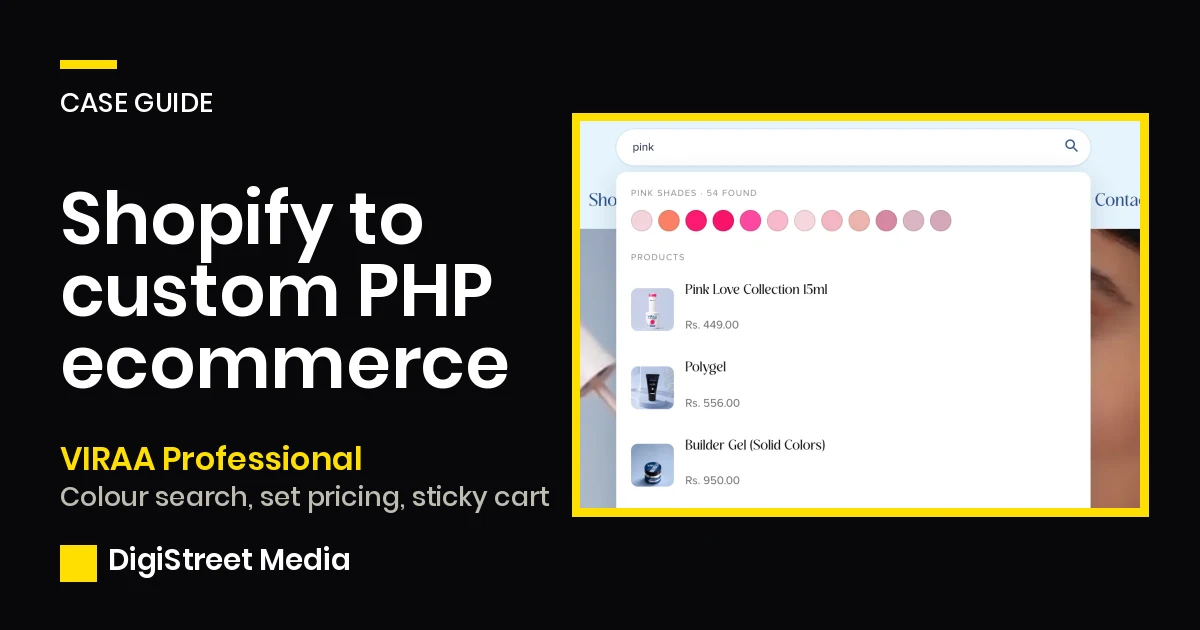
Updated 8 October 2026.
VIRAA Professional sells gel polish and nail supplies across India. We moved its store off Shopify and rebuilt it in custom PHP on the Laravel framework. Here is what the store does now, with screenshots from 8 October 2026, how Shopify and Laravel compare on features and on cost, and the SEO checks we run on any move like it.
A store should leave Shopify when its rules outgrow its templates. VIRAA’s rules are specific. One hero gel polish comes in 128 shades, shoppers think in colours, and a full set of every shade has its own price. Those three facts shaped the build.
The shop page at viraaprofessional.com lists 110 products: gel polish, builder gel, polygel, lamps, drills and tools for nail technicians, salons and home users. Colour is not an option on a VIRAA product. It is the product.
Every figure below was read from the live store on 8 October 2026. The screenshots are ours, taken the same day.
We build custom stores and we also tell clients when to stay where they are. The last section covers when to stay on Shopify.
The store at a glance
| Item | Detail |
|---|---|
| Store | VIRAA Professional, viraaprofessional.com |
| What it sells | Professional nail products and nail supplies in India |
| Platform before | Shopify |
| Platform now | Custom PHP application on the Laravel framework, running PHP 8.4 |
| Catalogue | 110 products on the shop page, with one hero range in 128 shades |
| Kept from Shopify | The /products/, /collections/ and /pages/ URL paths |
| Built for the move | Colour search, shade swatches, set and kit pricing, sticky add to cart, activity notifications, delivery estimate with pincode check, wishlist, reviews with product markup |
| Read on | 8 October 2026 |
What changed for the shopper
Colour search shows shades first
Search for a colour word and a row of swatches appears above the products, so the buyer picks a shade before opening a page.
The set price applies itself
Put one of every shade in the cart and 30 per cent comes off. There is no code to find or paste.
A buy bar follows the page
Once the buy box scrolls away, a bar at the bottom keeps the quantity, the colour menu and Add to cart in reach.
Delivery is answered before checkout
The product page gives an estimate of 4 to 5 working days and a pincode box, so a buyer in a smaller city knows the order reaches them.
Search by colour
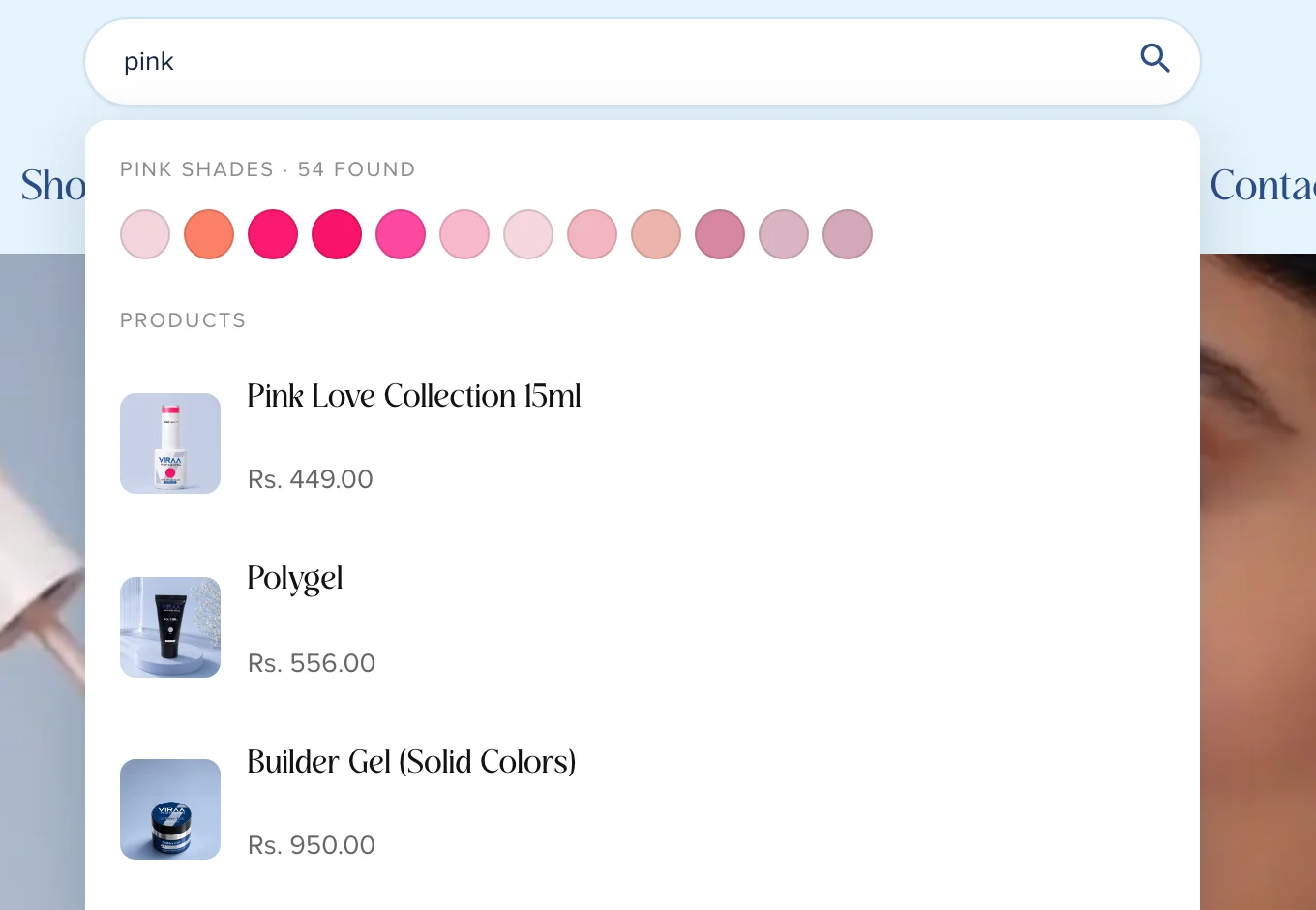
Type pink into the search box on VIRAA and a panel opens with a row of swatches headed Pink shades, 54 found, and the matching products underneath. The shopper sees the colours before a single product name.
That removes the step where a buyer opens six product pages to find one rose. People describe nail polish in colour words, so the search is built to understand colour words.
For SEO the risk sits in the URLs. Every search or filter can create a new address, and Google’s guidance on faceted navigation says to stop crawling of filter URLs you do not want indexed and to keep a clean, crawlable listing page. VIRAA’s search page names /search as its canonical address, so a search for pink does not add a page of its own to the index.
One data rule matters more than any code. Keep a single list of colour names with one spelling for each. If the catalogue says Red, red and RED, the filter shows three reds.
Swatches, a shade chart and honest colour
The 128 Color One Coat Gel Polish page shows the chosen shade, Color: One Coat 01, above a row of round swatches that scrolls through all 128. Under the row a line says shades may vary and points to the shade chart, which is the second image in the gallery.
Screens misreport colour. Saying so on the page and giving a chart to check against is what a technician buying for clients wants to see.

Set and kit pricing
The set discount is a rule in the cart, not a coupon. Put one of every shade in the cart and 30 per cent comes off the set. Extra bottles beyond a full set stay at the normal price.
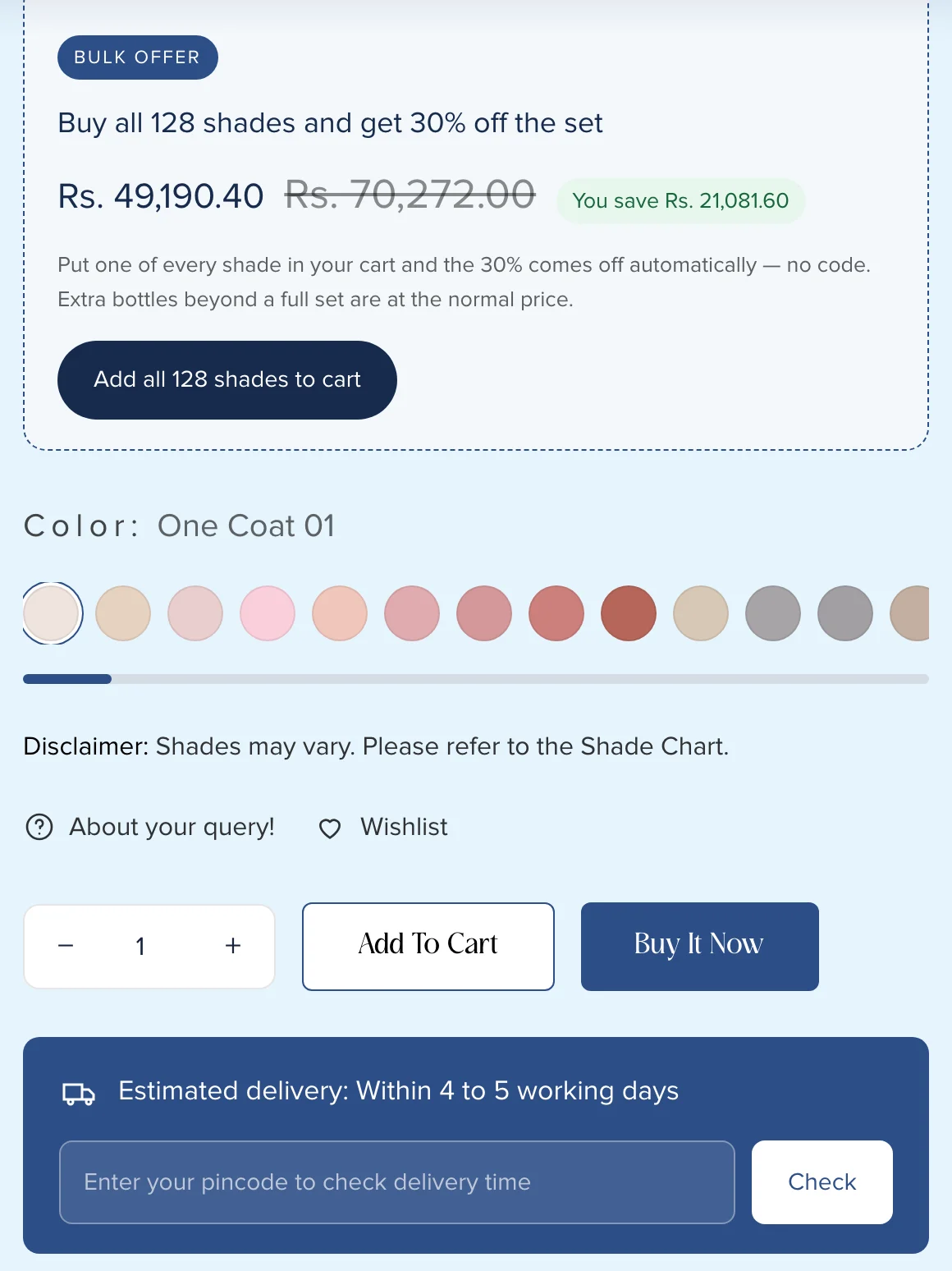
The arithmetic is plain. 128 shades at Rs. 549 is Rs. 70,272. Thirty per cent off leaves Rs. 49,190.40, a saving of Rs. 21,081.60. The kits carry their savings on the product card.
| Offer | Price | List price | Saving shown |
|---|---|---|---|
| All In One Complete Nail Kit | Rs. 2,761 | Rs. 3,068 | 10% |
| Beginner Nail Extension Kit, tips, glue and 5 gel polishes | Rs. 3,999 | Rs. 4,588 | 13% |
| Gel Polish Starter Kit with UV/LED lamp, 12 colours | Rs. 6,199 | Rs. 7,597 | 18% |
| All 128 shades of One Coat Gel Polish | Rs. 49,190.40 | Rs. 70,272.00 | 30% |
Prices read on 8 October 2026.
A buy bar that follows the page
A long product page pushes the buy box out of sight after the first screen. On VIRAA a bar pins itself to the bottom once the shopper scrolls past it: product name, quantity, a colour menu and Add to cart. The shopper can read the specification table, the highlights and the reviews without scrolling back up.

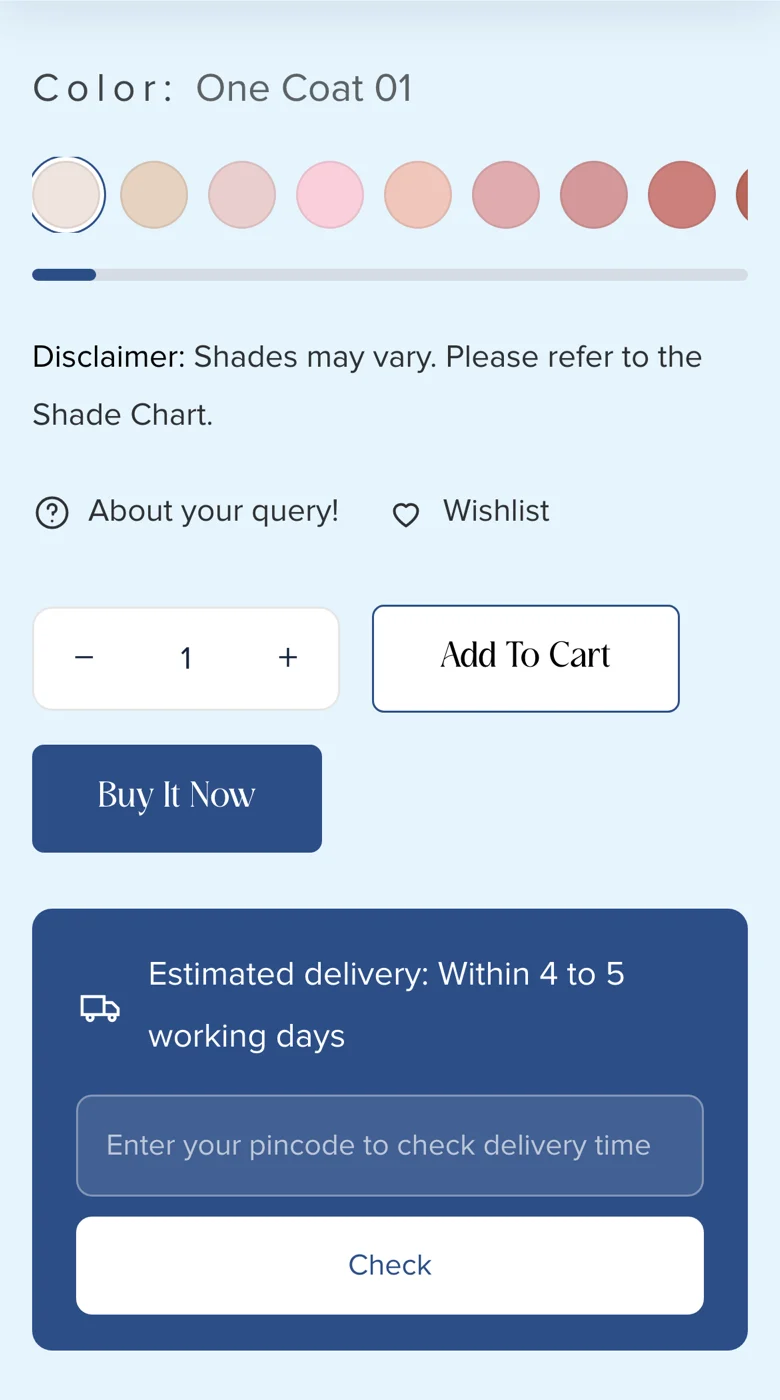
On a phone the colour swatches, the buy buttons and the delivery check stack in one short scroll.
The bar is fixed to the window, so it sits over the page instead of pushing content around. That helps Core Web Vitals, where Google’s good thresholds are 2.5 seconds for largest contentful paint, 200 milliseconds for interaction to next paint and 0.1 for layout shift, judged at the 75th percentile of real visits. Read those numbers in Search Console after launch, from field data.
Notifications that tell the truth
The store runs two kinds of marketing message. A banner across the top announces surprise freebies on orders above Rs. 4,999 and free shipping on orders over Rs. 999. A small card at the bottom left reads Someone added this to cart, with the product, its rating, the price and how long ago.

The build rule for any notification is that it reports something that happened or an offer that exists. India’s Central Consumer Protection Authority issued guidelines on dark patterns on 30 November 2023 and lists false urgency among 13 practices. Show real activity with real times and you stay clear of that list.
Reviews and the markup behind them
The product page carries a rating summary, written reviews and a Write A Review button. The same data feeds the page’s structured data. The 128-shade page declares a product group with an aggregate rating of 4.8 from 5 reviews, and the page shows those same figures.
Google splits product markup into product snippets and merchant listings, and pages where a customer can buy qualify for merchant listings. Its review rules ask for reviews that reflect a real experience, are visible on the page and are marked up for the specific item, not a category. Compare the count on screen with the count in the markup every time you edit a template.
Shopify vs custom PHP with Laravel, side by side
Laravel is a PHP framework, free to use under the MIT licence. It is the layer our developers build the store on, so the comparison is between a hosted platform and a store written for you.
| Area | Shopify | Custom PHP with Laravel |
|---|---|---|
| Time to launch | Weeks, with a theme and apps | Longer, because the rules are built and tested |
| Platform fee | Basic ₹1,499 a month on yearly billing, Grow ₹5,599, Advanced ₹22,680, Plus from ₹1,75,000 a month on monthly billing | Laravel costs nothing to license |
| Payment fees | Shopify Payments is not on its India list, so Shopify adds 2% on Basic, 1% on Grow, 0.6% on Advanced and 0.2% on Plus for sales through third-party gateways | No platform fee on sales. The gateway’s own charges apply on both |
| Custom rules and search | Themes, apps and theme code | Any pricing rule, search behaviour or integration, written in code |
| Hosting and maintenance | Hosting is in the plan. Our store management starts from ₹20,000 a month plus GST | Our hosting and maintenance starts from ₹20,000 a month plus GST, the same figure, and covers hosting, patches and backups |
| Upgrades | Shopify handles them | Laravel ships a major version every year, with bug fixes for 18 months and security fixes for 2 years, so plan an upgrade every year or two |
Prices from Shopify’s India pricing page and Laravel’s release notes, read 8 October 2026.
What each costs over three years
Shopify publishes its India prices, so that side of the sum is easy. Shopify charges a fee on sales that go through third-party gateways, and Shopify Payments is not listed for India, so most Indian stores pay it. The fee grows with sales. A custom store has no such fee.
Both stores carry the same running cost in this comparison: hosting and maintenance from ₹20,000 a month plus GST, which is where our packages start on Shopify and on custom PHP. The custom store adds a build fee once, from ₹2,50,000 plus GST. So the question is whether Shopify’s plan and fee add up to more than that build fee over three years.
| Monthly sales through the store | Cheapest Shopify plan | Shopify plan plus fee, a month | Shopify, three years with maintenance | Custom, three years with build and maintenance | Custom saves |
|---|---|---|---|---|---|
| ₹2,00,000 | Basic | ₹5,499 | ₹9,17,964 | ₹9,70,000 | Shopify saves ₹52,036 |
| ₹5,00,000 | Grow | ₹10,599 | ₹11,01,564 | ₹9,70,000 | ₹1,31,564 |
| ₹10,00,000 | Grow | ₹15,599 | ₹12,81,564 | ₹9,70,000 | ₹3,11,564 |
| ₹30,00,000 | Grow | ₹35,599 | ₹20,01,564 | ₹9,70,000 | ₹10,31,564 |
| ₹50,00,000 | Advanced | ₹52,680 | ₹26,16,480 | ₹9,70,000 | ₹16,46,480 |
Plan prices use yearly billing. The table leaves out the gateway’s own charges and GST, which you pay on either platform, and Shopify apps and themes, which would raise the Shopify figure. Maintenance is ₹20,000 a month for 36 months, ₹7,20,000, on both sides.
The lines cross at about ₹2.7 lakh of monthly sales. Below that Shopify costs less over three years. At ₹5 lakh the custom store pays back its build fee in about 24 months, at ₹10 lakh in 16 months and at ₹30 lakh in 7. Add apps to the Shopify side and each of those gets shorter.
Cost is only one input. A 128-shade set price and colour search are rules, and rules are what custom code is for. A standard catalogue with simple pricing and sales below your crossover belongs on Shopify.
The SEO checklist for leaving Shopify
Rankings follow addresses and signals. A move that keeps both intact is the safest kind. This is the list we work from.
| Check | What Google says | How to verify |
|---|---|---|
| Map every old URL to a new one | Map the old site’s URLs to the new site’s URLs before you start | Export the Shopify sitemap and keep it as the master list |
| Redirect permanently, in one hop | Use 301 or 308 redirects straight to the final page | Crawl the old list and confirm one redirect, then a 200 |
| Keep the redirects | Keep them for as long as possible, at least one year | Put the review date in the project plan |
| Control filter and search URLs | Block crawling of filter URLs you do not want indexed, and keep consistent filter order if you do | Test /search and filter addresses for canonical tags |
| Mark up products and reviews | Use product structured data that matches what the page shows | Run the Rich Results test on a product page |
| Hold Core Web Vitals | Good is 2.5 seconds, 200 milliseconds and 0.1 at the 75th percentile | Read the Core Web Vitals report in Search Console |
| Watch the move | Track old and new URLs in the Sitemaps and Indexing reports | Compare the old and new sitemap counts every week |
On the live VIRAA store we could verify these on 8 October 2026:
- Product, collection and page addresses keep the Shopify-style /products/, /collections/ and /pages/ paths, for example /products/one-coat-gel-polish and /collections/gel-polish.
- The product and collection pages name their own address as the canonical, and the search page names /search.
- The product page carries one H1.
- A sitemap sits at /sitemap.xml, and robots.txt keeps /cart, /checkout, /account, /admin and /orders out of search.
- Product pages declare OnlineStore, WebSite, ProductGroup and BreadcrumbList markup.
When to stay on Shopify
Most stores should. A custom store gives you control, and control comes with an owner: someone has to update PHP, apply security patches, watch uptime and keep backups. Our hosting and maintenance starts from ₹20,000 a month plus GST on either platform. If nobody owns that work on your side or ours, stay where you are.
| Situation | Better fit | Reason |
|---|---|---|
| Standard products with simple variants | Shopify | Themes and apps already cover it |
| You need to launch in weeks | Shopify | Hosting, checkout and security come ready |
| No one will own updates and uptime | Shopify | The platform maintains itself |
| A pricing rule, such as a full-set discount that applies itself | Custom | The rule lives in your cart logic |
| Search that understands your catalogue, such as colours | Custom | You control the data and the results |
| Stock, shipping or accounting must talk to the store directly | Custom | Integrations are built, not rented |
We build ecommerce websites from ₹2,50,000 plus GST. The scope moves that number, not the platform, and the ecommerce website cost guide shows how.
Questions people ask about moving from Shopify to custom PHP
Is Laravel better than Shopify?
Neither is better in general. Shopify is the faster and cheaper start for a standard store. Laravel is better when pricing rules, search or integrations need code. VIRAA’s set pricing and colour search are the second kind.
Is a custom Laravel store cheaper than Shopify?
Above about ₹2.7 lakh of monthly sales, yes. Shopify adds 2%, 1%, 0.6% or 0.2% on sales through third-party gateways, by plan, and Shopify Payments is not listed for India, so its cost grows with sales. With hosting and maintenance at ₹20,000 a month on both, the custom store saves ₹3,11,564 over three years at ₹10 lakh of monthly sales. Below ₹2.7 lakh, Shopify costs less.
How long does Laravel stay supported?
Each major version gets bug fixes for 18 months and security fixes for 2 years. Laravel 13, released on 17 March 2026, gets security fixes until 17 March 2028.
Can I move from Shopify to custom PHP without losing rankings?
Yes, if every old URL redirects once to its new equivalent. Google’s site-move guidance asks you to map each old URL to a new one, use permanent redirects straight to the final page, keep them for at least a year and watch Search Console. Keeping the same paths, as VIRAA does, removes most of the mapping work.
Does custom PHP rank better than Shopify?
No platform ranks a page by itself. Clean URLs, canonicals, structured data, fast pages and useful content do. Custom gives you control over each of them. Shopify gives you sensible defaults with less control.
How does search by colour work on the VIRAA store?
Type a colour word into the search box and a panel lists the matching shades as swatches, with a count, then the products. Typing pink returns 54 shades.
Why does the store say shades may vary?
Screens show colour differently from device to device. The line sits under the swatches and points to a printed shade chart in the product gallery.
What is a sticky add to cart bar?
It is a bar fixed to the bottom of the window that shows the product name, quantity, colour choice and the Add to cart button once the main buy box scrolls out of view.
Are Someone added this to cart notifications allowed?
Yes, when they report real activity. India’s consumer regulator lists false urgency among 13 dark patterns in its November 2023 guidelines, so the message and the time shown must match what happened.
How much does a custom ecommerce website cost with DigiStreet?
From ₹2,50,000 plus GST for the build. Hosting and maintenance start from ₹20,000 a month plus GST, the same as for a Shopify store. Catalogue size, integrations and custom rules decide where a project lands above that.
What should I check right after the move?
Crawl the old URL list and confirm one redirect each, submit the new sitemap, compare indexed counts for old and new URLs every week, and read the Core Web Vitals report once field data builds up.
References
- Google Search Central, Site moves with URL changes, last updated 20 August 2026, read 8 October 2026
- Google Search Central, Managing crawling of faceted navigation URLs, last updated 18 December 2025, read 8 October 2026
- Google Search Central, Product structured data, last updated 10 December 2025, read 8 October 2026
- Google Search Central, Review snippet structured data, last updated 8 September 2026, read 8 October 2026
- web.dev, Web Vitals, last updated 31 October 2024, read 8 October 2026
- Press Information Bureau, Central Consumer Protection Authority issues Guidelines for Prevention and Regulation of Dark Patterns, 2023, 30 November 2023
- Shopify India, plans and pricing, read 8 October 2026
- Shopify Help Center, Shopify Payments supported countries, read 8 October 2026
- Laravel, Release notes and support policy, 13.x, read 8 October 2026
- Laravel framework repository, MIT licence, read 8 October 2026
- VIRAA Professional, 128 Color One Coat Gel Polish product page, read 8 October 2026
Thinking about a move off Shopify
Send us the store address, the catalogue size and the one behaviour your current setup cannot do. We will tell you what to keep, what to rebuild and what it would take.