



Published 17 November 2026.
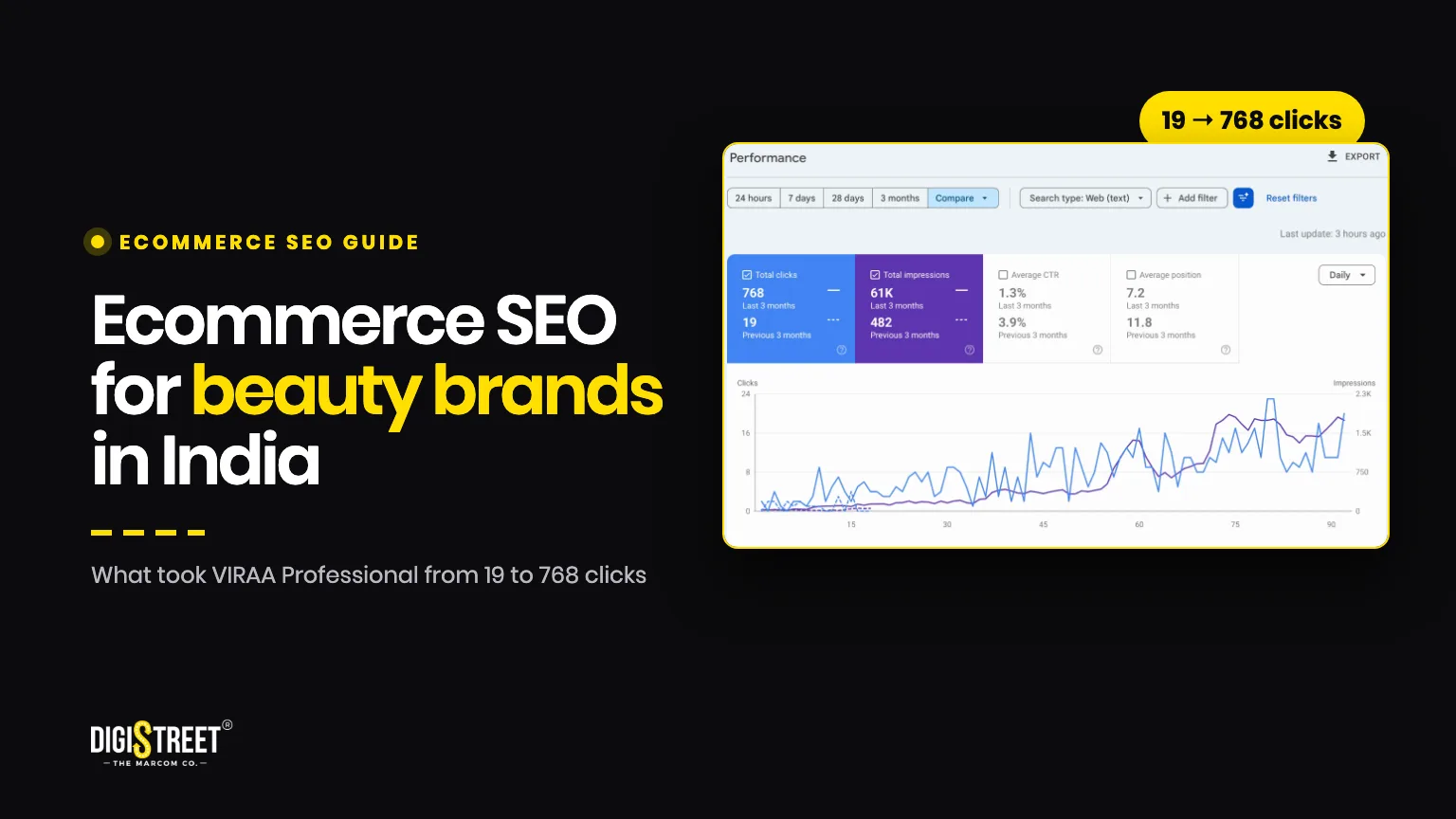
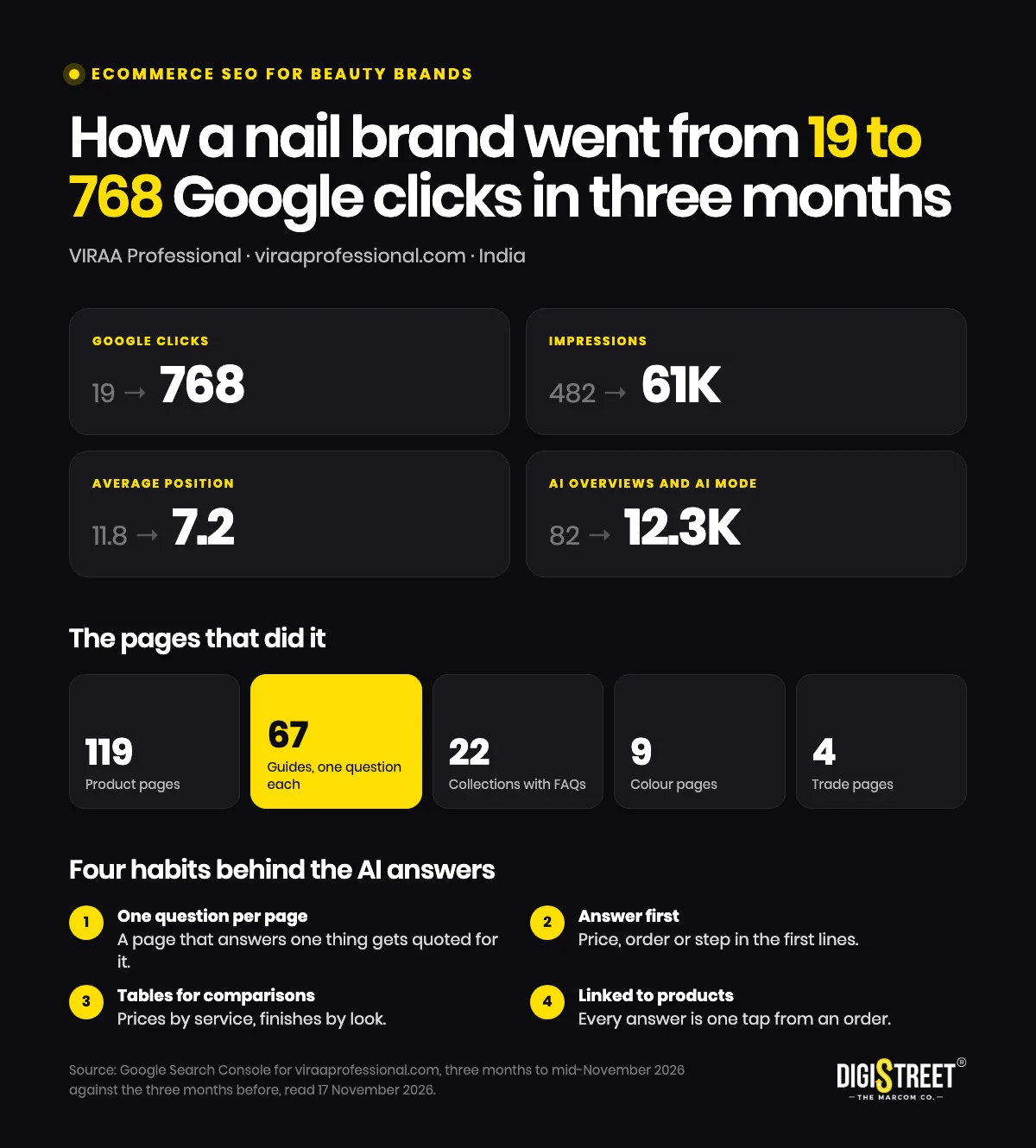
A beauty store in India gets found when it has one page for every way its buyers search: by product name, by colour, by question and by trade need. VIRAA Professional, a nail products brand we work with, had almost none of those pages when its store first showed up in Google Search Console. Three months later the store had 768 Google clicks against 19, 61,000 impressions against 482, and 12,300 appearances inside Google’s AI Overviews and AI Mode against 82.
This guide goes through what moved those numbers, page type by page type, so you can apply it to a cosmetics, skincare, haircare or nail store. The full results, with the Search Console screenshots, are in our VIRAA Professional ecommerce SEO case study.
Start with how beauty buyers actually search
Beauty is not one audience. A home user, a working technician and a salon owner all search for the same products in different words. Before building anything, write down who buys and what each of them types. For VIRAA it looked like this:
| Buyer | What they type into Google | The page that should answer |
|---|---|---|
| Home user starting out | nail kit for beginners list, how to use builder gel | A guide, linked to a starter kit |
| Working nail technician | TPO-free gel polish in India, universal cat eye gel polish | A product or collection page with the exact name in the title |
| Shopper choosing a shade | pink gel polish, milky white gel polish | A colour page listing every shade in that family |
| Someone opening a salon | how to open a nail salon in India, nail salon equipment list | A planning guide with costs and a checklist |
| Salon, academy or reseller | nail products wholesale, bulk nail supplies | A trade page with the offer, GST invoice and a rate card request |
| Client comparing prices | nail extension price, nail refill cost | A price guide with a table by service |
Every row in that table became a page type on viraaprofessional.com, and every search in the middle column is one the store now appears for in Search Console.
Give each page type one job
Most beauty stores on a theme have three page types: home, collection and product. That covers people who already know what they want. It misses everyone still deciding. VIRAA’s store now has five kinds of page that earn search traffic, and its sitemap lists 233 URLs:
| Page type | How many | What it is for | Clicks in 3 months* |
|---|---|---|---|
| Product pages | 119 | Selling one item, with shades, reviews and markup | 28 |
| Guides | 67 | Answering one question each | 185 |
| Collections | 22 | Comparing a range, with buying copy and an FAQ | 35 |
| Colour pages | 9 | Every shade in one colour family | Below the top 30 |
| Trade pages | 4 | Wholesale, salons, academies and resellers | 92 (wholesale) |
*Clicks from the 30 pages with the most clicks, 18 August to 16 November 2026, Google Search Console. The homepage took a further 312, mostly from people searching for the brand by name.
The useful number there is not the 185. It is the impressions behind it. The guides are where new people meet the brand. Brand searches grew alongside them, and “viraa professional” now ranks first with an 88% click-through rate.
Treat colour as a search term
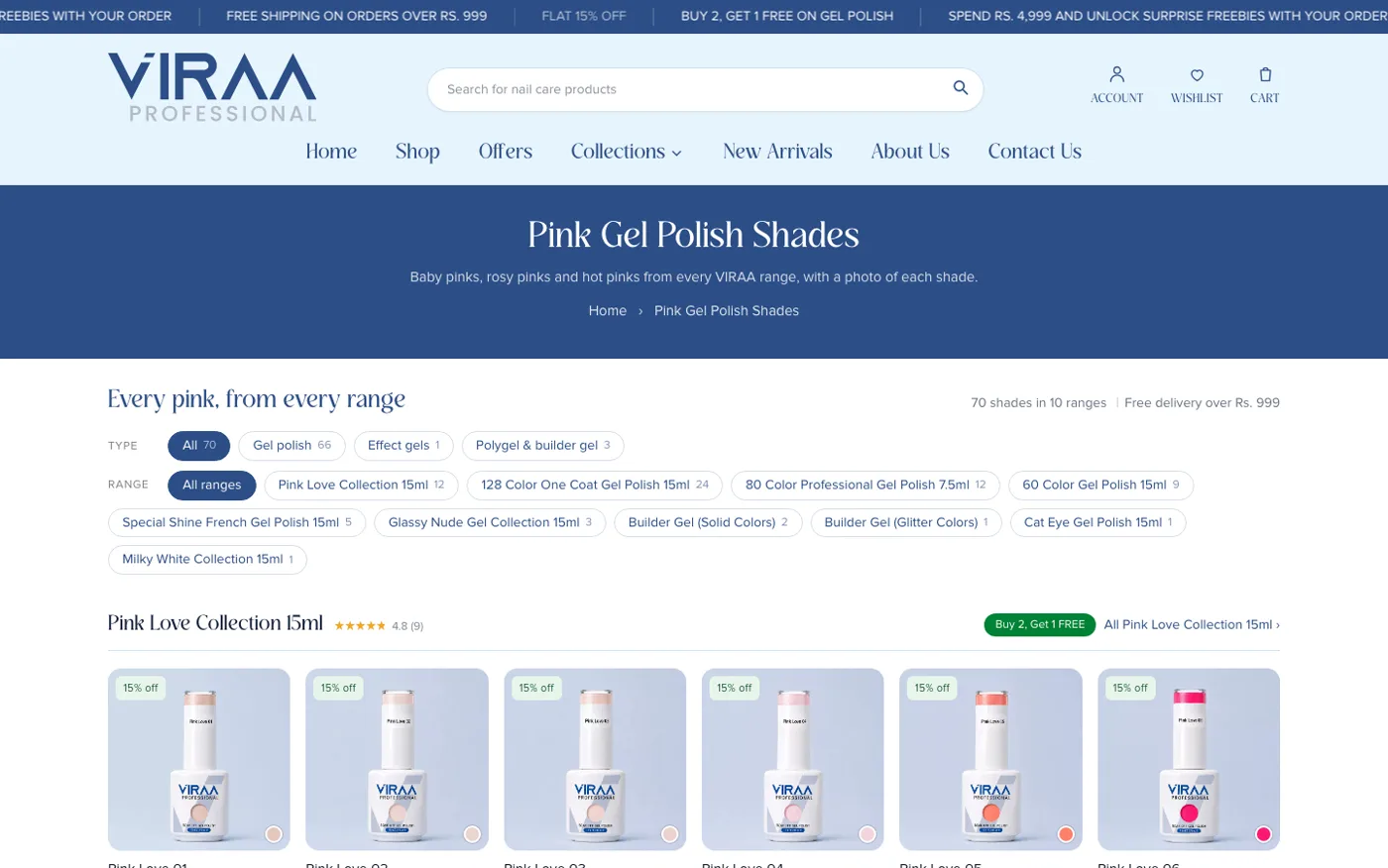
In nail, lip and hair colour, the shade is often what people search for, not the product. VIRAA’s hero gel polish comes in 128 shades, and its pink family alone runs to 70 shades across 10 ranges. A shopper typing “pink gel polish” does not care which range a shade sits in. They want to see every pink.
So the store has a page for each colour family, from pink and red to nude and milky white, with filters for product type and range on the page. Two rules keep this clean for Google:
- Make the colour page a real page with its own URL, title and intro, not a filter state. Google’s guidance on faceted navigation recommends stopping crawling of filter URLs you do not want indexed [3], so the filtered views stay out of the index and the colour page is the one that ranks.
- Keep one spelling for every colour name in the catalogue. If products say Pink, pink and PINK, the filter shows three pinks and the colour page undercounts.
Write guides that answer one question each
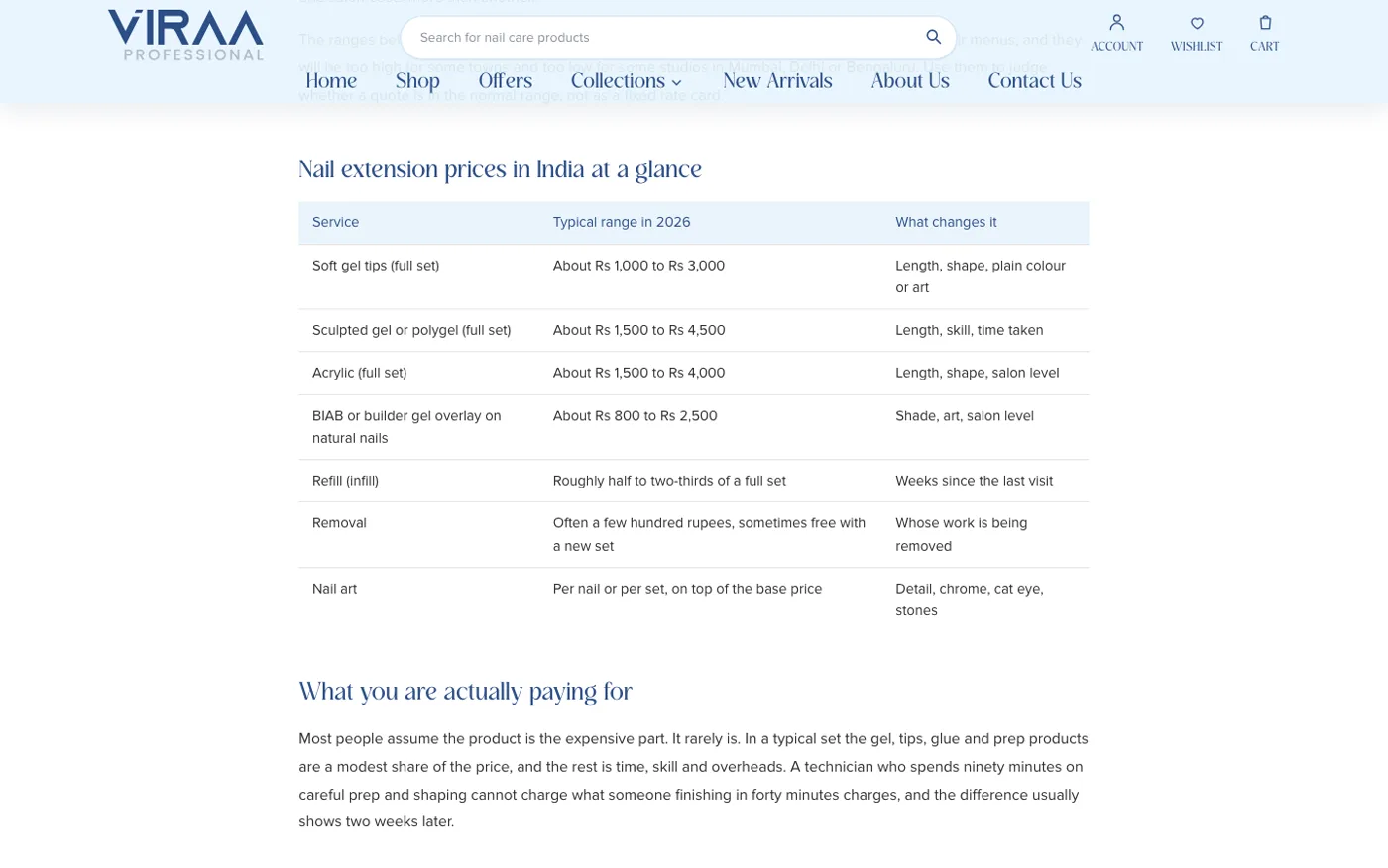
The guides on VIRAA’s store are narrow on purpose. “Nail extension price in India” is one guide. “Base coat vs top coat” is another. “Nail prep products: primer, bonder, base coat order” is a third. Each starts with the answer, then gives the detail, then links to the products it mentions.
Here is what the top guides did in three months:
| Guide | Impressions | Average position | Clicks |
|---|---|---|---|
| Nail extension price in India | 6,999 | 7.3 | 11 |
| Nail tips guide: shapes, sizes and how to apply | 6,748 | 7.3 | 22 |
| Base coat vs top coat | 5,227 | 7.7 | 8 |
| Nail prep products and the order to use them | 4,475 | 6.2 | 17 |
| How to open a nail salon in India | 3,969 | 5.5 | 43 |
Look at the gap between impressions and clicks. A price guide appearing nearly 7,000 times for 11 clicks looks poor until you remember what the searcher wanted: a number. Google often shows that number on the results page or in an AI Overview, and the searcher moves on. That is why the store’s overall click-through rate fell from 3.9% to 1.3% while clicks grew about 40 times. Planning guides, like opening a salon, need more than a number, so they convert views into visits far better. Write both kinds. The price guides make the brand familiar. The planning guides bring the visit.
Getting into AI Overviews without writing for a machine
Google’s documentation is plain about this. It says there are no additional requirements to appear in AI Overviews or AI Mode, and no special optimisation needed beyond normal SEO [1]. What gets a page used in an AI answer is what gets it ranked: it answers the question clearly, it is easy to crawl, and it comes from a source that knows the subject.
Since June 2026 you can measure this. Google added generative AI performance reports to Search Console on 3 June 2026, counting how often a site’s URLs appear in generative AI features in Search and Discover, and finished rolling them out to all websites by 31 August 2026 [2]. For VIRAA the report shows 12,300 impressions in three months, rising from single figures a day in August to about 380 a day by mid-November.
Four habits did most of the work:
- One question per page. A page that answers one thing can be quoted for that thing.
- The answer in the first lines. Price range, product order or the step, then the reasons.
- Tables for anything compared. Prices by service, finishes by look, drill bits by job.
- Named products and real numbers. Shade counts, wattages, ml sizes and rupee prices from the store itself.
Google’s guidance on helpful content asks whether content is made for people first, not to manipulate rankings [4]. A brand that makes the products and trains on them is in a strong position to pass that test, if it writes from what it knows.
Product and FAQ markup in 2026
Structured data still matters for a store, but the picture has changed this year. Google splits product markup into two uses: product snippets for pages where people cannot buy directly, and merchant listings for pages where customers can buy [5]. A store’s product pages qualify for merchant listings, so give them price, availability, shipping and review data that match what the page shows.
FAQ rich results are gone. Google stopped showing them in search results from 7 May 2026 [6]. We still put an FAQ and its markup on every VIRAA collection page, for a different reason: the questions answer real buyer doubts on the page, and clear question-and-answer text is easy for AI answers to use. Keep the visible FAQ and the markup identical.
Give trade buyers their own pages
Many beauty brands sell to salons, academies and resellers as well as to consumers, then hide the trade offer behind a contact form. Trade buyers search for it directly. VIRAA’s “Nail products wholesale in India” page explains who it supplies, what trade pricing covers and that every order carries a GST invoice, then asks for a rate card request. In three months it brought 92 clicks, more than any page except the homepage, and ranks around 8 for “nail products wholesale”.
Separate pages for salons, academies and resellers let each one speak to its buyer’s real question: monthly supply for a salon, student kits for an academy, margins for a reseller.
Build for the phone first
On VIRAA’s store, 72% of Google clicks and 83% of impressions came from phones in the three months to 16 November 2026. Nail technicians look things up between clients. Every page type, including the guides and the tables inside them, has to read well at phone width. The store uses a bottom bar for Shop, Search, Saved and Cart and a full-screen search sheet, so a guide reader is one tap from the product.
A 90-day plan for a beauty store
| When | What to do | What to watch in Search Console |
|---|---|---|
| Weeks 1 to 2 | List buyer types and their searches. Fix titles on products and collections to use the names buyers type. Submit a clean sitemap. | Indexed pages, brand clicks |
| Weeks 3 to 6 | Add buying copy and an FAQ to each collection. Build colour pages and trade pages. Add product and review markup. | Impressions on collections and trade pages |
| Weeks 7 to 12 | Publish guides: one price guide, one planning guide and one how-to per main category, each linked to products. | Impressions on guides, the generative AI report, non-brand clicks |
| Every month | Read which guides get impressions but no clicks, and add a clearer next step to the products. | Click-through rate by page, not sitewide |
Read the numbers by page, not as a site average. VIRAA’s sitewide click-through rate fell as the guides grew, which looks bad in a dashboard and was the sign that the plan was working.
What ecommerce SEO costs with us
Ecommerce SEO with DigiStreet Media starts at ₹75,000 plus GST a month, and our SEO plans start at ₹50,000 plus GST a month. If the store itself needs rebuilding first, ecommerce websites start at ₹2,50,000 plus GST. VIRAA’s move from Shopify to a custom store is written up in how we moved VIRAA Professional from Shopify to custom PHP with Laravel. Our ecommerce website, Shopify SEO and AEO services pages show how we work.
Frequently Asked Questions
How long does ecommerce SEO take for a beauty brand?
Expect the first clear movement in two to three months if the store is crawlable and the pages match real searches. VIRAA’s store went from 138 clicks in its first 30 days in this period to 381 clicks in its latest 30 days, and impressions from 3,571 to 43,012.
Do beauty brands need a blog for SEO?
They need guides, which is not the same as a news blog. Guides that answer one buyer question each, such as prices, product order or salon set-up, bring most of the new impressions. On VIRAA’s store 18 guides brought 185 clicks in three months.
How do I get my store into Google AI Overviews?
Google says there are no extra requirements beyond normal SEO. Answer one question per page, put the answer first, use tables for comparisons, and make sure the page is crawlable. Track it in Search Console’s generative AI performance report.
Why are my impressions rising but clicks are not?
Often because new pages appear for broad questions that Google answers on the results page or in an AI Overview. Check click-through rate page by page. Price and definition pages bring fewer clicks per view; planning and buying pages bring more.
Should a beauty store have separate pages for each colour?
Yes, for colour-led products such as nail polish, lipstick and hair colour. Give each colour family a real page with its own title and intro, and keep filtered views out of the index.
How much does ecommerce SEO cost in India?
With DigiStreet Media, ecommerce SEO starts at ₹75,000 plus GST a month, and SEO plans start at ₹50,000 plus GST a month.
References
- AI features and your website, Google Search Central, accessed 17 November 2026.
- Introducing Search generative AI performance reports in Search Console, Google Search Central Blog, 3 June 2026.
- Managing crawling of faceted navigation URLs, Google Search Central, accessed 17 November 2026.
- Creating helpful, reliable, people-first content, Google Search Central, accessed 17 November 2026.
- Intro to product structured data on Google, Google Search Central, accessed 17 November 2026.
- Latest documentation updates (FAQ rich result entries of 8 May and 15 June 2026), Google Search Central, accessed 17 November 2026.
- Google Search Console data for viraaprofessional.com, 18 May to 16 November 2026, read 17 November 2026.