



Marketing the US arm of an Indian manufacturer
Updated 29 October 2026.
India shipped $19.6 billion of engineering goods to the United States in 2025-26, more than to any other country, and the figure rose 2.3% even with tariffs in the way. If your group has a US plant or sales office, the India website will not sell for it. Here is what we change and what we charge.
The numbers behind the buyer you are chasing
EEPC India’s engineering trade analysis for March 2026 puts India’s engineering exports at $122.43 billion in 2025-26, up 4.86%, with the United States the single largest destination at $19,603 million, up 2.3% on the year before. North America took a 20% share of India’s engineering exports. Electrical machinery and components alone accounted for $4,385 million of US shipments.
The US side of that trade is bigger still. The Office of the United States Trade Representative reports US goods imports from India of $103.8 billion in 2025, up 18.9%, out of $149.1 billion of two-way goods trade. Your product category is not a niche in that figure. It is a line item that a US procurement team already buys from somewhere.
This is why the enquiry pattern looks odd on your India analytics. A plant manager in Ohio who found your group through a parent-company page is not going to fill a form that asks for a GST number and lists a Noida phone number as the only way to call.
What changes between the India site and the US one
Units, standards and part numbers change first. An Indian specification sheet in millimetres, kilograms and IS or BIS references reads as foreign to a US buyer who works in inches, pounds and ASTM, ANSI or UL numbers. Publish both. Not a converter widget, the actual second sheet, with the US designation in the file name so search can find it.
The address changes, and it has to be a real one. A US page that lists only an Indian office tells a buyer that parts, warranty claims and site visits all go through a 10 and a half hour time difference. If you have a plant in Texas or a sales office in New Jersey, that address, that phone number and that email belong at the top of the page.
Lead times and freight change the sale. The question a US industrial buyer asks third, after fit and price, is when it lands. Put the honest answer on the page: stock held in the US, typical lead time for a made-to-order run, and whether you quote delivered duty paid. We set these out as a block on the pages we build for industrial manufacturers.
| Flow | 2024-25 | 2025-26 | Change |
|---|---|---|---|
| All engineering goods, every destination | 116,754 | 122,431 | up 4.86% |
| All engineering goods to the USA | 19,157 | 19,603 | up 2.3% |
| Electrical machinery and components to the USA | 4,223 | 4,385 | up 3.8% |
| Non-ferrous metals to the USA | 3,105 | 3,005 | down 3.2% |
| Motor vehicles, two and three wheelers to the USA | 588 | 741 | up 26.1% |
| Engineering goods to Germany, for comparison | 4,337 | 4,969 | up 14.6% |
The words US buyers actually type
They type part numbers, alloy grades and standards, not category names. A US engineer searching for a pipe fitting types “ASTM A105 flange supplier” or a specific size and schedule. A maintenance buyer types the OEM part number and the word “equivalent”. Those queries have low volume and very high intent, and almost nobody writes a page for them.
They also type the thing they are trying to avoid. “Pump seal failure” and “motor overheating” bring in the person who has a problem, not a purchase order. One technical page per failure mode, with the diagnosis and the part that fixes it, picks up traffic your competitors’ brochure pages cannot touch.
Keyword tools will show most of these at ten or twenty searches a month and you will be tempted to skip them. Do not. Thirty pages at twenty searches a month, aimed at engineers who specify, is worth more than one page chasing a thousand searches from students. The method is the one on our B2B marketing page.
LinkedIn and trade search
LinkedIn reports more than 1.3 billion members, and for industrial selling its value is the targeting, not the feed. You can put a single ad in front of maintenance managers at companies with 500 to 5,000 employees in six states, which is roughly the shape of a US industrial territory. We run these through our LinkedIn ads team, usually as document ads carrying one spec sheet.
Spend follows the cycle, not the month. An industrial sale that takes nine months does not reward a four-week burst. We would rather run $2,000 a month for a year against a named list of 400 accounts than $24,000 in one quarter and nothing afterwards.
Trade directories and marketplaces still matter in US industrial buying, and the listings that convert are the ones with complete technical fields, CAD files and a named engineer to call. Fill them in fully once. Half-filled listings are why buyers assume an overseas supplier cannot support them.
JBM Group
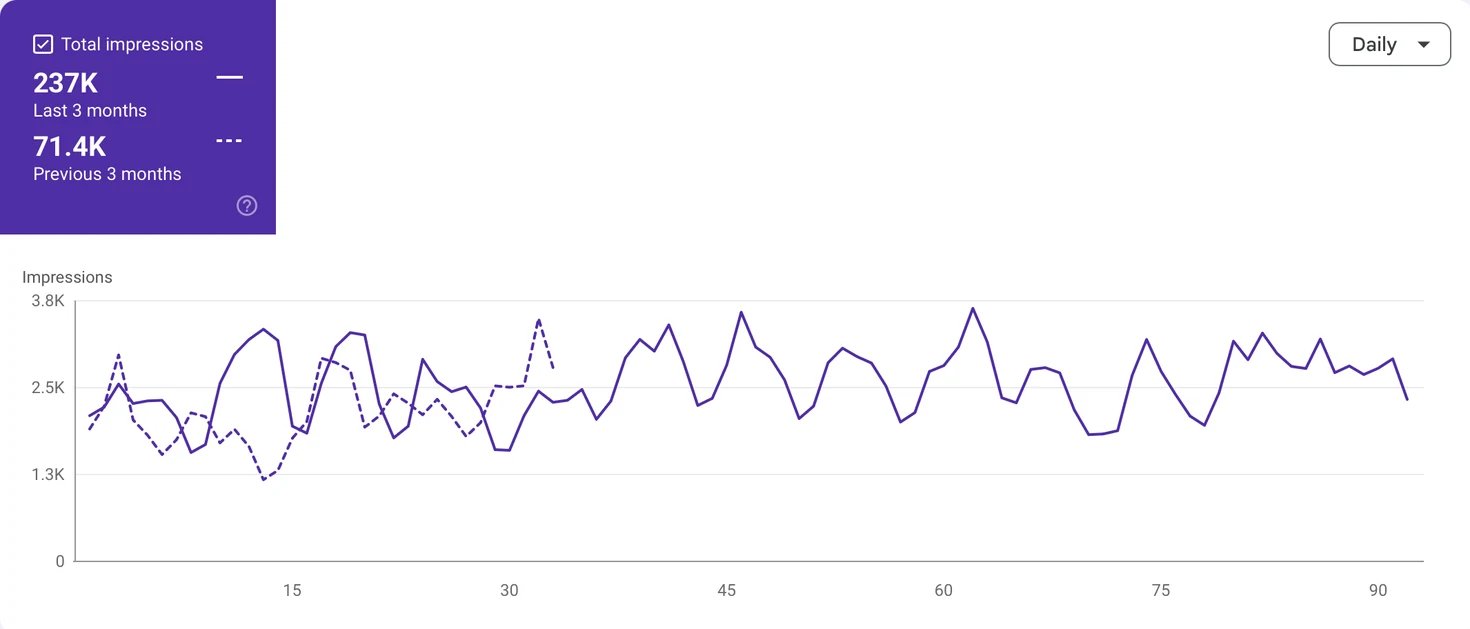
JBM Group makes buses, auto components and tooling, and sells to buyers who search by part and by standard. Annual organic sessions went from 52,935 to 329,261 in FY2024-25 on technical pages and structured data rather than brochure copy. The same method is what we put behind a US arm.
The RFQ page is the whole funnel
A US industrial enquiry arrives through a request for quotation, not a contact form, and the difference is the fields. Material or grade, size or capacity, quantity, drawing or specification upload, required delivery date, delivery state, and whether this is a one-off or a repeat order. Seven fields that a buyer can answer in two minutes from the drawing on the desk.
Ask for nothing you cannot act on. Budget range, job title and how they heard about you belong in the sales call, not the form. Every extra field on an RFQ page costs completions, and on industrial forms the drop happens fast after the eighth one.
Then answer it. A quote inside one US business day is the single biggest advantage an Indian group can hand its US arm, because the India team can price overnight while the buyer sleeps. That only works if someone in the US sends it at 9:00 am Eastern with a name and a direct line on it.
Spec sheets, drawings and certifications
Put the PDF behind nothing. Gated spec sheets are the most common mistake on manufacturer sites and they cost you the specification, because the engineer who cannot download the drawing uses the competitor’s drawing in the design. You get the lead later, through the part number, when the work is already yours to lose.
Name the certifications on the page in text, not only in a logo strip. ISO 9001 with the certificate number, the registrar and the expiry. Material test certificates on request, stated as such. Any UL, CE or API approval that applies to the specific product family, on that product’s page rather than a general quality page.
Give every drawing a file name a buyer would search. “Flange-ASTM-A105-150lb-dimensions.pdf” is found. “download_1.pdf” is not. This is dull work and it moves more revenue than a redesign.
Time zones, and who answers at 9 am Eastern
India is 9 and a half hours ahead of the US east coast in American summer and 10 and a half in winter, because the United States moves its clocks and India does not. In 2026 US daylight saving time ran from 8 March to 1 November. Put both numbers in your sales playbook and nobody argues about a missed call again.
The working arrangement that holds is simple. The US arm owns the first reply and the relationship. India owns pricing, drawings, technical answers and the website work, and turns them around overnight. Our own overlap for this is 8:00 am to 12:00 noon Miami time, which is 5:30 pm to 9:30 pm in India in summer and 6:30 pm to 10:30 pm in winter.
What breaks is the handover note. If the India team does not know by its evening what the US team promised that morning, the buyer gets two different answers in two days and stops trusting both. One shared thread per enquiry fixes it.
What we charge to run this
US search work is $750 a month for Starter with 30 keywords, $1,100 for Growth with 50, $1,850 for Scale with 80, and $2,950 for a resource-based team of two specialists. Every plan includes answer engine and generative engine monitoring, because a US buyer increasingly asks an assistant before a search engine. There is no GST on a US invoice.
Paid media management is the higher of 15% of monthly media or $750 a month, with the rate on the whole budget falling to 10% from $20,000 of media, 8% from $50,000 and 4% from $100,000. Media is paid separately to the platform. A US site is $2,600 for B2B scope or $3,300 for a corporate build, with hosting and maintenance from $300 a month.
Most groups should not start with the website. Start with the thirty technical pages and the RFQ form on what you already have, and move the build to next quarter. Our USA page sets out how we sequence it.
References
- EEPC India, Engineering Trade Analysis for March 2026, using DGCIS, Government of India data
- Office of the United States Trade Representative, India country page, 2025 goods trade figures, accessed 11 October 2026
- Ministry of Commerce and Industry, Department of Commerce, PIB release, 16 March 2026
- LinkedIn, About us, member figures accessed 11 October 2026
Frequently asked questions
Do we need a separate website for the US arm?
A separate section, usually, not a separate site. A /us/ path or a us. subdomain on the parent domain keeps the group’s authority and lets you run US addresses, US units and a US RFQ form. A second domain starts from zero.
How big is India’s engineering trade with the USA?
$19,603 million in 2025-26, up 2.3%, which made the United States India’s largest engineering export destination according to EEPC India’s March 2026 analysis. US goods imports from India were $103.8 billion in 2025 on USTR’s figures.
What does marketing a US arm cost a month?
$750 to $2,950 a month for search, depending on whether you want 30, 50 or 80 keywords or a team of two specialists. Paid media management is the higher of 15% of media or $750, with media paid separately.
Should we gate our spec sheets?
No. The engineer who cannot download your drawing designs the competitor’s part into the machine. Publish the PDF, name the file after the standard and the size, and capture the lead at the RFQ stage instead.
How many fields should the RFQ form have?
Seven. Material or grade, size or capacity, quantity, drawing upload, required date, delivery state, and one-off or repeat. Budget range and job title belong in the sales call.
Who answers a US enquiry, India or the US office?
The US office answers first, within one US business day. India prices and answers the technical questions overnight, inside an 8:00 am to 12:00 noon Miami overlap, and the two sides share one thread per enquiry.