

The difference between B2B and B2C marketing is not the channels. It is what the buyer needs proven before they will talk to you — and for a B2B buyer placing a volume order, almost none of that proof is what consumer marketing is built to deliver.
The order is the difference
A consumer buys one unit. If the purchase disappoints, they lose a few thousand rupees and move on. Everything in B2C marketing follows from that low cost of being wrong: short consideration, emotional triggers, scarcity, impulse.
A B2B buyer is not placing an order. They are appointing a supplier.
When a manufacturer evaluates a components vendor, the question is rarely “is this product good”. It is “can this company supply forty thousand units a month, to specification, for the next three years, without becoming my problem”. One or two small orders are not the prize — they are the audition, and often not even that. Many industrial buyers will not run a trial at all until they are satisfied the supplier can scale.
That single shift changes what marketing has to do. B2C marketing is built to create desire. B2B marketing has to retire risk. The buyer is not asking to be excited. They are asking to be reassured that choosing you will not be the decision that goes wrong.
This is also why chasing traffic volume is the classic error in B2B — a point we made at length in our B2B marketing playbook. The buyer’s frame is order volume. The marketer’s frame too often becomes visitor volume. Those are not the same thing, and optimising for the second can actively cost you the first.
What a B2B buyer is actually checking
Sit in on a vendor evaluation and you will hear the same five questions, in some order, every time. They are the questions your digital presence either answers or leaves hanging.
Capacity — can you actually supply at our volume?
The single most common gap on Indian industrial websites. Companies list what they make and never say how much they can make. Installed capacity, number of plants, floor area, lines, shift patterns, annual output — this is not confidential information for most manufacturers, and its absence is read as smallness. If a buyer cannot find your capacity, they will assume it is not impressive.
Experience — how long have you been doing this?
Longevity is a proxy for survival, and survival is a proxy for reliability. A company incorporated in 1963 has been through several downturns, technology transitions and customer generations. That is worth stating plainly on the homepage, not burying in an “About Us” page nobody opens.
Association — who else trusts you?
OEM relationships, group companies, export markets, stock exchange listings, joint ventures, technical collaborations. In B2B, the customer list is the credential. A buyer who sees that you already supply three manufacturers larger than them stops worrying about whether you can handle their volume.
Quality standards — can you prove it, not claim it?
Every company says quality is important. Certifications are the difference between saying and proving. IATF 16949, ISO 9001, ISO 14001, customer-specific approvals, testing infrastructure, rejection rates. For a procurement team these are not badges; they are gate criteria. A supplier without the certification is not compared unfavourably — they are not compared at all.
Leadership — do you understand where this category is going?
This is the one most companies skip, and the one that separates a vendor from a partner. A buyer choosing a components supplier for the next five years wants to know you have a view on electrification, on emissions regulation, on where the category moves next. Thought leadership in B2B is not opinion writing. It is evidence that you will still be relevant when the market changes.
Your website is the qualification round
Here is what most B2B companies get wrong about their own digital assets: they treat the website as a brochure, when the buyer is using it as a filter.
By the time a procurement team contacts you, they have already shortlisted. That shortlist was built from whatever they could verify without speaking to a salesperson — your site, your search results, your LinkedIn presence, whatever an AI assistant says about you when asked who supplies a given component in India. If your digital presence does not carry capacity, credentials and category authority, you are not losing at the negotiation stage. You are being removed before the conversation starts.
The uncomfortable version of this: large, capable companies routinely lose to smaller competitors who present better. The buyer cannot see your plant. They can only see what you have published.
A worked example: SPR Auto Technologies
We are completing a full website redesign for SPR Auto Technologies Limited — formerly Shriram Pistons and Rings Ltd., originally incorporated as Shama Pistons and Rings in 1963. They are one of India’s significant automotive components manufacturers: pistons, piston pins, piston rings, engine valves, and now electric motors and controllers, supplying domestic OEMs across passenger vehicles, two and three wheelers, and commercial vehicles.
The problem was not the company. It was that almost none of that was legible from the website.
 BEFORE
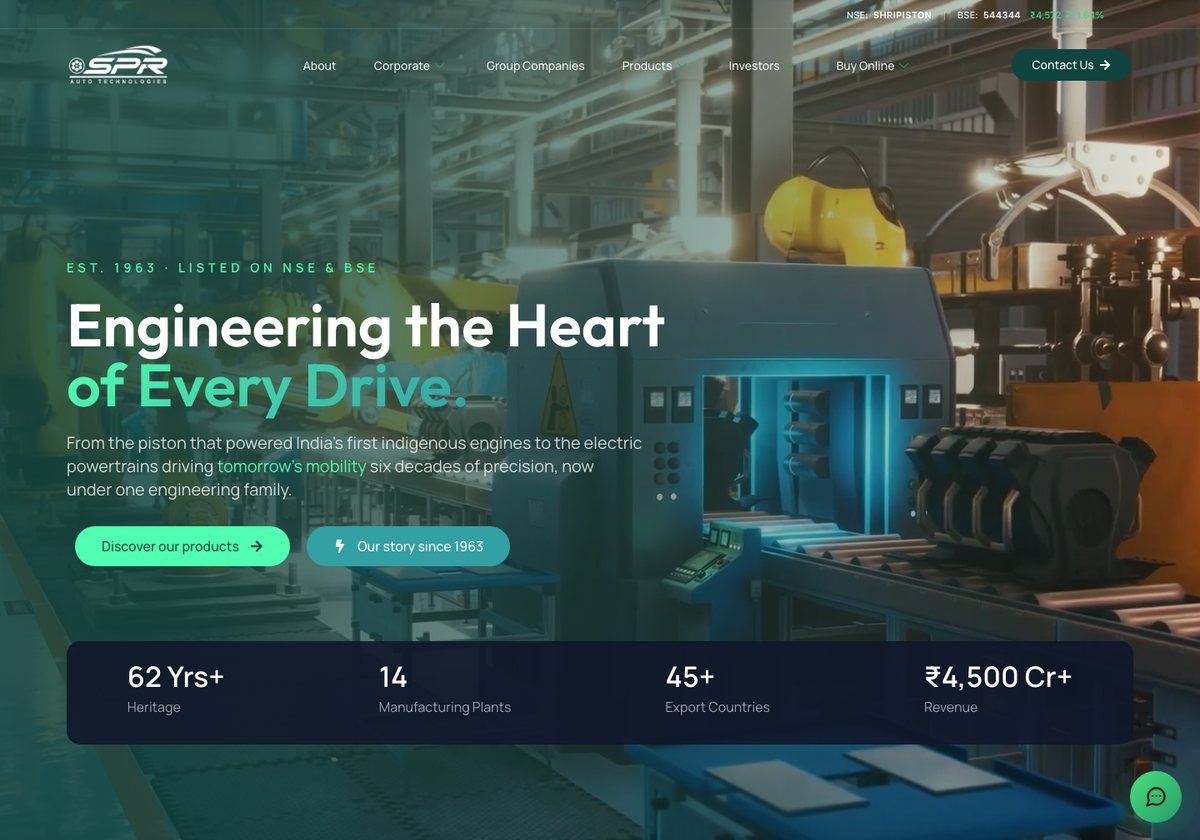 AFTER
AFTERThe existing site ran to roughly a thousand words. Its section headings were bare labels — “Products”, “Management”, “Manufacturing Facilities”. A company listed on the stock exchange, in business for six decades, supplying the country’s largest vehicle makers, presented itself with less positioning than a mid-sized job shop. The credentials were not missing from the business. They were missing from the page.
The redesigned homepage now opens with the proof bar a buyer is actually looking for — six decades of heritage, 14 manufacturing plants, 45+ export countries, revenue — none of which appeared anywhere on the page before. The rebuild is roughly three times the content, but the volume is not the point — the selection is. The three shifts that mattered:
- Credentials moved above the fold. “Est. 1963 · Listed on NSE & BSE” now sits in the first thing a visitor reads. Longevity and listing status are stated, not implied. Across the old site, the exchange listing appeared once; on the new one it is present throughout, because it is a qualification signal, not a fact to be filed away.
- Quality standards became visible. The old site did not mention ISO or IATF certification anywhere. Not once. The new site surfaces the quality framework repeatedly — because for an automotive procurement team, that is the first gate, and a site that does not clear it does not get read.
- The portfolio was restructured around how buyers think. Instead of a flat product list, the range is organised by business segment — internal combustion engine components, electric mobility components, precision engineering. That structure does something a product list cannot: it tells an OEM evaluating an EV programme that this supplier has already made the transition.
None of this invented anything. Every claim on the new site was true of the company before we touched it. The work was recognising which facts function as proof to a B2B buyer, and giving them the prominence that a consumer-style brochure site had denied them.
What actually changes in the marketing
Once you accept that the job is retiring risk rather than creating desire, the tactical differences follow logically.
Search: specifications, not slogans
B2B search is specific. Buyers search part numbers, materials, tolerances, standards and applications — not category headlines. That means your specification data has to exist as crawlable HTML rather than sitting inside a downloadable PDF where search engines and AI assistants cannot read it properly. We have written separately about why specification pages outperform product pages for manufacturers, and it remains the single highest-return technical change available to most industrial sites.
Content: written for the evaluator, not the browser
The people reading B2B content are doing a job, not passing time. Application notes, capability documentation, plant and process detail, case histories with real numbers. Content that helps someone build an internal business case is worth more than content that attracts a wide audience, because one qualified reader is the entire point.
Video: show the thing they cannot visit
A buyer cannot walk your plant before shortlisting. A well-made corporate or capability film is the closest substitute, and in B2B it does measurable work — it is often the asset a champion forwards internally to people who will never visit your website at all.
AI search: an unusually open opportunity
Technical buyers increasingly ask AI assistants who supplies a given component or service. Being cited in those answers depends on having specific, structured, verifiable content — exactly what most industrial sites lack. That makes answer engine optimisation comparatively easy to win in B2B categories, simply because so few competitors have done the groundwork.
Measurement: accept the honest timeline
A nine-month buying cycle means last-click attribution will misattribute nearly everything. Judging B2B marketing on monthly lead counts pushes teams toward cheap, unqualified enquiries and away from the work that actually shortens shortlists. Measure pipeline influence and shortlist inclusion, and give the programme long enough to report honestly.
Where B2C thinking still applies
It would be dishonest to claim nothing transfers. Three things do.
Craft. The idea that B2B can look dull because the audience is rational is wrong. Procurement managers are people, and a site that looks neglected reads as a company that is neglected.
Usability. Every friction lesson from e-commerce applies. If a buyer cannot find a datasheet in two clicks, the failure is the same failure as an abandoned cart.
Retargeting. Long cycles make sustained presence more valuable, not less. The difference is what you retarget with — a capability film or technical document, rather than a discount.
What does not transfer is the underlying assumption. B2C marketing assumes the decision is small enough to be made emotionally and reversed cheaply. B2B marketing exists precisely because it is neither.
The practical starting point
If you sell to businesses and want a straightforward test of your own digital presence, open your homepage and ask whether a stranger could answer these five questions in under a minute: How much can you make? How long have you been doing it? Who already buys from you? What are you certified to? Do you have a view on where this category is going?
Most industrial websites fail on at least three. That failure is rarely a reflection of the business. It is a reflection of a website built to describe a company rather than qualify it — and unlike capacity or certification, it is the part you can fix this quarter.
If you would like a view on how your own site reads to a B2B buyer, that is what our B2B digital marketing team does — for manufacturers, industrial groups and technical service businesses across India and export markets.
Frequently Asked Questions
What is the main difference between B2B and B2C digital marketing?
The cost of being wrong. A consumer risks a small amount on a single unit, so B2C marketing is built to create desire quickly. A B2B buyer is appointing a supplier for a volume programme, often for years, so B2B marketing has to retire risk instead — proving capacity, certification, experience and stability before a conversation will even start.
Why do B2B buyers care about capacity so much?
Because they are not buying one or two orders. They are assessing whether you can supply consistently at their volume without becoming a production problem. A supplier who cannot demonstrate capacity is treated as a risk regardless of product quality, which is why installed capacity, plant count and output belong on the website rather than in a sales conversation.
Does my B2B company really need thought leadership content?
If you want to be chosen as a long-term partner rather than a replaceable vendor, yes. A buyer committing for several years wants evidence that you understand where the category is heading — electrification, regulation, materials. It is less about opinion and more about demonstrating you will still be relevant when the market shifts.
Should certifications be on the homepage or a separate page?
Visible on the homepage, with detail on a dedicated page. For procurement teams, standards like IATF 16949 or ISO 9001 are gate criteria rather than credentials — a supplier who does not clearly clear the gate often is not evaluated at all. Hiding them one level deep costs shortlist places.
How long does B2B digital marketing take to show results?
Expect meaningful movement in six to nine months, aligned to the buying cycle rather than the reporting month. Early indicators — the right companies visiting, better quality enquiries, inclusion on shortlists — appear well before revenue does, and are the more honest measure in a long cycle.
Is our website really that important if we sell through relationships?
Relationships open doors; the website decides whether you survive the shortlist behind them. Even a warm referral is verified online before a meeting is granted, and increasingly that verification includes what AI assistants say about you. A strong relationship and a weak digital presence still loses to a competitor who has both.
Related Reading
- B2B Digital Marketing Agency: Why B2B Needs a Different Playbook
- SEO for Manufacturers: Why Specification Pages Outperform Product Pages
- Automotive Digital Marketing Agency: What Actually Works in 2026
If your buyers are engineers, procurement teams and committees, consumer tactics will keep underdelivering. See our B2B SEO work, the SKF and Prem Cables case studies, or talk to us.