


International SEO for Indian exporters: hreflang basics
Updated 22 October 2026.
Hreflang helps Google connect equivalent pages written for different languages or regions. It does not create rankings, translate a page or replace a clear international site structure. Indian exporters should use it only after each market URL is stable and genuinely useful.
Google accepts hreflang annotations in HTML, HTTP headers or XML sitemaps and says the methods are equivalent. Each language version must list itself and every alternate version, and the references must return the same relationship. The URL must be fully qualified. A value begins with an ISO 639-1 language code and may add an ISO 3166-1 Alpha 2 region code, such as en-GB or ar-AE. The related DigiStreet commercial page is SEO services in India.
An exporter does not need a separate page for every country it can ship to. Create a market version when price, product availability, compliance, delivery, terminology, currency or the buying process changes enough to help that audience. Where the content is identical, a single clear page may be more maintainable than a web of annotations nobody owns.
Choose language and region with care
Language answers how the page is written; region narrows the intended market. “en” can cover English speakers generally, while “en-GB” indicates English for Great Britain and “en-AE” English for the United Arab Emirates. Google warns that a country code cannot appear by itself because the first part is interpreted as a language. “UK” is also not the supported region code; Great Britain uses GB.
Do not infer that every English export page needs a regional tag. If an industrial product has one specification, one price request flow and one global English page, “en” may be sufficient. Add en-AE or en-US when the page itself changes for that market. The annotation should describe existing content, not manufacture market relevance that the page does not contain.
Build a complete return-link cluster
Every alternate page should reference itself and all other members of the set. If the Indian English page links to the German page but the German page does not link back, Google may ignore the incomplete relationship. For three versions, each page carries the same three alternate references. The canonical URL normally points to the page itself when each version is a valid localized page.
Use absolute URLs including the protocol and domain. Relative paths introduce avoidable uncertainty, especially when markets sit on subdomains. Keep the cluster focused on true equivalents: a German product category should not point to an English home page merely because a translation is missing. A mismatched pair gives users the wrong task after Google selects the alternate.
Select one implementation method
HTML link elements work well when the publishing platform can manage page-head metadata. XML sitemaps can be easier for large catalogues because the relationships live in one structured feed. HTTP headers are useful for non-HTML resources such as localized PDF catalogues. Google says there is no search benefit in implementing all three at once, and maintaining duplicates increases the chance of disagreement.
Pick the method the site team can validate after every release. The source of truth needs an owner, a generation rule and a test. When a market page is removed or redirected, update the entire cluster. A stale alternate that resolves through several redirects or returns an error is not a useful signal.
Use x-default for the unmatched visitor
The reserved x-default value identifies the fallback when no other language or region matches. Google recommends it particularly for a country or language selector. An Indian exporter might point x-default to a global English catalogue or a market-selection page rather than forcing every unmatched user onto the Indian page.
The fallback should still offer a clear path. Show language and market choices, preserve access to every version and avoid automatic redirects that prevent people or crawlers from selecting another page. Google notes that its crawler generally originates from the United States and does not send an Accept-Language header, so automatic language routing can conceal variants.
Localise the buying decision, not only the navigation
Search engines can identify the language from visible page content. Translating a menu while leaving the main product copy unchanged creates a poor experience and a weak reason for the alternate. Export pages often need locally understood units, certification references, incoterms context, delivery information, warranty boundaries, distributor routes and an enquiry form that reaches the correct market owner.
The exporter should also decide which evidence travels. A factory capability, technical test or Indian manufacturing credential may support every market. A customer quote, regulatory mark or price may have territorial limits. Hreflang does not validate those claims; the content owner still has to approve them.
Audit hreflang as a live system
Start with an export of indexable URLs and create clusters by equivalent page. Check status codes, canonical targets, language-region values, self-references and return links. Then inspect the rendered head or sitemap rather than only the CMS field. JavaScript injection, caching and deployment rules can change what a crawler receives.
Monitor new errors after migrations, catalogue changes and market launches. Also review landing pages in Search Console by country and page; a mismatch is a prompt for investigation, not proof that hreflang failed. Content relevance, crawling, canonicals and links still influence which page appears. The annotation is one part of an international SEO system.
Plan an exporter release without creating orphan markets
For a new market, record the source page, target language, target region, translator, product owner, legal reviewer and publishing route. Decide whether the alternate belongs on the same domain, a subdomain or a country domain. Each option can work, but the team must be able to maintain navigation, analytics, canonicals and the selected hreflang method across it. A URL plan is an operating document, not only a keyword list.
Release the smallest complete cluster. A translated product page without its shipping, contact or enquiry path can send a buyer into another language at the point of action. Check the menu, breadcrumbs, forms, confirmation messages, downloadable specifications and sales routing. If a market version cannot complete the intended task, keep it out of the alternate set until the gaps are resolved.
After publication, crawl every member from outside the CMS. Confirm a successful status, an indexable response, a self-canonical and the full reciprocal alternate set. Test language switching on desktop and mobile, then submit or refresh the chosen discovery route. The final sign-off should include screenshots or exports of the live annotations so later releases have a reliable comparison.
Handle products, distributors and market ownership
Export sites often mix direct sales, distributor enquiries and information-only markets. The page should say which route applies. A visitor in Germany should not be sent to an Indian domestic checkout if the product is available only through a distributor. Region-specific copy, contact details and structured navigation can make that ownership clear before hreflang points searchers to the URL.
Decide how products that are unavailable in one market relate to their global equivalents. Do not place a market page in an alternate cluster if it represents a materially different item or no purchasable option at all. The closest alternate for a technical product should match the decision task, specification and audience, not merely share a model-family word.
Keep a register of market owners and distributor changes. When a territory changes hands, update contact paths, legal text, inventory language, internal links and the alternate cluster together. This avoids a technically valid annotation sending a buyer to an obsolete commercial route. International SEO quality depends on both code and maintained market truth.
For large catalogues, generate annotations from a product-market map rather than manual page fields. The map should contain only published equivalents and should reject unsupported language or region values. Build validation can catch a missing self-reference, non-reciprocal pair, relative URL or non-success response before the release reaches production.
For a smaller exporter site, a reviewed spreadsheet can serve the same purpose. Give every row a source URL, alternate URL, language-region value, fallback choice and owner. The format matters less than maintaining an accurate cluster. A documented list also makes translation gaps and obsolete market pages visible to commercial teams.
| Need | Example | Check before release |
|---|---|---|
| General English page | hreflang="en" | The same offer works across English-speaking markets |
| English for the UAE | hreflang="en-AE" | The page carries a genuine UAE variation |
| Arabic for the UAE | hreflang="ar-AE" | Arabic content is visible in the main page |
| Fallback selector | hreflang="x-default" | Users can reach every supported market |
| Localized PDF | HTTP Link header | Every alternate PDF returns the same complete set |
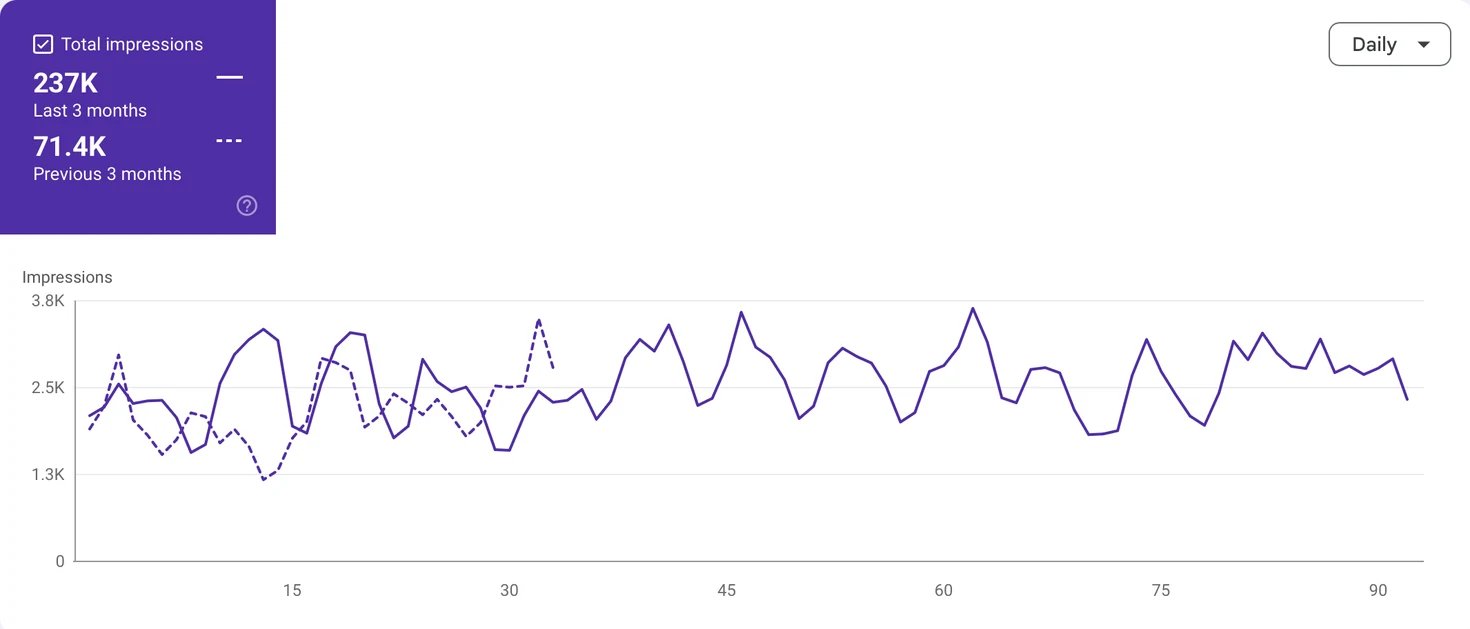
JBM Group
The published JBM Group case contains this client asset with a named caption. The source opens the evidence in its original context.
Frequently asked questions
Does hreflang improve rankings by itself?
No. It helps Google understand equivalent language or regional versions and show an appropriate URL. The page still needs useful content, crawling and normal search signals.
Must every hreflang page link back?
Yes. Google requires each version to list itself and every alternate version. Missing return links can cause the annotation to be ignored.
Can I use only a country code such as IN or AE?
No. The first code must be a supported language code. A region is optional and follows the language, as in en-IN or ar-AE.
Should I use HTML, a sitemap and HTTP headers together?
Google treats the three methods as equivalent and says there is no search benefit in using all of them. Choose the method your team can maintain correctly.
What is x-default?
It is the fallback annotation for users whose language or region does not match another version. It is often suited to a global page or market selector.
Do all export countries need their own URL?
No. Create a market page when the offer, language, compliance, availability or buying process is usefully different. Avoid versions that only change the country name.