




Updated 20 October 2026.
DigiStreet field guide
How Many Keywords Should an SEO Plan Target?
Thirty well-mapped keywords can be enough for one product line. Eighty can be too few for an international catalogue. Count decisions and page groups before you count phrases.
DigiStreet uses up to 30 keywords in Starter, 50 in Growth and 80 in Scale. Those are planning capacities, not promises of rankings and not limits on every query a page can earn. A single useful page may surface for many close variants that were never placed in a spreadsheet.
The right count comes from the number of page groups that need a distinct answer. A clinic with six services in one city has a different map from a manufacturer with three divisions, export markets and technical applications. Both may own websites of similar size.
Build the keyword set after grouping search intent. If ten phrases lead to the same answer, keep one primary phrase and the useful variants under it. If two phrases sound similar but need different evidence or buying paths, give them separate page plans.
Use this guide as a working document: keep the URL, date, owner and source beside every decision.
The working view
| Scope signal | Likely planning set | Why |
|---|---|---|
| One market, one focused offer | Up to 30 keywords | Enough room for core commercial pages and supporting questions |
| Several categories or cities | Up to 50 keywords | Separate intent groups need their own priorities |
| Competitive or international work | Up to 80 keywords | More markets, competitors and page types |
| Changing catalogue or many stakeholders | Resource-based | Two specialists work from a backlog instead of a phrase cap |
Turn a long keyword list into a page plan
Start with money pages
List the services, categories or products that can lead to revenue. Each needs a clear page owner and a search intent. A blog phrase belongs later unless it supports one of those commercial pages or answers a question that affects a purchase.
Separate discovery from purchase
A person asking what a material is needs a different page from one asking for a supplier. Mixing both intents into one count makes the plan look larger while leaving the commercial page vague. Mark each query as research, comparison, local or transaction.
Map variants under one primary query
Singulars, plurals, word-order changes and close synonyms often belong together. Keep them in the research sheet, but do not pretend each creates a fresh unit of work. The page needs natural language and complete coverage, not repeated headings for every variation.
Give locations a business reason
A city page needs real service coverage, local proof and an answer that differs from the national page. Adding fifty place names to a tracker does not create fifty useful pages. Count only locations the business can serve and describe honestly.
Use Search Console to widen the set
Existing impressions show how Google already understands a page. Queries near the bottom of page one, or clusters earning impressions without the right landing page, can enter the next planning cycle. Keep the original page map so expansion does not create cannibalisation.
Do not let tools set the quota
Keyword tools are good at discovery and grouping. Their databases are not your sales ledger. A phrase with modest recorded volume may matter if it describes a valuable industrial application, while a large informational phrase may never lead to a qualified enquiry.
Reserve capacity for evidence pages
Case studies, comparison pages, specifications and clear FAQs support both search results and answer engines. They may not begin as high-volume keywords, yet they supply the facts a buyer and a retrieval system need before naming a company.
Track page groups, not vanity totals
A monthly dashboard should show the commercial group, target page, clicks, impressions, average position and the work completed. A total count of ranking keywords can rise because of irrelevant variants. Page-group reporting keeps the number connected to a decision.
Review the set when the site changes
A new product line, market or merger can make the original quota useless. Remove phrases that no longer map to an offer. Add new groups only when there is a page owner, evidence and a reason to publish or improve something.
Choose capacity that the team can act on
A list of 500 phrases is cheap to export and expensive to use. Choose a set that editors, developers and subject experts can support each month. Unactioned research is not a larger SEO plan. It is a parking lot.
Build the first keyword map
Open a sheet with columns for phrase, intent, target page, business value, existing position, owner and next action. Do not add volume first. Begin with the services and products the business can actually sell. This keeps research attached to the offer instead of letting a tool’s database dictate the shape of the site.
Sort the phrases into page groups and read each group aloud. If every phrase can be answered by the same page without awkward repetition, keep the group together. If one phrase needs a different specification, proof set or conversion path, split it. The page distinction should be obvious to a buyer before it is obvious to a crawler.
Mark existing pages before proposing new ones. A weak page is often improved faster than a second page can earn trust. When two URLs already compete for the same group, choose the better destination and plan the consolidation. Creating a third variation makes the ownership problem harder.
Give every keyword group a measurement view. Save the Search Console page filter, query regex or exported query list used for the baseline. Then the monthly report can show the group’s clicks and impressions without relying on a third-party rank snapshot. Rank tools can still help with daily movement, but the first-party page view holds the decision together.
Review the map with sales or product staff. They often know which wording signals a qualified enquiry and which popular phrase attracts the wrong audience. Record that judgement beside the data. The final plan should reflect commercial language, customer questions and search evidence, not only one source.
Three sizing examples and the habits that inflate a keyword count
A clinic with six services in one city
For example, a clinic offers six treatments from one address. Each treatment needs a page, and each page has one primary phrase and perhaps four close variants. That is six primary keywords with a city modifier on each, so the planning set is about six to twelve, not sixty. Add the main service-area page and two questions patients ask before booking, and the set reaches about fifteen. A thirty-keyword tier is more than this clinic can act on in the first quarter. The sensible move is to start with the six treatment pages, read Search Console after the rewrites, and widen the set only when a page group runs out of room.
A manufacturer with three divisions and export buyers
For example, a manufacturer has three divisions, each with two or three product families, and buyers in three countries. Count the product families first, and say there are eight. Each has a specification page for engineers and a supplier page for procurement staff, which makes sixteen intents before any country is added. Buyers abroad may use different names for the same part, so the language can differ by market even when the product does not. Arithmetic like this explains why eighty can be tight here, and why fifty may be enough if only one country is a real priority. Decide the markets before you decide the tier.
Habits that make a list look bigger than the work
Three habits do most of the damage. The first is counting plurals and word-order swaps as separate keywords. The second is listing every city the business could theoretically serve, with no page or proof behind any of them. The third is adding every question a research tool produces, including ones no buyer asks before purchasing. To spot them, sort the sheet by target page and look for pages carrying more than six phrases, then for phrases with no target page at all. Rows with no page are wishes. Delete them, or assign a page and an owner this week.
A one-hour test before you approve the number
Before you sign off a keyword count, divide the sheet by the number of people who will act on it each month. If one editor and one developer must handle sixty phrases, each needing a rewrite, links and a check, the plan will stall by month three. Next, pick five phrases at random and ask for the exact URL that will answer each one, plus the sentence on that page that earns it a place. If the team hesitates on three of the five, the count is a target on paper only. Fix the map first. The tier can follow it, and the monthly report will be easier to read.
Evidence from DigiStreet work
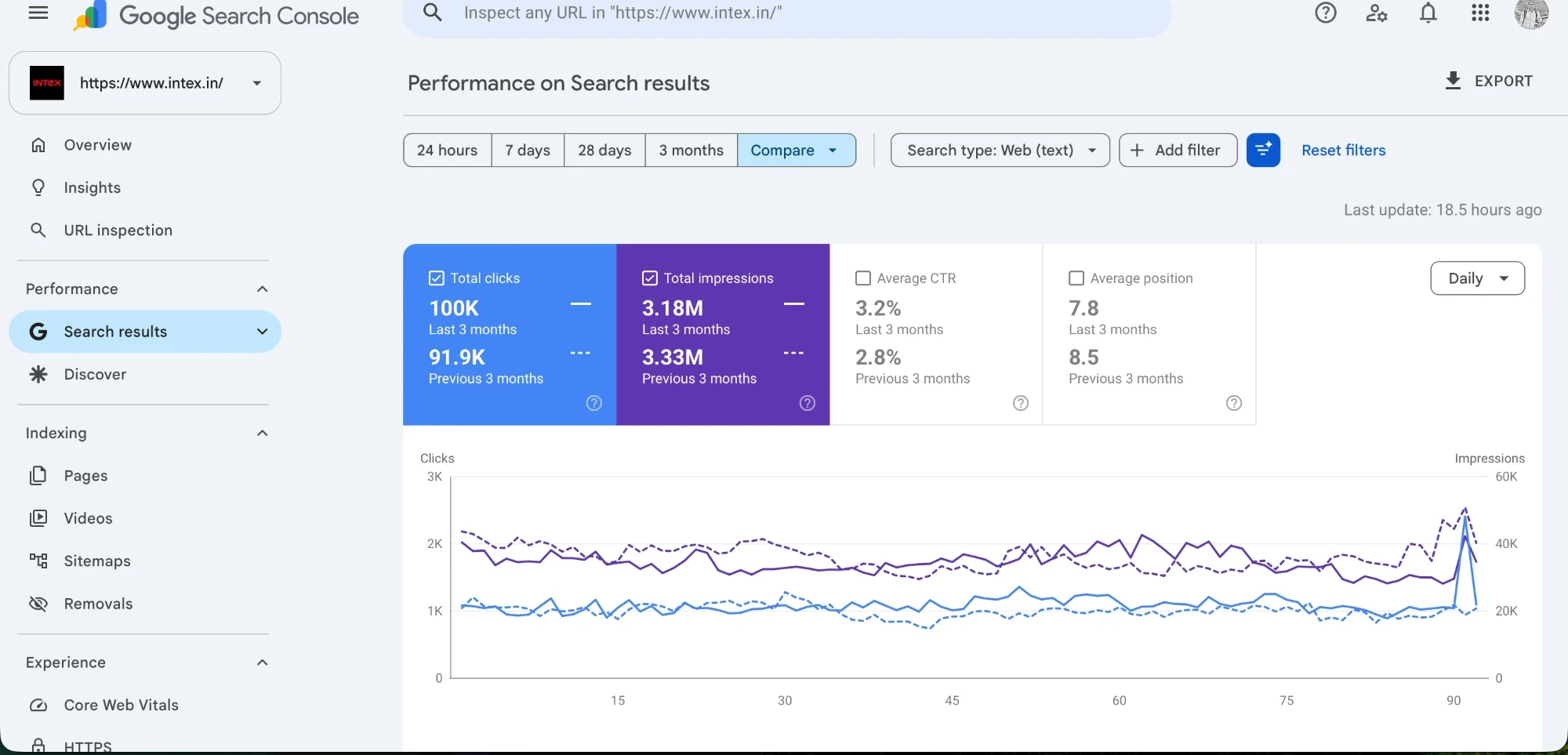
The Intex Search Console chart sits behind a real SEO case page. The useful habit is not admiring the total. It is asking which categories and pages created the line, which queries are rising, and where the next page-level action belongs.
For a first plan, prefer a smaller map that names the page, intent and owner. Expand it when the reporting shows a real gap. That keeps keyword research connected to work someone can ship.
Questions people ask before using this guide
Is 30 keywords enough for SEO?
Yes, for one focused market or product line when the phrases are grouped into useful pages.
Should every keyword have its own page?
No. Close variants with the same intent usually belong on one complete page.
How often should the keyword set change?
Review it when offers, markets or Search Console evidence change, then record additions and removals.
Do blog keywords count?
They should count when the article supports a commercial page or answers a buying question.
What is included in the Growth tier?
Growth is ₹75,000 plus GST a month and covers up to 50 keywords for multi-category or multi-city work.
Does the plan include AEO and GEO?
Yes. DigiStreet includes AEO and GEO visibility monitoring in every published SEO tier.
Put the next decision on one page
Bring the URL, the evidence you already have and the business action that matters. We will tell you what should be checked first.