




SEO for Dubai business set-up and corporate services firms
Updated 1 November 2026.
2,709 new companies joined the Dubai Chamber of Commerce in March 2026, and 41.2% of them were in real estate, renting and business services, on the chamber’s figures reported by Gulf News. That is the demand a set-up firm competes for every month. Here is how the search terms split and which pages win them.
The category is crowded because the demand is real
One month, 2,709 new member companies at the Dubai Chamber of Commerce. Real estate, renting and business services took 41.2% of them, trading and services 29.5%, construction 15% and social and personal services 9.3%. Every one of those founders typed something into Google first, and most of them typed a question rather than a brand.
The problem is that every set-up firm in Dubai knows this. The paid auction on business set-up terms is one of the most expensive in the emirate, and the organic results are full of pages that all say the same four things. Which is good news, because a category where everybody publishes the same page is a category you can take with better pages.
The work that moves a set-up firm is not more pages. It is pages that answer the specific question a founder is stuck on, with a number on them. That is the whole of our Dubai SEO method in this category, and it is why RadiantBiz works.
How the search terms actually split
Four clusters, and they behave differently. Jurisdiction questions compare free zone against mainland, or name a specific zone. Cost questions ask what a licence, a visa or the whole exercise comes to. Process questions ask about steps, documents and timelines. Adjacent-service questions cover accounting, VAT registration, corporate tax, a bank account and residency.
The UAE government describes its own business section as “Planning, starting, running and closing businesses on the mainland and in free zones”, which is almost exactly how buyers phrase it. Mainland or free zone is the first fork in the road, and a firm that does not have a page for each side of it is invisible at the top of the funnel.
Cost terms convert fastest and cost the most. Process terms bring volume and patience, and they are where you build the internal links that feed the commercial pages. Adjacent-service terms are the quiet win, because a founder who finds you through VAT registration often has not chosen a set-up consultant yet. The UAE charges VAT at 5%, per the Federal Tax Authority, and a page that explains the registration threshold and the filing calendar picks up traffic from people who already have a licence and are about to need everything else.
| Sector | Share of new members | What they search first | Page that answers it |
|---|---|---|---|
| Real estate, renting and business services | 41.2% | Free zone or mainland, trade licence cost | Jurisdiction comparison page plus a licence cost page |
| Trading and services | 29.5% | General trading licence, import and export licence | One page per licence type, with the activity list on it |
| Construction | 15% | Contracting licence, approvals needed | Licence page plus an approvals and documents checklist |
| Social and personal services | 9.3% | Professional licence, freelance permit | Professional licence page plus a visa route page |
| All new members, March 2026 | 2,709 companies | Business set-up cost in Dubai | Hub page with the decision table and visible fee bands |
The pages a set-up firm needs
One page per jurisdiction you actually register in. Not thirty free zone pages written from the same template, which is the standard mistake. If you register in six zones, write six real pages with the licence types, the activity list, the office requirement and the fee bands for each.
One page per licence type, one per visa route, one per adjacent service, and one cost page per question rather than one cost page for everything. A page titled around total set-up cost will always lose to three pages titled around licence cost, visa cost and the annual renewal, because each of those matches a real query.
Then a hub. The hub page carries the decision table and links down to every spoke, and every spoke links back up and sideways to the two or three pages a reader would want next. This is standard SEO service architecture and it works in this category better than almost any other, because the buyer’s questions are genuinely sequential.
Keep prices on the pages. A founder comparing four consultants will shortlist the ones who published a number, and so will the AI answer summarising the category.
Winning the comparison searches
Free zone against mainland is the highest-value comparison in the category and the easiest to do badly. The pages that win it give a decision rule, not a balanced overview. Which one suits a founder who needs to invoice UAE government clients. Which one suits a consultant with no physical office. Which one suits a trader importing goods. Name the situation, then name the answer.
Build it as a table. Ownership, where you can trade, office requirement, visa allocation, audit obligation, renewal cost. Tables get quoted in AI answers more often than paragraphs, and Google’s documentation on AI features is clear that a page only needs to be indexed and snippet-eligible, with no special markup, to be eligible for them. Our AEO work is mostly about making the table and the FAQ good enough to lift.
Never name a competing consultancy. Comparison pages that rank in this category compare jurisdictions, licence types and structures. The ones that compare firms read as advertising and get treated as advertising by readers who are already suspicious.
RadiantBiz
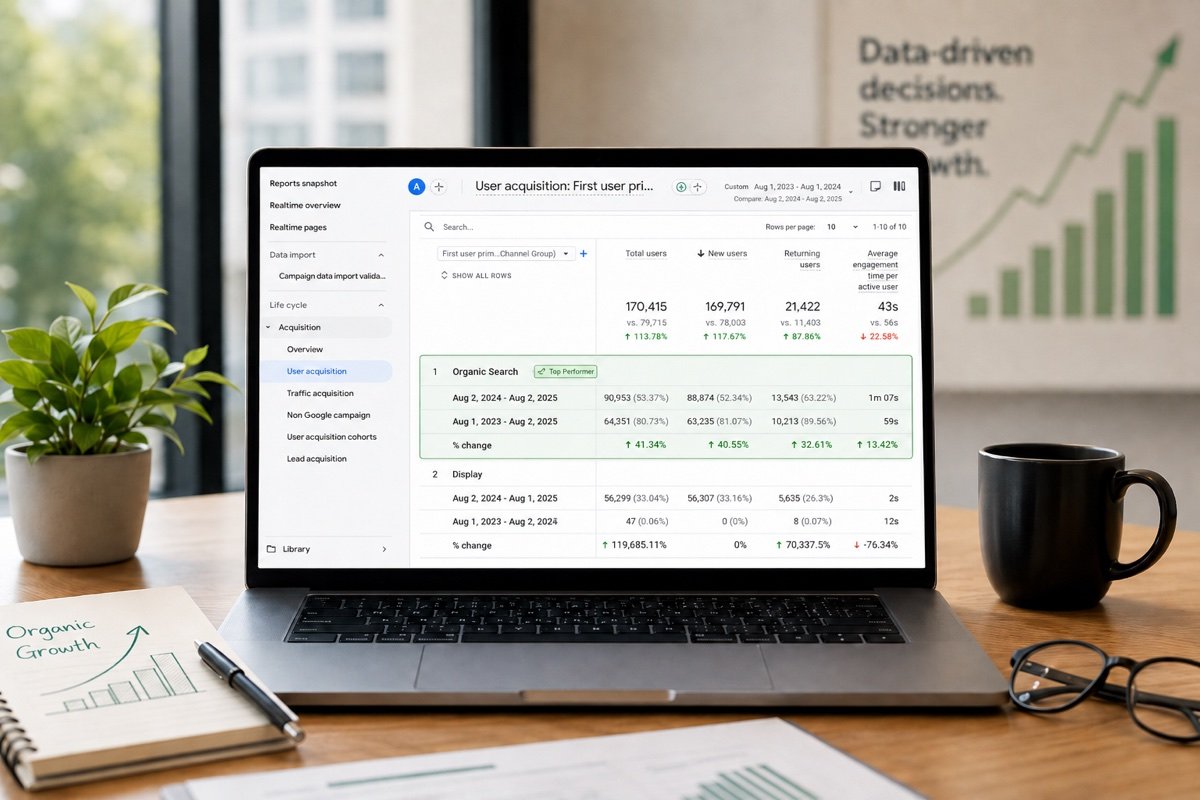
RadiantBiz helps founders and investors open companies in the UAE from Dubai. We targeted the decision-stage questions, free zone against mainland, licence and set-up costs, corporate banking and visa steps, and structured the site as service, jurisdiction and cost pages linking into the commercial pages. Organic users rose 41.34% year on year and organic became the account’s top channel.
Lead quality, and the leads you do not want
Set-up firms drown in bad enquiries. Students researching, people three countries away with no budget, founders who want a free zone licence for a mainland activity, and price shoppers running the same form on ten sites. Volume is not the problem in this category. Sorting is.
Ask four questions on the form and the sorting happens before a salesperson picks up the phone. Which activity, which jurisdiction you think you need, how many visas, and when you intend to start. The fourth question does most of the work, because a founder who answers this month behaves differently from one who answers next year.
If you run Google lead forms, turn on OTP verification. Google’s own help page describes it as a way to “Reach users in the right moment and use features like OTP Verification to ensure highly qualified prospects”. Also note the storage limits before you build a process around it, because Google stores leads for sixty days and the CSV download only covers the last thirty, so the webhook into your CRM is not optional.
Then score. Jurisdiction plus timeline plus visa count gives you a three-band score that tells the sales team who to call in the first hour and who goes into a nurture sequence.
What it costs to run this properly
₹75,000 plus GST a month is where most set-up firms start, which buys fifty tracked keywords. Thirty keywords at the ₹50,000 Starter tier does not stretch across four clusters, two or three jurisdictions and the adjacent services, and we would rather tell you that before you sign than after.
Firms running six or more jurisdictions, or both Arabic and English, belong at ₹1,25,000 for eighty keywords. The ₹2,00,000 resource-based tier puts two specialists on the account with the scope set in your brief, which suits a firm publishing weekly and running paid alongside.
AEO and GEO monitoring is included at every tier. Overseas clients can be billed in INR or USD at the conversion rate fixed in the agreement. The same team runs our B2B SEO accounts in India, and the method transfers almost unchanged because the buyer is the same kind of buyer.
What we changed on a Dubai set-up account
RadiantBiz is a business set-up consultancy in Dubai, and the work there went after decision-stage questions rather than the head term. Free zone against mainland. Licence and set-up costs. Corporate banking. Visa steps. Each of those became a page with figures on it, structured as service, jurisdiction and cost pages with internal links running into the commercial pages.
Organic users went from 64,351 to 90,953 year on year, up 41.34%, with new users up 40.55% and average engagement time per user up 13.42%, measured in Google Analytics 4 across August 2023-24 against August 2024-25. Organic search became the top-performing channel in the account, ahead of paid and display.
The head term on business set-up in Dubai was left to paid, deliberately. The organic first page there was already held by firms with far older domains, and the cost pages were converting better per visit anyway. Pick the fight you can win in the first two quarters, then take the head term with the authority those pages build.
Where set-up firms waste the money
Thirty near-identical free zone pages. They cannibalise each other, none of them ranks, and the time would have bought six pages that did. The test is simple. If you cannot write two hundred words about a zone that are not true of the zone next to it, do not give it a page.
No prices anywhere. A category where the buyer’s first question is cost, answered with a contact form. Every month we audit a set-up firm’s site and find the fee information sitting in a PDF behind an email gate.
Chasing the head term with content while ignoring the clusters underneath it. And measuring at the wrong level, counting form fills instead of counting which cluster produced a signed client. Tag the source cluster on every lead and three months later the content plan writes itself.
Our Dubai marketing team starts every set-up account with the same audit, which is a crawl, a keyword split into the four clusters, and a list of the pages that already exist and should not.
References
- Gulf News, 2,709 new member companies joined Dubai Chamber of Commerce in March 2026, 5 April 2026
- Government of the United Arab Emirates, Business section, accessed 11 October 2026
- UAE Federal Tax Authority, Value Added Tax, page last updated 16 May 2024
- Google Search Central, AI Features and Your Website, last updated 10 December 2025
- Google Ads Help, About lead form assets, accessed 11 October 2026
Frequently asked questions
How long does SEO take for a Dubai set-up firm?
Usually six to nine months before the cost and jurisdiction pages carry real volume, with the first movement on long process queries inside eight to twelve weeks. The cost pages take longest because that is where the competition is.
Should we write a page for every free zone?
Only for the zones you actually register in. If you cannot write two hundred words about a zone that are not equally true of the one next door, the page will cannibalise your others rather than add anything.
Do we need Arabic pages from day one?
No. Start with English, because that is where most commercial set-up search sits, then add Arabic on separate URLs once the English cluster is ranking. Arabic is the official language of the UAE, so it belongs on the roadmap, just not in month one.
What does this cost?
₹75,000 plus GST a month for fifty tracked keywords is where most set-up firms start. ₹50,000 covers thirty keywords, ₹1,25,000 covers eighty, and ₹2,00,000 puts two specialists on the account. Overseas clients can be billed in INR or USD at the conversion rate fixed in the agreement.
How do we stop junk enquiries?
Ask four questions on the form, which activity, which jurisdiction, how many visas and when you intend to start, then score the answers into three bands. If you use Google lead forms, switch on OTP verification and push leads to your CRM by webhook, because Google only keeps them for sixty days.
Can you show this working for a Dubai client?
Yes. RadiantBiz, a Dubai business set-up consultancy, went from 64,351 to 90,953 organic users year on year, up 41.34% in Google Analytics 4, with organic becoming the top channel ahead of paid and display.