





Updated 4 October 2026.
Practical buying guide
Build the website around product families, applications, technical documents and qualified enquiry paths, then use SEO to make those pages discoverable. Use this guide when briefing an web design company in India.
Chemical buyers often search by material, grade, application, property, standard or problem. A website needs a content model that can answer those routes without creating a thin page for every keyword variation.
The information architecture should connect product families, individual products, industries, applications, documents and contact paths. Each page needs a clear purpose and a stable owner for technical accuracy.
Search work starts during design, not after launch. URLs, templates, titles, internal links, document handling and migration rules affect how the new site is crawled and understood.
The aim is a site that helps technical buyers find, verify and enquire about the right product. That outcome gives the buying team a firmer basis than presentation style or an isolated headline metric.
Six building blocks for the website and search plan
For a chemical manufacturer website and SEO programme, ask every supplier for the same evidence and record the answer beside the scope.
A product information model
Define the fields every product needs, such as chemistry, grade, form, properties, applications, pack information and available documents. Request a content schema, naming rules, product relationships and an owner for each technical field.
Ask, “Which facts help a buyer confirm fit before making contact?” The answer should be specific enough to enter the scope, not left as a promise for later.
This keeps product pages consistent without making them identical. Give full credit only when the proposal identifies the owner, deliverable and review point.
Application routes for non-product searches
Some buyers begin with an industry, process or performance need rather than a known product name. Request application groups, buyer questions, linked products and source-backed technical explanations.
Ask, “Which application questions lead to the right product family?” The answer should be specific enough to enter the scope, not left as a promise for later.
This creates useful discovery routes.
Documents that remain searchable and current
Technical data, safety information and certificates need clear labels, dates, versions and links from the relevant product. Request a document register, update owner, expiry rule and stable public URL pattern.
Ask, “How will a buyer know this document is the current one?” The answer should be specific enough to enter the scope, not left as a promise for later.
This makes the document library usable for people and search systems.
Qualified enquiry paths
Forms should collect enough context for routing without asking the visitor to complete an internal specification sheet. Request product context, application, quantity range, market and a named routing owner.
Ask, “Which fields help the right commercial or technical person respond?” The answer should be specific enough to enter the scope, not left as a promise for later.
This improves the value of enquiries without adding needless friction.
Search-ready templates
Product and application templates need unique titles, headings, body fields, internal links and index controls. Request template rules, structured content fields, canonical behaviour and a quality threshold.
Ask, “What makes this page useful enough to stand alone in search?” The answer should be specific enough to enter the scope, not left as a promise for later.
This reduces duplicate or empty pages.
A migration and measurement plan
A redesign should preserve valuable URLs, redirect retired pages and record the pre-launch search baseline. Request URL inventory, redirect map, analytics events, Search Console data and launch checks.
Ask, “Which existing pages and documents already earn useful discovery?” The answer should be specific enough to enter the scope, not left as a promise for later.
This protects known value while the new structure goes live.
Map each buyer need to a page type
The model should stay small enough to manage and detailed enough to answer a technical buyer.
| Area | Evidence to request | What it tells you |
|---|---|---|
| Product family | Range, selection logic and linked products | Buyer comparing options |
| Product detail | Properties, uses, documents and enquiry context | Buyer verifying fit |
| Application | Problem, requirements and relevant products | Buyer starting from a use case |
| Document hub | Current files with dates and product links | Technical or procurement review |
| Contact path | Product and application context in the form | Qualified routing |
Score the evidence on a simple zero-to-two scale: absent, partly defined or ready to place in the agreement. Discuss the lowest-scoring operating areas before reopening the price conversation.
Build search requirements into the redesign
Inventory products, pages and files
List current URLs, product records, PDFs, images, traffic and enquiries before deciding the new navigation.
The inventory reveals duplicate names, missing fields, outdated documents and pages that already earn search visibility.
Prototype the content model
Create one product-family page, one product page and one application page using real information before designing every template.
Technical, sales and search reviewers can then correct the model while change is still inexpensive.
Write the migration map
Match every retained, merged and retired URL to its destination, and preserve useful document links where possible.
Test the map in staging and again after release so search users and existing customer bookmarks reach a useful page.
Measure qualified discovery
Track organic landings by page type, document use, product-context enquiries and accepted sales conversations.
Use those observations to improve fields, internal paths and missing application coverage after launch.
What the written recommendation should contain
A recommendation for a chemical manufacturer website and SEO programme should begin with the business problem, the evidence reviewed and the constraint selected for action. It should explain how A product information model and Application routes for non-product searches affect the proposed scope, with a named owner for every material handoff.
The document should repeat the central direction in plain language: Build the website around product families, applications, technical documents and qualified enquiry paths, then use SEO to make those pages discoverable. It should then state the deliverables, review dates, approval route and commercial assumptions that make the direction workable. This is also the place to define what counts as completed work and which record will be used at the review meeting.
Evidence should sit beside each recommendation rather than in an appendix that nobody can trace. Connect Search-ready templates with the agreed measurement view, and connect A migration and measurement plan with the person who will use the finding. The final document should create a site that helps technical buyers find, verify and enquire about the right product, while leaving the team with a clear reason for the next allocation of time and money.
Budget the website and SEO as connected scopes
DigiStreet websites start at ₹1,00,000. The final website scope should state templates, product migration, document handling, forms, integrations, content entry and redirect work.
SEO Starter is ₹50,000 plus GST a month for up to 30 keywords, Growth is ₹75,000 for up to 50 and Scale is ₹1,25,000 for up to 80. Resource-based delivery is ₹2,00,000 for two dedicated specialists.
AEO and GEO visibility monitoring is included in every SEO tier. For a chemical manufacturer, the useful scope is defined by product families, application areas, markets, source documents and the people available to approve technical content.
Put the selected commercial model beside the deliverables, approval responsibilities and reporting period. A price is ready for approval when the team can explain exactly what changes if volume, rights, markets or channel responsibility changes.
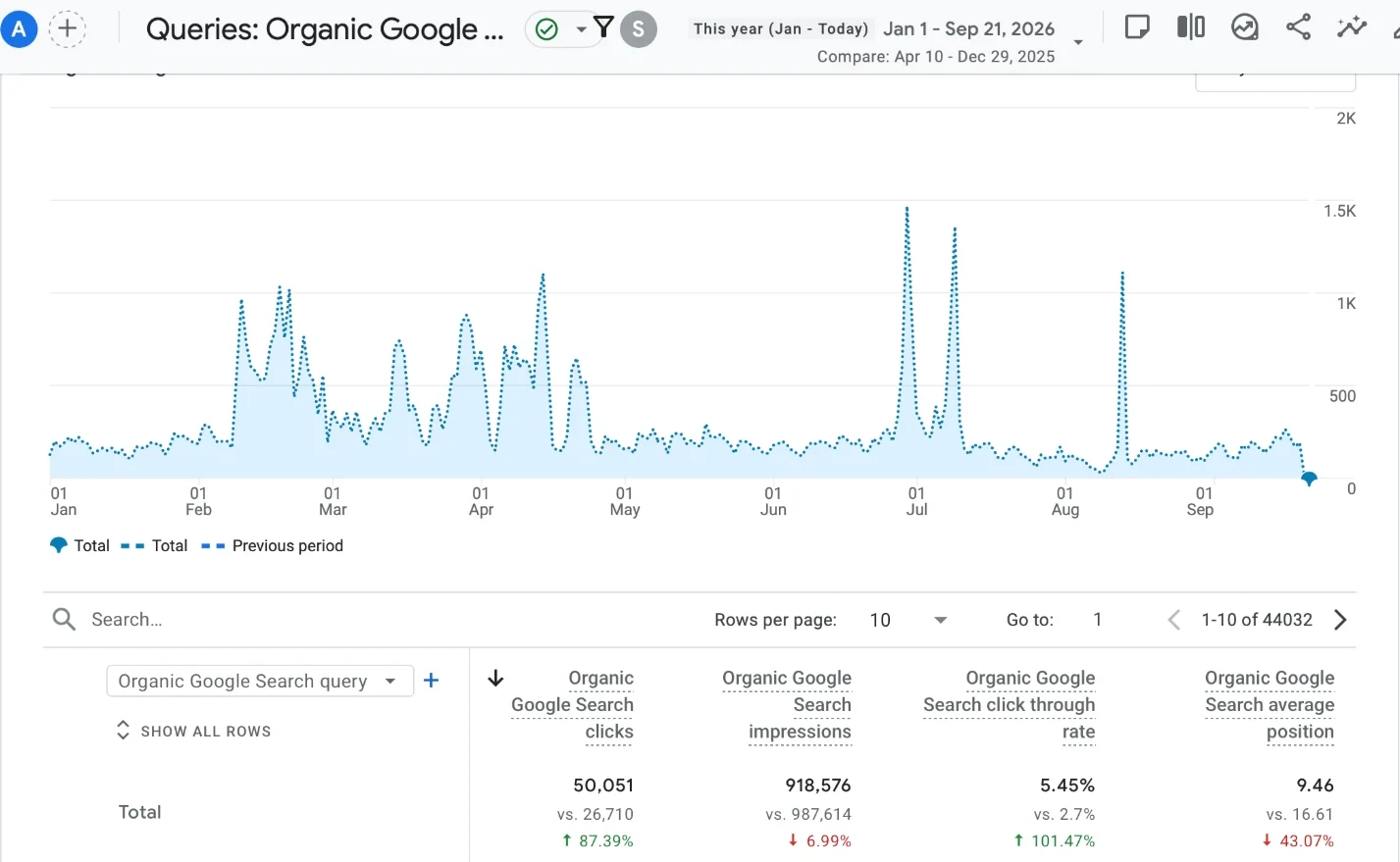
Use sector-relevant search evidence
The Sirca Paints chart above is a real search case-study asset from a materials-led brand. It gives a reviewer a dated surface for discussing pages, queries and site changes rather than relying on a generic manufacturing claim.
A manufacturer should request the same level of context for website examples: the original brief, product depth, document model, mobile layouts and the enquiry path that users actually received.
Continue with the source material
Use the linked service, cost and case pages to verify scope details and inspect the work behind the examples.
Frequently Asked Questions
What pages does a chemical manufacturer website need?
It needs a manageable set of product-family, product, application, document, company and contact pages based on the actual catalogue and buyer routes.
Should every chemical grade have its own page?
Only when the grade has enough distinct, approved information and search or buyer value to support a useful standalone page.
How should technical documents be handled?
Use current versions, dates, clear labels, stable links and direct connections to the relevant product pages.
When should SEO start in a website redesign?
It should start during discovery, before navigation, templates and URLs are fixed. Migration and measurement also need pre-launch work.
What does a chemical manufacturing website cost?
DigiStreet websites start at ₹1,00,000, with the final scope shaped by templates, catalogue depth, documents, migration, integrations and content entry.
What does ongoing SEO cost?
DigiStreet SEO starts at ₹50,000 plus GST a month, with Growth at ₹75,000, Scale at ₹1,25,000 and resource-based delivery at ₹2,00,000.
Put the decision into a clear brief
Share the objective, market, current evidence and the decision date. We will answer with a defined scope and the published commercial model.