A business website starts at ₹1,00,000 plus GST with us, and that is the entry price for a basic CMS site, not a typical bill. A B2B site starts at ₹1,75,000, a corporate site at ₹2,25,000 and an ecommerce store at ₹2,50,000. Every one of those is a starting price, and the final quote moves with what you ask the site to do.
This guide explains the four packages, what pushes a quote up, what is left out unless it is written in, and how to choose between WordPress, Shopify and custom. The scope sits on our website development page. We have not listed typical page counts or turnaround times here, because we do not quote either before we have seen your content and your approval process.
The four packages and what they cover
The price depends on the job the site has to do. A company site, an online store and a business portal solve different problems, so we sort the packages by that job and not by number of pages.
| Package | Starting price (plus GST) | What it covers | Who it suits |
|---|---|---|---|
| Basic CMS website | ₹1,00,000 | Responsive layouts, core business pages, a contact route and CMS handover | A clear business presence with content your own team can manage |
| B2B website | ₹1,75,000 | Product or solution architecture, relevant proof, an enquiry or RFQ route and core analytics | Considered buying decisions, technical products and qualified enquiries |
| Corporate website | ₹2,25,000 | Corporate information architecture, reusable CMS components and routes for different stakeholders | Established organisations with several audiences or business verticals |
| Ecommerce website | ₹2,50,000 | Catalogue, product pages, cart, checkout and agreed payment and shipping setup | A connected store, with product pages leading into checkout |
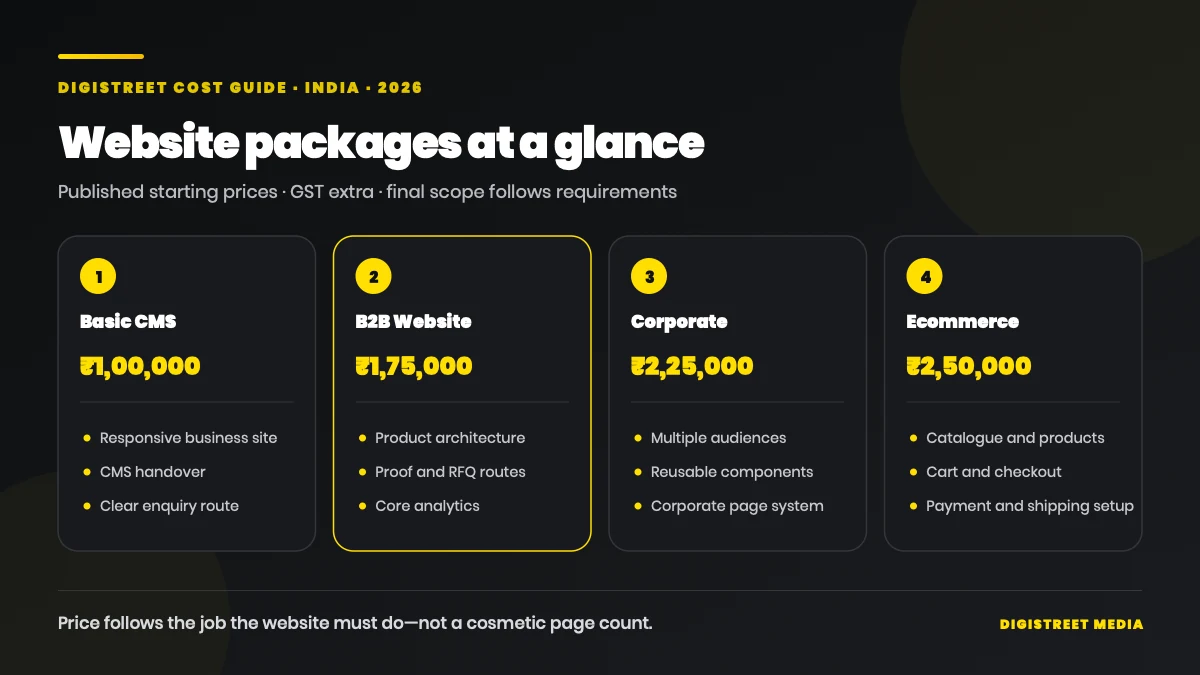
Some simple arithmetic on the gaps, using only the published prices. The B2B package starts ₹75,000 above the basic one. Corporate starts ₹1,25,000 above it and ecommerce ₹1,50,000 above it. Those gaps buy structure: product architecture and an RFQ route, reusable components for several audiences, or a catalogue with checkout. They are not a charge for looking more impressive.
The floor is also worth knowing. No package engagement with us starts below ₹75,000 plus GST, and a complete website starts at ₹1,00,000 plus GST. If someone quotes you much less for a full site, ask what has been left out.
What moves the final quote
Four things move it, and you control most of them.
Pages and features. More page types, more templates and more features mean more design and build work. A site with five page types and a contact form is a different job from one with a product finder, a dealer locator and gated downloads.
Content readiness. If your copy, product details and images exist and are approved, the build runs on its own schedule. If they do not, someone has to produce them, and either you pay for it or you wait for your own team. Review speed and content readiness affect the schedule as much as the design does.
Catalogue size. For a store, the number of products and variants decides how much setup and testing there is. A handful of products with simple variants is quick to set up and test. Thousands of products with attributes, filters and stock rules are a project of their own.
Integration complexity. Connecting to a payment gateway is routine. Connecting to your CRM or ERP means checking available APIs, authentication, data ownership and what happens when a sync fails. We scope integrations after reading the documentation, and they are included only when the proposal lists them.
What is not in the price unless it is listed
Hosting, paid licences, substantial content or asset production, third-party tools, complex integrations and ongoing maintenance are included only when expressly listed. That is how the quote is written, and you should hold any agency to the same standard.
In practice, it means you should ask about each line. Who pays for hosting, and in whose name is the account? Does the theme or plugin need a licence, and who renews it? If the site needs a hundred product photographs or a brand video, is that in the quote or extra? Who keeps the site updated and patched after launch? Software needs updates, backups and monitoring, and those jobs do not vanish because the launch went well. We scope maintenance separately, and we plan it before launch and not after the first problem.
We do not publish a standard hosting fee or a maintenance fee, and we have no flat price for a redesign as a separate product. Both are quoted against your site.
WordPress, Shopify or custom
Choose the platform from the job, content ownership and how your team works, not from what is fashionable.
WordPress and other CMS options suit content that changes regularly, such as services, corporate pages or articles. The questions that matter are the content structure, how easy it is for your team to edit, permissions, security and maintenance. How many plugins can be installed is not one of them.
For selling online, Shopify and WooCommerce are the two usual routes, and the right one depends on catalogue complexity, how you run operations and which integrations you need. Settle stock, payments, shipping, taxes and who owns the store before you approve a storefront design. A pretty storefront that cannot handle your tax setup is expensive to fix.
Custom development makes sense when your workflows, data or integrations cannot be handled sensibly by a standard platform. It also needs decisions on architecture, authentication, hosting, monitoring and long-term maintenance, so it costs more to decide as well as to build.
We cannot tell you which platform wins before we know your catalogue and operations, and nobody honest can. We would rather spend an hour on that in discovery than sell you a platform first.
Redesigns and keeping your search visibility
A redesign can lose traffic if it changes URLs carelessly, so the old site gets reviewed before the new one is designed. We look at which pages and entry points carry value, agree which ones to keep, map old URLs to the right new pages, and test forms and tracking before switching over.
That reduces avoidable damage. It does not guarantee rankings, and anyone who promises that a new design will hold or lift your position is guessing. Migration decisions belong in discovery, not in a hurried launch checklist.
Who owns the website
You should. Ownership, source files, platform accounts, licences and access are written into the proposal and the handover. We recommend that business accounts, such as your domain, hosting, analytics and store, sit in your name, and that any third-party dependency is written down from the start. If an agency holds your domain, changing agency becomes a negotiation.
What a website does for SEO, and what it does not
A good build gives search a fair start. During the build we agree page titles, meaningful URLs, content structure, internal links, indexation and suitable markup. Measurement is planned around the enquiries or purchases that matter, with suitable consent and data handling.
Those are foundations. They support discovery, but they do not replace ongoing content, authority or campaign work. Ongoing SEO, answer-engine optimisation and generative-engine optimisation are separate scopes, and technical readiness does not guarantee rankings or AI citations. Our SEO, AEO and GEO services start at ₹50,000 plus GST a month.
For a sense of what the ongoing work looks like on a store, our Pravek SEO case study reports that clicks from Google Search rose 19% to 6.18K in the latest quarter, with average position at 9.3. That result came from a continuing SEO programme and not from a site build. If you sell online, ecommerce SEO and ecommerce marketing are where that conversation continues.
Apps are scoped separately
A mobile app is a separate product, not a feature assumed inside a website package. Its screens, backend, access rules and maintenance differ from a marketing site. Our app tiers start at ₹75,000 plus GST for a progressive web app, and we explain how they are priced in our app development cost guide. Custom software and portals sit under web application development.
What to bring to the first conversation
Bring your current website if there is one, the audiences that matter most, your core products or services, brand assets, the people who own the content and the tools the site must connect to. With those, we can say what can be kept, what needs changing and which dependencies belong in the proposal. Without them, any quote is a guess, ours included.
Corporate and industrial sites such as Jakson, Roto Pumps and Indus Towers appear in the portfolio on our website page, and each has a different structure because the audiences differ. Looking at them tells you more about fit than any package name does.
Frequently Asked Questions
How much does a business website cost in India?
With us, a basic CMS website starts at ₹1,00,000 plus GST. A B2B site starts at ₹1,75,000, a corporate site at ₹2,25,000 and an ecommerce site at ₹2,50,000, all plus GST. These are starting prices, and the final quote follows pages, features, content, catalogue size and integrations.
What does an ecommerce website cost?
Our ecommerce package starts at ₹2,50,000 plus GST and covers the catalogue, product pages, cart, checkout and agreed payment and shipping setup. A larger catalogue and more integrations raise the quote, and paid licences and third-party tools are extra unless listed.
What is not included in the website price?
Hosting, paid licences, substantial content or asset production, third-party tools, complex integrations and ongoing maintenance are included only when the proposal lists them. Ask for each one by name so nothing is assumed.
Should I choose WordPress, Shopify or a custom website?
Choose from the job. WordPress suits content-led sites, ecommerce platforms such as Shopify or WooCommerce suit online selling, and custom suits workflows a standard platform cannot handle. We make the trade-offs explicit in discovery before anything is built.
Can I keep my search visibility when I redesign my website?
You can reduce the risk, but not remove it. We review valuable pages, map old URLs to the right new ones and test before launch. Rankings cannot be guaranteed, though a planned migration avoids the damage that comes from changing URLs without a plan.
Does a new website include SEO?
It includes agreed technical and on-page foundations. Ongoing SEO, AEO and GEO are separate scopes, and our SEO services start at ₹50,000 plus GST a month. Technical readiness does not guarantee rankings or AI citations.
Who owns the website and the accounts?
You should. Ownership, source files, platform accounts, licences and access are written into the proposal and handover, and we recommend client-controlled accounts for your domain, hosting and analytics.
References
- DigiStreet Media, Website Development Company in India, packages, exclusions and FAQs, checked 3 October 2026.
- DigiStreet Media, Pravek SEO case study, Q3 2026 update, from Google Search Console.
- DigiStreet Media, SEO, AEO and GEO services, plan pricing.