

A brand ranks comfortably for its English keywords, sees decent traffic, and assumes the Saudi market is handled. Then a competitor with a fraction of the marketing budget shows up above them for the exact Arabic search term that actually drives purchase decisions in Riyadh. That gap is rarely a budget problem. It is almost always an Arabic SEO problem, and it is one of the most common, most fixable mistakes brands make when they treat Saudi Arabia as an English-first market with an Arabic afterthought.
Riyadh alone behaves nothing like a single homogeneous search audience. Government and enterprise decisions happen there, Jeddah is where consumer brands typically test new ideas first, and the Eastern Province around Dammam runs on an entirely different industrial and energy-driven search pattern. A campaign built for one of these cities and quietly copied across all three usually underperforms in at least two of them.
Mistake one: treating Arabic as a translation, not a language of its own
Google can tell the difference between original Arabic content and content that has been translated from an English source, and it ranks the two very differently. A page that reads like it passed through a translation tool, with sentence structures borrowed from English rather than written the way a Saudi reader actually speaks, rarely earns the trust signals a native page does.
This mistake shows up constantly in service and product pages that were clearly written in English first. The fix is not to become a better translator. It is a native Arabic content process built from the keyword research stage onward, so the Arabic page targets how Saudi searchers actually phrase a query rather than a literal rendering of the English one.
Mistake two: running one SEO strategy across two languages
Arabic and English searches in Saudi Arabia often target different intent entirely, even when the underlying product or service is identical. A brand that builds one keyword list, translates it, and calls the job done misses the fact that these are effectively two separate audiences sharing one market.
Digistreet’s approach to this treats Arabic and English as two coordinated but distinct SEO programmes, built on a shared technical foundation but with separate keyword research, separate content calendars, and separate performance tracking. This matters most for enterprise and government-adjacent brands based in Riyadh, where the English-speaking decision maker and the Arabic-speaking end user may be searching for the same solution using completely different terms.
Mistake three: ignoring hreflang and technical signals that confuse Google
A site running both Arabic and English versions without correctly implemented hreflang tags risks Google showing the wrong version to the wrong audience, or worse, treating the two as duplicate content competing against each other. Right-to-left layout also needs genuine technical attention rather than a CSS patch, since a broken RTL experience on mobile pushes Saudi visitors away fast in a market where mobile search dominates far more heavily than desktop.
A .sa domain is not mandatory for ranking well in Saudi Arabia, but the technical fundamentals underneath it are non-negotiable regardless of domain choice. Clean hreflang implementation, correctly structured RTL pages, and fast load times on mobile matter more to Google.sa rankings than the domain extension itself.
Mistake four: writing generic content instead of Vision 2030-aware content
Saudi Arabia’s economy has opened entirely new search categories over the past few years as Vision 2030 has unlocked sectors that barely existed commercially before, including entertainment, tourism, and expanded private-sector professional services. Brands that keep publishing the same generic category content miss a genuine window, since these newer sectors currently carry far less established competition than mature categories.
Content that references specific Saudi regulatory changes, sector developments, or local business context signals real market expertise to both readers and Google’s trust systems. A generic “why choose us” page reads the same in every country. A page that clearly understands what has actually changed in the Saudi market this year reads like it was written by someone who operates there.
Mistake five: building authority signals that mean nothing locally
Backlinks and citations carry different weight depending on where they come from, and this matters more in Saudi Arabia than many marketers assume. Links and mentions from Saudi-domain sources, Saudi business directories, and recognised Saudi publications carry meaningfully more local authority than an equivalent link from an unrelated international site.
Brands chasing generic global backlinks while ignoring Saudi-specific citation sources are building authority that Google’s local ranking signals barely register. This is a slower fix than the technical mistakes above, but it compounds steadily once addressed properly.
What fixing this actually looks like
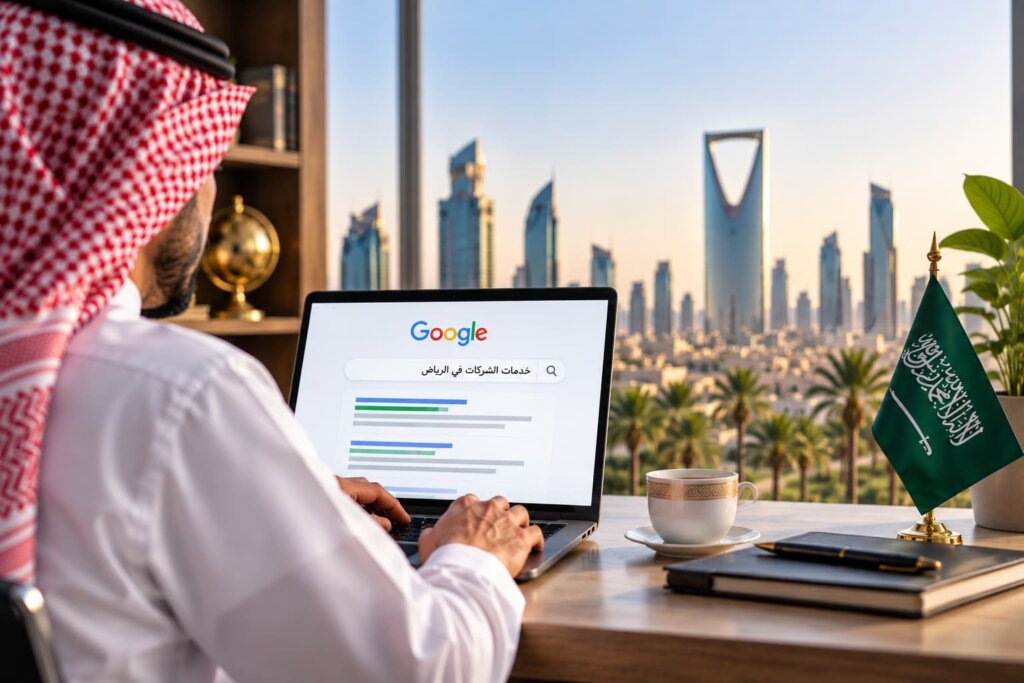
None of these mistakes require rebuilding a brand from scratch. They require treating Arabic search as its own discipline rather than a checkbox next to the English site, and Digistreet has built exactly this kind of dual-language SEO approach for brands operating across Riyadh, Jeddah, and the wider Kingdom, detailed further in its broader look at digital marketing across the GCC.
A brand losing ground to competitors on Google.sa rarely needs a bigger budget first. It usually needs an honest audit of whether its Arabic presence was ever built properly in the first place.
Where to look next
| Resource | What’s there |
| Digital marketing agency in Saudi Arabia | GCC-wide approach covering Saudi Arabia and neighbouring markets |
| Digital marketing across the GCC | City-by-city breakdown of Riyadh, Jeddah, Dammam, and other GCC markets |
| SEO services | Technical SEO and content approach behind the Arabic and English programmes |
| Digistreet LinkedIn | Recent GCC project updates |
FAQs
Why does translated Arabic content rank worse than original Arabic content?
Google can detect translated sentence structures, and translated pages often fail to match how Saudi searchers actually phrase queries. Native Arabic content built from keyword research upward performs noticeably better.
Should a brand target Riyadh, Jeddah, and Dammam the same way?
No. Riyadh skews toward enterprise and government decision-making, Jeddah toward consumer brand testing, and Dammam toward industrial and energy sectors, so content and keyword strategy should reflect that.
Is a .sa domain required to rank in Saudi Arabia?
No. A .com domain with correct hreflang tags, strong Arabic content, and proper technical SEO can outperform a .sa domain with weak fundamentals.
Do Arabic and English SEO need separate keyword strategies?
Yes. Search intent often differs between the two languages even for the same product, so treating them as one translated strategy usually underperforms.
How does Vision 2030 affect SEO opportunities in Saudi Arabia?
It has opened new search categories with less established competition, giving early movers in sectors like entertainment, tourism, and expanded professional services a real ranking window.
Do backlinks from outside Saudi Arabia still help local rankings?
They help less than links and mentions from Saudi-domain sources, local directories, and recognised Saudi publications, which carry stronger local authority signals.