




Practical buying guide
Put the first ₹3 lakh into one clear learning plan: four Growth months for SEO, or two PPC months with ₹1,00,000 media and a ₹50,000 management fee each month, plus GST. Use this guide when briefing an SEO services.
Choose the SEO path when the site has durable commercial topics, weak organic coverage and enough time to build useful pages. Choose the PPC path when search demand already exists and the business can answer leads quickly.
Do not divide a small starting budget by habit. A thin allocation across both channels can leave PPC without enough learning and SEO without enough implementation time.
The useful question is which uncertainty needs answering first. PPC can test queries, offers and page response quickly. SEO can build durable pages and reveal technical or content gaps that paid traffic alone will not repair.
The aim is evidence about search demand, conversion quality and the channel that deserves the next allocation. That outcome gives the buying team a firmer basis than presentation style or an isolated headline metric.
Six conditions that decide the first channel
For the first ₹3 lakh search budget decision, ask every supplier for the same evidence and record the answer beside the scope.
Demand is already expressed in search
PPC has a stronger starting case when buyers use specific commercial queries and the offer can compete on the results page. Request keyword themes, search-term evidence, current enquiry language and a clear geographic market.
Ask, “Are people already searching for this offer in words we can target?” The answer should be specific enough to enter the scope, not left as a promise for later.
This tests whether paid search can meet existing demand. Give full credit only when the proposal identifies the owner, deliverable and review point.
The website can convert paid visits
A clear page, a working form or call path and prompt follow-up are needed before buying more traffic. Request mobile page checks, conversion events, form tests and sales response ownership.
Ask, “What happens in the ten minutes after a qualified enquiry arrives?” The answer should be specific enough to enter the scope, not left as a promise for later.
This protects the media test from an avoidable page or response failure.
Organic topics have lasting value
SEO has a stronger case when product, category and problem pages will remain useful beyond one campaign window. Request a topic-to-page map, existing ranking baseline and content gaps tied to commercial intent.
Ask, “Which pages would still help buyers a year from now?” The answer should be specific enough to enter the scope, not left as a promise for later.
This identifies assets worth building once and improving over time.
Technical work is blocking discovery
Indexing, duplicate pages, internal links and weak templates can hold back every organic topic. Request crawl findings, index coverage, canonical checks and a ranked implementation list.
Ask, “Which technical issues affect the largest group of commercial pages?” The answer should be specific enough to enter the scope, not left as a promise for later.
This gives the SEO budget an implementation target.
Sales can classify lead quality
Both channels improve when the team records accepted, rejected and progressed enquiries with reasons. Request CRM stages, rejection reasons, source fields and a weekly feedback owner.
Ask, “How will marketing learn which enquiries were commercially useful?” The answer should be specific enough to enter the scope, not left as a promise for later.
This moves the decision past click and form totals.
The business can sustain the next step
The first ₹3 lakh should create a decision, and the team needs capacity to continue the winning work. Request a follow-on budget range, responsible owners and the decision date.
Ask, “What evidence releases the next allocation?” The answer should be specific enough to enter the scope, not left as a promise for later.
This keeps the first spend from becoming an isolated experiment.
Two exact ways to use ₹3 lakh
Both examples use DigiStreet’s published pricing and exclude GST.
| Area | Evidence to request | What it tells you |
|---|---|---|
| SEO Growth | ₹75,000 a month for 4 months | ₹3,00,000 |
| PPC media | ₹1,00,000 a month for 2 months | ₹2,00,000 |
| PPC management | ₹50,000 a month for 2 months | ₹1,00,000 |
| PPC combined | Media plus management for 2 months | ₹3,00,000 |
Score the evidence on a simple zero-to-two scale: absent, partly defined or ready to place in the agreement. Discuss the lowest-scoring operating areas before reopening the price conversation.
Set a decision rule before spending
Write the commercial question
For PPC, the question may be which query and offer produce accepted enquiries. For SEO, it may be which commercial page groups deserve sustained build effort.
Keep the question narrow enough that the team can answer it with the chosen time and budget.
Record the starting point
Save current search visibility, enquiries, landing-page conversion events, sales outcomes and the pages already available.
A baseline prevents later reviews from comparing a campaign period with memory.
Protect the implementation time
Reserve page, analytics, creative and sales-team time before the first campaign or SEO sprint begins.
Money without implementation capacity creates incomplete tests and inconclusive reports.
Hold the next allocation meeting
Use the agreed date to review accepted leads, search terms, page changes, organic movement and work completed.
Choose the next spend from the evidence gathered rather than switching channels because one weekly number moved.
What the written recommendation should contain
A recommendation for the first ₹3 lakh search budget decision should begin with the business problem, the evidence reviewed and the constraint selected for action. It should explain how Demand is already expressed in search and The website can convert paid visits affect the proposed scope, with a named owner for every material handoff.
The document should repeat the central direction in plain language: Put the first ₹3 lakh into one clear learning plan: four Growth months for SEO, or two PPC months with ₹1,00,000 media and a ₹50,000 management fee each month, plus GST. It should then state the deliverables, review dates, approval route and commercial assumptions that make the direction workable. This is also the place to define what counts as completed work and which record will be used at the review meeting.
Evidence should sit beside each recommendation rather than in an appendix that nobody can trace. Connect Sales can classify lead quality with the agreed measurement view, and connect The business can sustain the next step with the person who will use the finding. The final document should create evidence about search demand, conversion quality and the channel that deserves the next allocation, while leaving the team with a clear reason for the next allocation of time and money.
What the published rates mean for the choice
DigiStreet SEO Starter is ₹50,000 plus GST a month for up to 30 keywords, Growth is ₹75,000 for up to 50, Scale is ₹1,25,000 for up to 80, and resource-based delivery is ₹2,00,000 for two dedicated specialists.
Google Ads management is the higher of 15% of monthly media spend or ₹50,000, plus GST. At ₹1,00,000 monthly media, the ₹50,000 minimum applies, which creates the two-month ₹3 lakh example above.
If the conditions point clearly to one channel, concentrate the first allocation there. Add the second channel when the first has produced a stable page, measurement and sales-feedback base that the next channel can use.
Put the selected commercial model beside the deliverables, approval responsibilities and reporting period. A price is ready for approval when the team can explain exactly what changes if volume, rights, markets or channel responsibility changes.
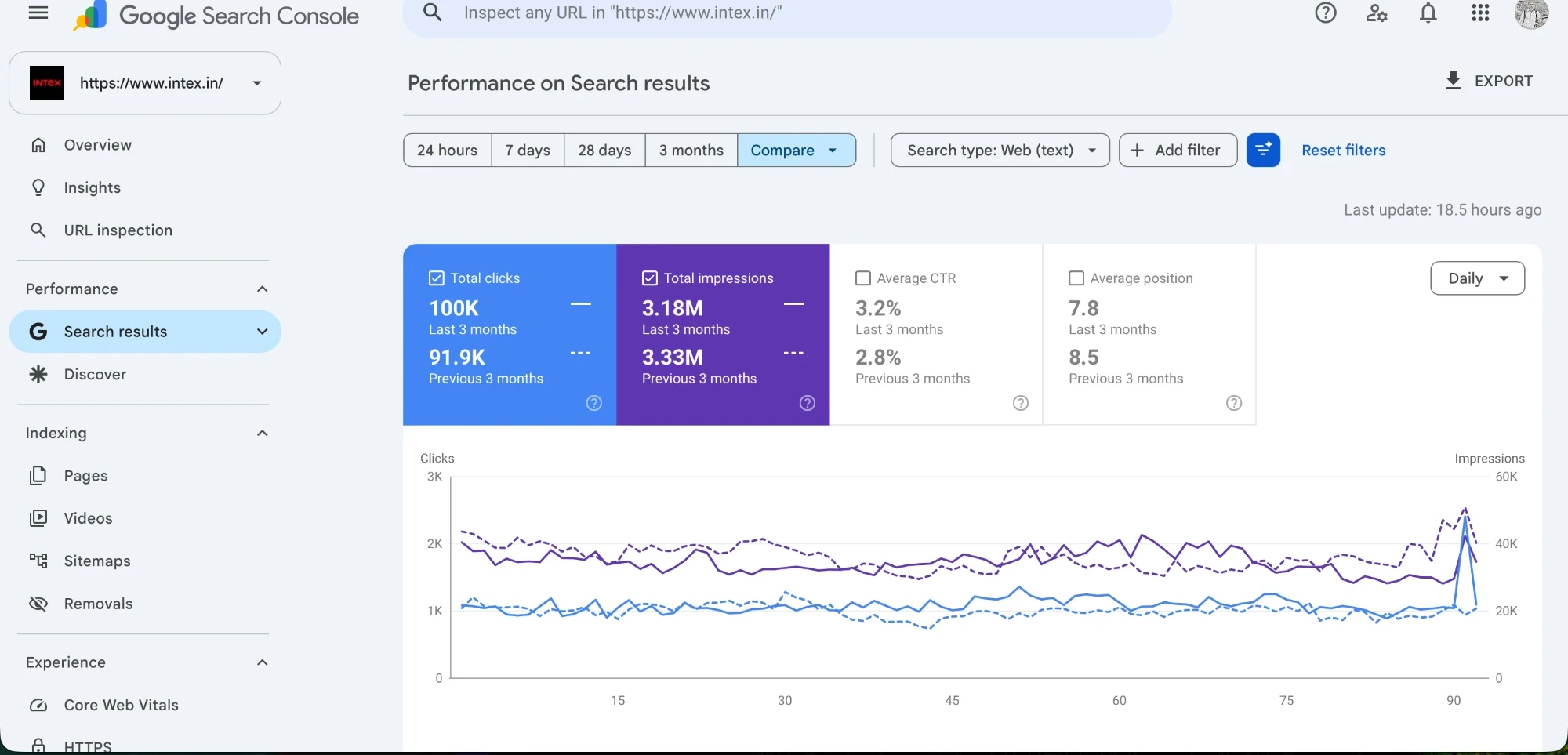
Organic evidence needs a dated chart
The Intex Search Console chart above is the kind of case evidence an SEO buyer should inspect. It shows a real measurement surface and date range rather than a detached percentage.
For PPC, request the parallel operating view: search terms, spend, conversion definitions and accepted-lead feedback for the same period. The formats differ, but both need enough context to review.
Continue with the source material
Use the linked service, cost and case pages to verify scope details and inspect the work behind the examples.
Frequently Asked Questions
Should a new business start with SEO or PPC?
Start with PPC when proven search demand and a ready conversion path need testing; start with SEO when durable commercial coverage and site quality are the larger gap.
Can ₹3 lakh fund both SEO and PPC?
It can, but a split may weaken the learning period. The examples above concentrate the money so one channel can be judged properly.
How long does the ₹3 lakh SEO example run?
It funds four months of the ₹75,000 Growth plan, excluding GST. The work should be reviewed against the baseline and completed page priorities.
How long does the ₹3 lakh PPC example run?
It funds two months with ₹1,00,000 media and ₹50,000 management each month, excluding GST.
What should be measured before choosing again?
Measure accepted leads, search terms, conversion quality, page changes, organic visibility and the work completed during the agreed period.
When should the second channel be added?
Add it when the first channel has produced stable measurement, usable pages and enough evidence to define the second channel’s job.
Put the decision into a clear brief
Share the objective, market, current evidence and the decision date. We will answer with a defined scope and the published commercial model.