




What a real estate lead actually costs in India, with our own numbers
Updated 28 October 2026.
A Meta lead for a Lucknow housing project cost us between ₹209 and ₹358 across 8,425 leads in 2024. By July 2026 the same work cost ₹925 a lead, and only 14.6% of those leads were warm or hot. Both numbers are true, and only one of them matters to a sales team. Here is the full data set.
The numbers, before the explanation
Across six reported months of 2024 we generated 8,425 Meta leads for Jashn Realty in Lucknow at a cost per lead of ₹248 in June, ₹230 in July, ₹233 in August, ₹310 in September, ₹358 in November and ₹209 in December. Google leads over July to September 2024 ran dearer, between ₹505 and ₹698.
Two years on, the same account looks different. In May 2026, 347 leads reached the CRM and only 7.2% of them were marked warm or hot, with our best campaign landing a qualified lead at ₹2,410. By July 2026 we were buying 130 leads at ₹925 each, 14.6% were warm or hot, and the best campaign produced 58 leads at ₹539.
We have run this account since 2024 and more than 500 units have been booked over that period. The reason we publish the dearer numbers alongside the cheap ones is that ₹209 a lead is a number for a dashboard, and ₹2,410 a qualified lead is a number for a budget.
A lead and a qualified lead are different products
A lead is a name, a number and a tick box. A qualified lead is somebody a salesperson has spoken to who has the budget, the city and the timeline to buy. In our Jashn data the ratio between them was 1 in 14 in May 2026 and roughly 1 in 7 by July 2026.
That ratio is the whole game. A campaign at ₹250 a lead with a 5% qualification rate costs ₹5,000 a qualified lead. A campaign at ₹900 a lead with a 20% qualification rate costs ₹4,500. The second one looks far worse in the platform and is cheaper in reality.
Agencies report the first number because it is available on day one. The second number needs the developer’s CRM to send outcomes back, which is work, and it is the only reporting we will sign up to on a real estate account.
| Month | Platform | Cost per lead | Warm or hot share | What it tells you |
|---|---|---|---|---|
| June 2024 | Meta | ₹248 | Not tracked then | Short form, broad audience, cheap volume |
| July 2024 | Meta | ₹230 | Not tracked then | Best Meta month of the year |
| August 2024 | Meta | ₹233 | Not tracked then | Stable, same creative set |
| September 2024 | Meta | ₹310 | Not tracked then | Cost rose as creative aged |
| November 2024 | Meta | ₹358 | Not tracked then | Festive auction, dearest month |
| December 2024 | Meta | ₹209 | Not tracked then | Cheapest month, year-end offer hook |
| May 2026 | Meta and Google | Best campaign ₹2,410 per qualified lead | 7.2% of 347 CRM leads | Volume without qualification |
| July 2026 | Meta and Google | ₹925 (best campaign ₹539 for 58 leads) | 14.6% | Fewer, dearer, twice as likely to be real |
Why cost per lead on its own misleads
Cheap leads are easy to buy. Ask for a form with two fields, run it on a broad audience with a discount hook, and the cost per lead falls. The leads are mostly people who will answer a call once and never again.
The 2024 figures above sit in the ₹209 to ₹358 band partly because that is what a well-run Meta lead campaign cost in 2024 and partly because the form was short. The 2026 figures are higher because the forms got longer and the targeting got narrower, deliberately.
The auction has moved too. Meta’s own filing for the June 2026 quarter puts the average price per ad 12% above the year before, on 14% more impressions. Some of the gap between ₹209 and ₹925 is us tightening the funnel, and some of it is the price of attention going up.
What actually moves the number
City first. A lead in Lucknow is not priced like a lead in Gurugram, where more developers bid for the same square kilometre and ticket sizes are larger. ANAROCK data reported by Business Today on 5 October 2026 puts Delhi NCR’s average primary-market rate at ₹9,980 per square foot in Q3 2026, up 12% year on year, against 13,765 units sold, down 1%. Higher prices and flat volumes mean more marketing money chasing the same buyers.
Project stage second. A pre-launch with a price advantage and no RERA number to show gets cheap, curious leads. A ready-to-move tower at a known price gets fewer, better ones.
Then creative and the form. The hook decides who clicks, the form decides who gets through, and a single extra question (budget band, or whether the buyer is in the city) can halve lead volume and double the qualified rate.
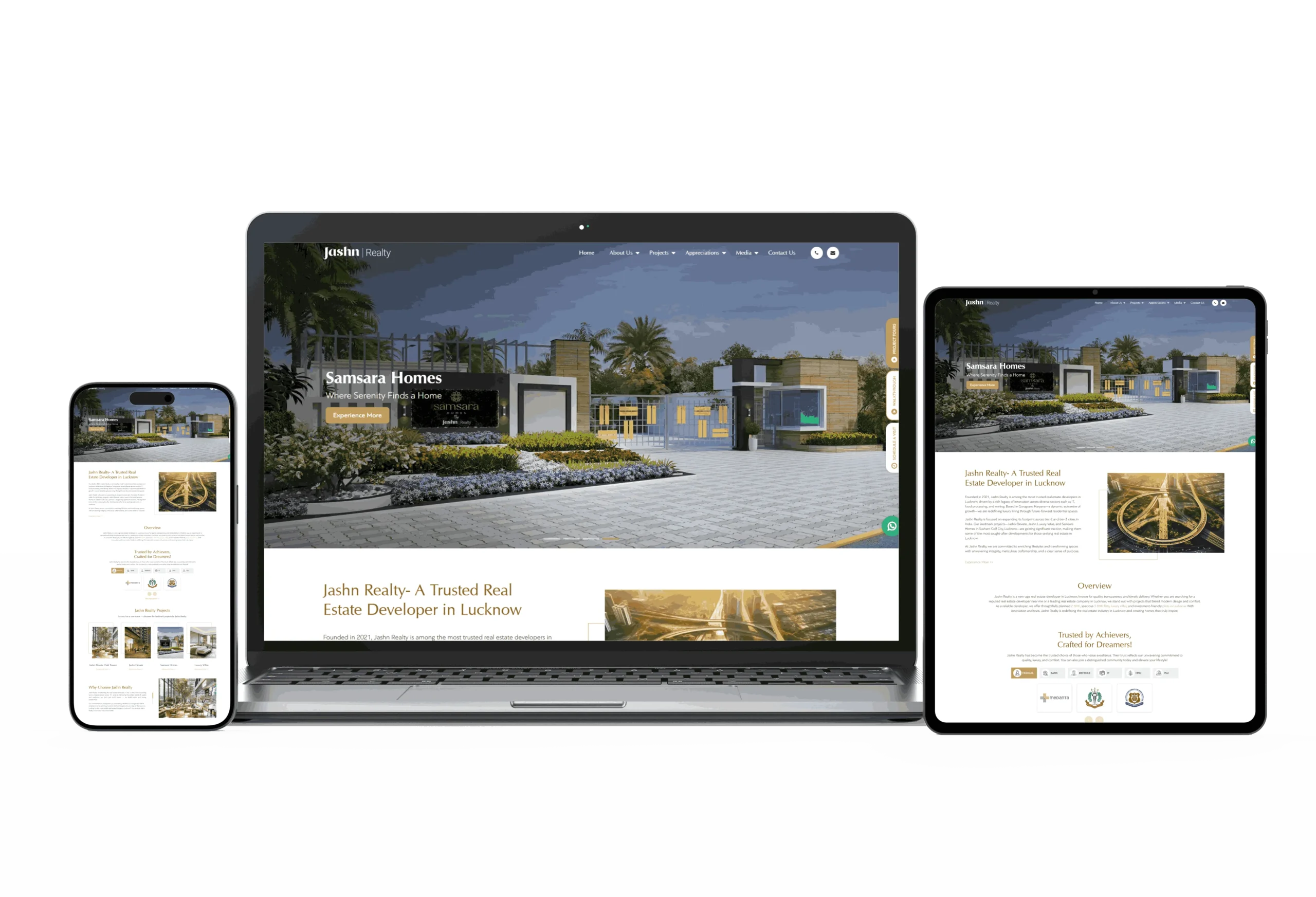
Jashn Realty
We have run Jashn Realty’s property campaigns in Lucknow since 2024, and more than 500 units have been booked over that period. The six reported months of 2024 produced 8,425 Meta leads from ₹209 a lead. In 2026 we moved the reporting onto qualified leads, which is why the numbers in this post get dearer and more useful at the same time.
What changed between 2024 and 2026
Buyers take longer. Magicbricks’ Housing Sentiment Index for August 2026, built from 2,769 prospective buyers across India’s top 11 markets, read 112 nationally with Delhi at 128 and Gurugram at 127, and nearly 69% of respondents expected flat prices or a rise of up to 5% over the next year. People who do not expect prices to run away from them do not rush.
Longer consideration shows up in the account as a worse-looking cost per lead and a better-looking cost per sale, as long as the follow-up is good. That is why we moved the Jashn reporting onto qualified leads in 2026 rather than defending a ₹209 number we could no longer repeat honestly.
The other change is competition for the impression. The dentsu-e4m Digital Advertising Report 2026 has India’s digital ad spend closing at ₹71,621 crore after 19% growth, estimated at 59% of all advertising by the end of 2025, and projected to reach ₹84,977 crore by the end of 2026. Every category, property included, is bidding against more money each year.
How to budget for a project launch
Work backwards from units. If you need 50 bookings and your sales team closes 1 in 25 qualified leads, you need 1,250 qualified leads. Our July 2026 account average of ₹925 a lead at a 14.6% qualification rate works out at about ₹6,300 per qualified lead, so 1,250 of them is roughly ₹79,00,000 of media across the launch period. The best campaign that month would have brought it well below that.
Then check the arithmetic against the ticket size. On a ₹75 lakh flat, ₹79,00,000 of media for 50 bookings is roughly 2% of ₹37.5 crore of sales. If your internal marketing allowance is 1%, either the sales conversion has to improve or the launch has to be smaller.
Management on top is the higher of 15% of monthly media or ₹50,000 plus GST, falling to 10% once monthly media passes ₹20,00,000. Full terms are on the performance marketing page.
The lead form decides your cost per qualified lead
On Meta, an instant form with name and phone will always be cheaper per lead than one that asks for budget and possession timeline. We usually run both, because the cheap form tells us which creative works and the longer form tells us who is real.
On Google, lead form assets attach to Search and Performance Max campaigns, and Google notes in its own help documentation that leads are stored for 60 days with CSV downloads covering the last 30 days. Teams that pull leads monthly lose them, which is a reporting problem that looks like a lead quality problem.
Our standing rule is that every lead carries its campaign, its ad and its form version into the CRM. Without that, nobody can tell you why May was worse than July.
What a developer should ask this month
Ask for cost per qualified lead by campaign, not cost per lead by platform. Ask what share of last month’s leads the sales team marked warm or hot. If the answer is under 10%, the targeting or the form is wrong, not the budget.
Ask which single ad produced the most site visits last month, and whether it is still running. In our July 2026 Jashn month, one campaign did 58 leads at ₹539 while the account average sat at ₹925. Finding that campaign and feeding it is most of the job.
If you are running projects in Lucknow or anywhere in the tier-two belt, the numbers in this post are a fair starting band. Send us a month of CRM outcomes and we will tell you which part of your funnel is the expensive one.
References
- Business Today, Delhi NCR housing prices jump 12% in Q3 2026, average rate hits ₹9,980 per sq ft (ANAROCK data), 5 October 2026
- The Realty Today, Delhi, Gurugram and Kolkata top India’s housing sentiment rankings as national HSI stands at 112 (Magicbricks, August 2026 survey of 2,769 buyers), updated 7 September 2026
- Meta Platforms, Form 10-Q for the quarterly period ended 30 June 2026, US Securities and Exchange Commission
- Google Ads Help, About lead form assets (lead storage of 60 days, 30-day CSV downloads), accessed 11 October 2026
- exchange4media, Digital projected to command 70% of total ad spends by 2027 (dentsu-e4m Digital Advertising Report 2026), 2 February 2026
Frequently asked questions
What does a real estate lead cost in India?
₹209 to ₹358 on Meta in our 2024 Lucknow data across 8,425 leads, and ₹505 to ₹698 on Google over July to September 2024. By July 2026 the same account was paying ₹925 a lead for better quality.
What is the difference between a lead and a qualified lead?
A qualified lead has been spoken to and has the budget, city and timeline to buy. In our May 2026 month only 7.2% of 347 CRM leads were warm or hot. By July 2026 that was 14.6%.
Why did your cost per lead go up between 2024 and 2026?
Because we made the forms longer and the targeting narrower on purpose, and because the auction got dearer. Meta’s own filing for the quarter ended 30 June 2026 reports average price per ad up 12% year on year.
What is a good cost per qualified lead for a housing project?
Anything at or under ₹2,500 is workable in a tier-two city on our data. Our best May 2026 campaign hit ₹2,410 per qualified lead, and in July 2026 one campaign bought 58 leads at ₹539 each against a 14.6% qualification rate. Gurugram and Mumbai sit higher.
How much media does a 50-unit launch need?
Around ₹79,00,000 if your sales team closes 1 in 25 qualified leads and you pay roughly ₹6,300 per qualified lead. A better campaign brings that down sharply, which is why campaign-level reporting matters.
Should a developer use Meta or Google for leads?
Both, for different jobs. Meta ran at ₹209 to ₹358 a lead in our 2024 data against ₹505 to ₹698 on Google, but Google leads arrive with intent already formed. Judge each on cost per qualified lead, not cost per lead.