


How Dubai brands get cited in AI answers
Updated 26 October 2026.
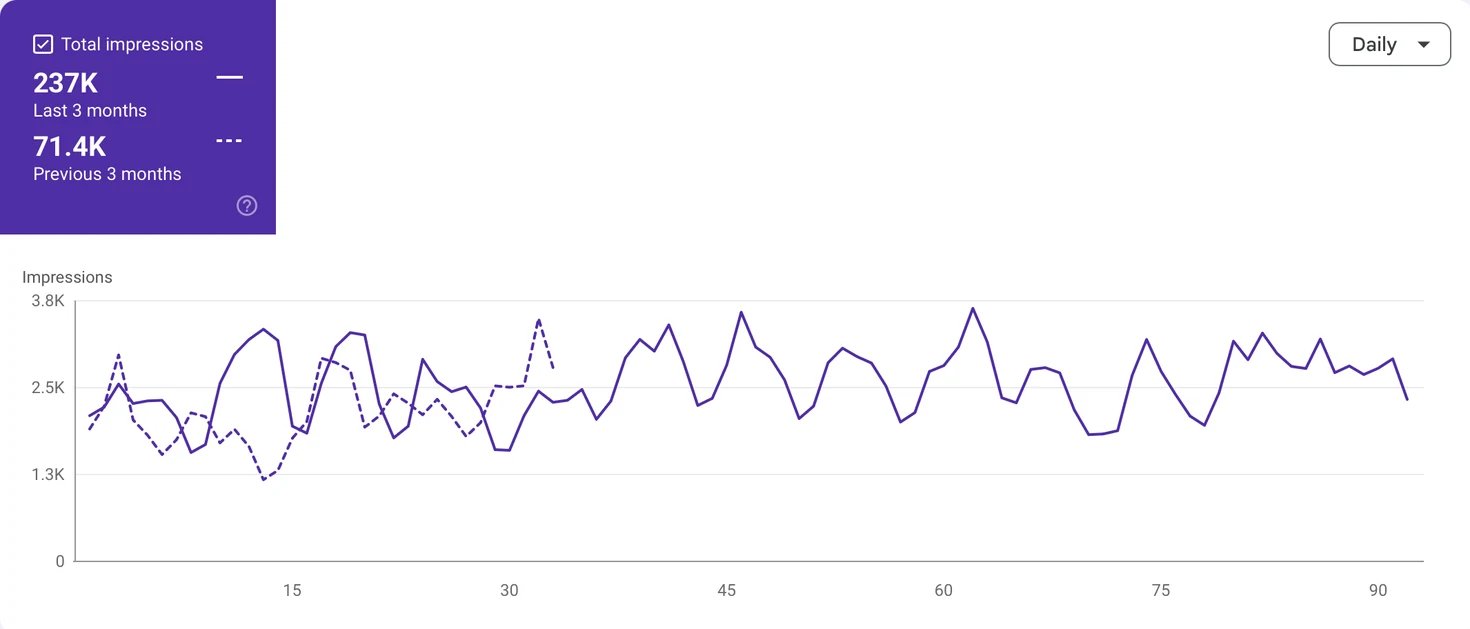
Google Search Console now reports generative AI impressions as their own view. For our client JBM Group, that report counted 237,000 impressions inside Google’s AI answers over the three months to 21 September 2026. This is the page work behind a number like that, how we measure it, and what it costs a Dubai brand.
What AEO and GEO actually mean
Two labels, one job. Answer engine optimization (AEO) is the work that gets your page used as the answer, whether that answer sits in a Google AI Overview, in AI Mode, or in a reply from an assistant. Generative engine optimization (GEO) is the same work pointed at the models that write those replies, which today means ChatGPT, Gemini, Perplexity and Google’s own AI Mode.
Google is unusually plain about the mechanics. Its documentation on AI features says a page “must be indexed and eligible to be shown in Google Search with a snippet”, and then adds that there “are no additional requirements to appear in AI Overviews or AI Mode, nor other special optimizations necessary”. It also says there is “no special schema.org structured data that you need to add”.
So why does the work exist. Because eligible and chosen are two different states. Google says AI Overviews and AI Mode use query fan-out, issuing several related searches to build one answer. A page that answers one narrow question properly gets pulled into more of those fan-out searches than a page that covers twelve questions in passing. That is the thing we change.
Our AEO work and GEO work sit inside the same retainer as SEO, because the edits are the same edits made in a different order.
What changes when the business sits in Dubai
Language is the first thing. Arabic is the official language of the UAE, and the UAE government portal notes that in the courts the other five official languages are Chinese, English, French, Hindi and Russian, with Bengali, Farsi, Malayalam, Turkish and Urdu widely spoken. Assistants answer in the language of the prompt, and they pull sources in that language. An English-only site is invisible to an Arabic prompt unless the model decides to translate for you.
The second thing is jurisdiction. A Dubai buyer rarely asks a flat question. They ask whether a free zone or the mainland suits them, what a licence costs, which bank will open an account, how long a visa takes. Those are list questions, and list questions are exactly what AI answers are good at. Being one of the named options in that list is the whole game.
The third is proof. Models lean on pages that carry numbers with sources attached. A Dubai services page that states a price, a timeline and a named client gets quoted. One that says it is a trusted partner does not. That is why our Dubai digital marketing and Dubai SEO pages carry figures on them.
| Tier | Fee a month | Keywords tracked | Cost per keyword | AEO and GEO monitoring |
|---|---|---|---|---|
| Starter | ₹50,000 | 30 | ₹1,667 | Included |
| Growth | ₹75,000 | 50 | ₹1,500 | Included |
| Scale | ₹1,25,000 | 80 | ₹1,563 | Included |
| Resource-based | ₹2,00,000 | Set in the brief | Two specialists | Included |
The page work that gets you quoted
One question per page, answered in the first sixty words. Then the detail. If a reader has to scroll past a founder story to reach the licence cost, the model has already moved on to a page that leads with the number.
Headings in the words people actually type. “Free zone or mainland for a trading licence” beats “Our jurisdiction advisory”. We write the heading, then search it, then rewrite it if real queries phrase it differently.
A table with figures in it, every time. Tables get lifted into answers more often than paragraphs, because the model can read a row and reuse it without guessing. Prices, timelines, document counts, fee bands. Adjectives do nothing here.
An FAQ block where the schema matches the words on the screen. Google’s guidance is that structured data should match the visible text on the page, so we never ship an FAQ in the markup that a human cannot read on the page itself.
Crawlers, robots and the controls that quietly switch you off
Before anything creative, check what you are blocking. OpenAI runs separate crawlers for separate jobs, and its own documentation says that “Sites that are opted out of OAI-SearchBot will not be shown in ChatGPT search answers”, although they “can still appear as navigational links”. GPTBot is the training crawler, and disallowing it “indicates a site’s content should not be used in training generative AI foundation models”. ChatGPT-User handles user-initiated visits, and OpenAI states it “is not used to determine whether content may appear in Search”.
The three are independent. You can allow OAI-SearchBot and disallow GPTBot, which is what most brands want. OpenAI also notes that after a robots.txt change it can take about twenty four hours for its search systems to adjust.
On Google’s side, the controls are the familiar ones. Googlebot robots.txt rules govern crawling for Search, and nosnippet, data-nosnippet, max-snippet and noindex limit what can be shown. We have opened Dubai accounts where a security plugin or a CDN rule was blocking half of this by default, and nobody in the business knew. That is a thirty minute fix that changes the ceiling on everything else.
JBM Group
JBM Group is an Indian automotive and engineering group we have run SEO for across a long programme. Annual organic sessions rose from 52,935 to 329,261 in FY2024-25, and the same site now shows 237,000 impressions inside Google’s AI answers over three months, about 2,600 a day, with a best day near 3,700.
How we measure citations now
Google shipped the thing that made this measurable. Its Search Central blog announced Search generative AI performance reports in Search Console on 3 June 2026, first to a subset of sites, and a note on the same post records the rollout to all websites worldwide on 31 August 2026. The report gives impressions, the pages that appeared, countries, devices for Search results, and dates down to hourly granularity. It does not give clicks.
That is the number we quote. For JBM Group, the generative AI features report showed 237,000 impressions over the last three months to 21 September 2026, roughly 2,600 a day, against 71,400 in the previous period that covers about one month of data. Day for day the average moved from about 2,200 to about 2,600. The full read is in the JBM Group GEO case study.
Treat those impressions as presence, not traffic. Pew Research Center tracked the browsing of 900 US adults in March 2025 and found that users clicked a traditional search result in 8% of visits to pages with an AI summary against 15% of visits to pages without one, and clicked a link inside the AI summary in just 1% of visits. If you budget for AI answers expecting clicks, you will be disappointed. Budget for being the brand named in the answer.
Alongside the report we run a fixed prompt set every month, the same thirty questions typed into each assistant, and log whether you were named, linked, or absent. Dull work. It is the only way to see Perplexity and ChatGPT, which publish no equivalent of Search Console.
What this costs
₹50,000 plus GST a month is the floor. That is the Starter tier, thirty tracked keywords, and AEO and GEO monitoring is included in it rather than sold as an add-on. Growth is ₹75,000 for fifty keywords, Scale is ₹1,25,000 for eighty, and Resource-based is ₹2,00,000 for two specialists working to a scope set in the brief.
For a Dubai brand with one service line and under forty pages, Starter is enough for the first quarter. For a set-up firm, a property developer or anyone with multiple jurisdictions and both languages to cover, Growth is the realistic entry point, because the keyword spread alone eats thirty slots.
Overseas clients can be billed in INR or USD at the conversion rate fixed in the agreement. We do not quote in dirhams. Our AI SEO team works from Noida, and the rate card is the India rate card.
The first thirty days on a Dubai account
Week one is diagnostics. We pull robots.txt, the snippet directives, any CDN bot rules and the current Search Console generative AI report, and we record a baseline for the fixed prompt set. Most of the surprises surface here.
Week two is choosing the questions. Eight to twelve of them, the ones a buyer asks a salesperson in the first call. We check each one against real query data before we commit, because the question a founder thinks matters is often not the one with volume behind it.
Weeks three and four are writing and shipping. Each question becomes a page or a section with a figure, a table and an FAQ. Then we leave it alone and watch the report, because recrawling is on Google’s timetable, not ours, and Google’s own documentation warns that a recrawl can take days to months.
Where this goes wrong
Machine-translated Arabic dropped onto the same URL as the English. Google recommends a different URL for each language version and advises against using cookies or browser settings to switch the content language on a page. Do it the lazy way and you get one page that ranks in neither language.
Chasing an assistant answer without an indexed page behind it. There is no submission form for AI Overviews. If the page is not indexed and snippet-eligible, nothing downstream matters.
Reading AI impressions as if they were sessions, then cutting the budget when GA4 does not match. Two different things, measured in two different places.
And hiding the price. A Dubai buyer comparing four agencies will take the one whose page answered the money question. So will the model.
References
- Google Search Central, AI Features and Your Website, last updated 10 December 2025
- Google Search Central Blog, Introducing Search Generative AI performance reports in Search Console, 3 June 2026
- Pew Research Center, Athena Chapekis and Anna Lieb, Google users are less likely to click on links when an AI summary appears in the results, 22 July 2025
- OpenAI, Overview of OpenAI crawlers, accessed 11 October 2026
- Government of the United Arab Emirates, Fact sheet, accessed 11 October 2026
Frequently asked questions
Is AEO different from SEO?
Mostly it is the same work in a different order. Google’s own documentation says there are no additional technical requirements to appear in AI Overviews or AI Mode. What changes is the shape of the page, one question answered early, a table with figures, and an FAQ whose schema matches the visible text.
How long before a Dubai page shows up in AI answers?
Usually four to twelve weeks after the page is recrawled. Google warns that a recrawl can take days to months, so the honest answer is that we control the page and not the timetable.
Do we need a .ae domain to rank in the UAE?
No. A country domain is one signal among many, and a .com with correct hreflang and real UAE content does the job. Google lists country domains, subdomains and subdirectories as equally workable.
Can you publish Arabic pages?
Yes, on separate URLs, with a native Arabic speaker reviewing the copy before it goes live. We do not publish machine-translated Arabic, because Google recommends separate URLs per language and a half-translated page ranks in neither.
What does AEO and GEO work cost?
₹50,000 plus GST a month at Starter, with thirty tracked keywords, rising to ₹75,000 for fifty and ₹1,25,000 for eighty. AEO and GEO monitoring is in every tier. Overseas clients can be billed in INR or USD at the conversion rate fixed in the agreement.
How do you prove we are being cited?
Two ways. The Search Console generative AI performance report, which Google rolled out worldwide on 31 August 2026 and which gives impressions by page and country, and a fixed set of thirty prompts we run monthly in ChatGPT, Gemini and Perplexity and log by hand.