




A homeowner fills in two forms on the same evening. The first company calls back in ten minutes. The second replies the next afternoon. By then, the homeowner has already chatted with the first company and booked a visit. The second company never learns what happened. It only sees a lead marked “not interested.” This pattern repeats across industries, and it explains why speed to lead matters so much.
Speed to lead means the time between a person’s enquiry and your first useful reply. This guide shows why it matters, sets response targets by channel, gives you sample scripts and lays out a simple system that works even for a small team.
Why Speed to Lead Matters
When people enquire, they act on a need right now. They also contact several providers at once. The first provider to reply often shapes the rest of the process. That provider sets the price anchor, answers the main doubts and builds a bit of trust before others reach the buyer.
Speed also signals care. A quick, polite reply tells the buyer that your team stays organised and respects their time. A slow reply suggests the same behaviour after the sale.
Studies from sales research firms have linked faster responses with higher contact and conversion rates, though results vary by industry and method, so test the effect in your own data.
What Counts as a Response?

A real response is more than an auto-email that says “We received your message.” Auto-replies help, but they do not replace a human touch. A good first response:
- Uses the person’s name and mentions what they asked about
- Answers one useful question or gives a clear next step
- Offers an easy way to continue, such as a call time or a WhatsApp chat
- Comes from a named person
Measure two times: time to first automatic acknowledgement and time to first human response. The second one matters most.
Response-Time Targets by Channel
Targets depend on your business, hours and team size, but these starting points suit many service companies.
| Lead source | Starting target for first human response |
|---|---|
| Phone call request or “call me now” form | Within a few minutes |
| WhatsApp or chat message | Within minutes during working hours |
| Website contact form | Within 15 to 30 minutes in working hours |
| Social media lead ad form | Within 15 to 30 minutes in working hours |
| Email enquiry | Within one to two hours |
| Out-of-hours enquiry | An automatic reply with next-morning call time, then a human reply first thing |
Set your own targets after you look at your data. If you cannot meet a target, choose a slower one that you can meet every time. Consistency beats a bold promise you break.
Build a Simple Speed-to-Lead System
You do not need expensive software. You need a clear process.
1. Capture every lead in one place
Leads arrive from forms, ads, calls, chat and email. If they land in six inboxes, some will slip through. Send all leads to one shared sheet, a CRM or a shared inbox. Our guide to GA4 key events for lead-generation sites shows how to track each source.
2. Alert the right person instantly
Set notifications by email, WhatsApp, SMS or an app alert, so the assigned person knows within seconds. Use a round-robin rule to share leads among team members, and add a backup if the first person does not reply within a set time.
3. Send an instant acknowledgement
An automatic message sets expectations and proves that the form worked. Keep it friendly, short and honest.
4. Assign an owner for every lead
Each lead needs one named owner. When “everyone” owns a lead, no one does.
5. Reply with value, not just “Call me”
Share one helpful detail, ask one smart question and offer a choice of next steps.
6. Track the clock
Log the time of enquiry and the time of first reply. Review the average weekly. Look at the slowest ten percent, which usually shows where the process breaks.
7. Follow up in a planned sequence
Most deals need more than one contact. Plan a sequence over a week or two: a call, a message, an email and a final check. Space the steps, and stop when the person asks you to.
Sample Scripts
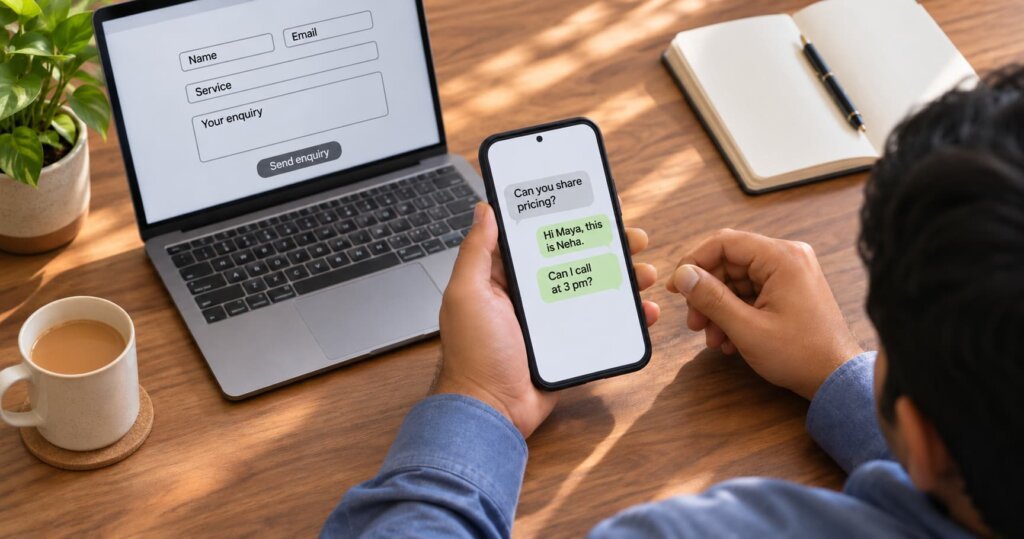
Adapt the tone to your brand. Keep each message short and respectful.
Instant automatic reply (form) “Hello [Name], thank you for contacting [Company]. We have received your request about [service]. [Person] will call you within [time]. If you prefer WhatsApp, reply here.”
First human message (WhatsApp or SMS) “Hello [Name], this is [Person] from [Company]. I saw your enquiry about [service]. May I ask what you are hoping to achieve? I can call you today at [time] or send a short summary here.”
First phone call opening “Hello [Name], this is [Person] from [Company]. You enquired about [service] a few minutes ago. Is this a good time for a two-minute chat?”
Follow-up if there is no answer “Hello [Name], I tried calling about your enquiry. Here is a quick summary of how we can help: [one line]. Would [day] at [time] suit you for a short call?”
Out-of-hours reply “Thanks for reaching out, [Name]. Our team is offline now. [Person] will call you at [time] tomorrow. If something is urgent, please message us here.”
Balance Speed With Quality
Fast does not mean careless. A rushed, generic reply can hurt more than a slightly slower, thoughtful one. Aim for both.
- Prepare quick answers to the five most common questions.
- Use templates as starting points, and personalise at least one line.
- Train new staff on tone, listening and honest answers.
- Qualify gently. Ask about need, timeline and budget in a natural way.
Our post on cost per lead vs cost per qualified lead shows why you should judge leads by quality, not just by count.
Where Speed Often Breaks
- Leads arrive at night or on weekends with no one on duty.
- Forms send emails to a single person who may be away.
- Staff wait to “batch” calls until they have time.
- Phone numbers are wrong, because the form has no format check.
- Sales and marketing blame each other. Marketing sends leads, and sales says they are poor, so no one acts fast.
- No tracking exists, so nobody knows how slow replies are.
Use Technology Wisely
Several tools can help.
- CRM systems that log leads, assign owners and send reminders
- WhatsApp Business features such as quick replies and away messages
- Chatbots that answer basic questions and book calls
- Call tracking to log calls and missed calls
- Workflow tools that send alerts and trigger follow-ups
Choose tools your team will actually use. Keep the flow simple, and always give people an easy way to reach a human. Follow consent and privacy rules when you send messages, and respect requests to stop.
Link Speed to Ad Spend
Slow replies waste paid leads. If you pay for every form fill, each missed lead is lost budget. Compare conversion rates for leads you contacted within your target and leads you contacted later. If the first group converts better, you have proof for a staffing or process change.
Share this data with whoever manages your ads. If you run lead ads or search campaigns, our performance marketing team can connect lead response data to campaign results, so budget moves toward sources that convert. Our guide on reducing cost per lead with better creative pairs well with this work.
A Hypothetical Test
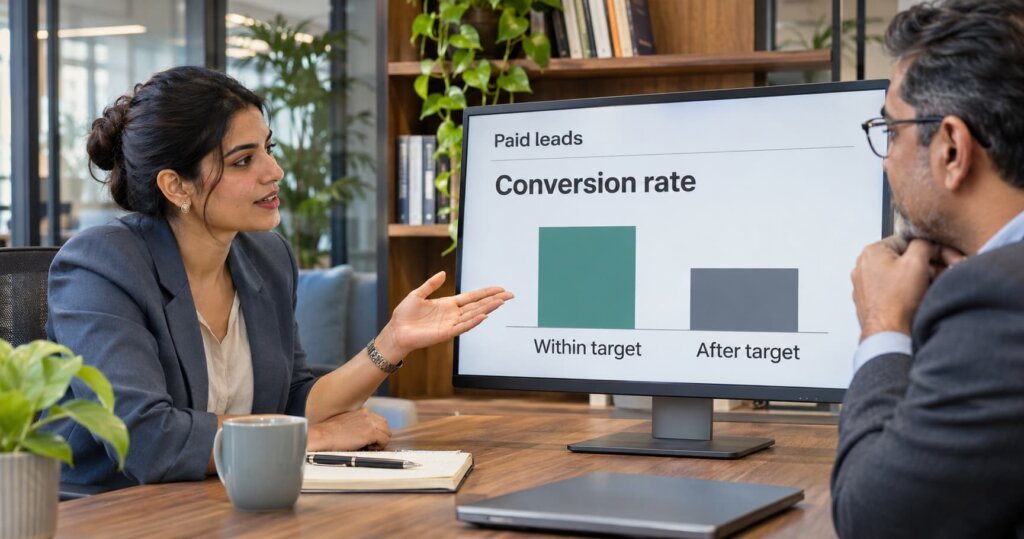
We made up this example for illustration. A Chennai training institute receives 200 enquiries a month. For four weeks, it records the reply time for each one and the number that book a demo. The team finds that enquiries answered within 30 minutes book demos more often than those answered after several hours. The institute sets a duty roster for evenings, adds a WhatsApp alert and reviews the numbers each Monday. Real results will differ, but the habit of measuring is what counts.
Common Mistakes
- Promising “instant reply” and failing. Under-promise, then deliver.
- Sending long messages first. Keep the first reply short.
- Calling once and giving up. Use a sequence.
- Ignoring lead source. Some sources need faster action than others.
- Not recording outcomes. You cannot improve what you do not track.
- Treating speed as a sales-only issue. Marketing, operations and tech all affect it.
Start Small This Week
- Record the time of enquiry and first reply for every lead for two weeks.
- Set a realistic target for each channel.
- Add one alert, one owner and one template.
- Review results every Monday and fix one gap.
Need Help Building the System?
If you want to connect ads, forms, tracking and follow-up in one clean flow, contact DigiStreet Media. We can review your lead journey, spot the slow points and suggest practical fixes.
Reference Links
| Relevant Topic or Resource | Why It Is Relevant | Verified Link |
|---|---|---|
| Google Analytics key events | Supports tracking form and call actions as key events | https://support.google.com/analytics/answer/9267568 |
| WhatsApp Business app features | Official overview of quick replies and away messages | https://business.whatsapp.com/products/business-app |
| Google guidance on creating helpful, people-first content | Supports clear, useful replies and content | https://developers.google.com/search/docs/fundamentals/creating-helpful-content |
Frequently Asked Questions
What is speed to lead?
Speed to lead is the time between a person’s enquiry and your first useful reply. Faster, relevant replies tend to improve contact and conversion rates.
How fast should I respond to a lead?
Aim for minutes for call requests and chats, and within 15 to 30 minutes for web and social forms during working hours. Set targets you can meet every time.
Does a fast reply really improve conversions?
Many sales studies link faster replies with better results, but effects vary. Measure response time against outcomes in your own data.
What should I say in my first reply to a lead?
Use the person’s name, mention their enquiry, give one useful detail and offer an easy next step, such as a call time or a WhatsApp chat.
Is an auto-reply enough?
No. An auto-reply confirms receipt, but a named person should follow with a personal message or call as quickly as possible.
How do I handle leads that arrive at night?
Send an automatic reply that sets a clear call time, then have a person reply first thing in the morning. A duty roster can cover busy periods.
How many times should I follow up with a lead?
Many teams use a short sequence of calls, messages and emails over one to two weeks. Space the contacts, and stop when the person asks.