




Cost per lead versus cost per qualified lead
Updated 4 October 2026.
Cost per lead divides spend by all captured leads. Cost per qualified lead divides spend by the smaller group that meets an agreed sales-fit rule. The second number is usually higher, but it is often more useful for budget decisions because it reflects whether the enquiries can progress.
If ₹3,00,000 in media produces 1,000 leads, CPL is ₹300. If the sales team accepts 150 of those leads as qualified, CPQL is ₹2,000. Both calculations can be correct. They answer different questions: CPL describes acquisition volume, while CPQL describes the cost of reaching the agreed quality gate. The related DigiStreet commercial page is performance marketing services.
DigiStreet’s performance fee is the higher of 15% of media spend or ₹50,000 + GST per month. The percentage becomes 10% from ₹20 lakh, 8% from ₹50 lakh and 4% from ₹1 crore, while the ₹50,000 minimum applies up to ₹3,33,333 in media. A typical media starting range is ₹50,000–₹1,00,000. These fees are separate from media, and quality must be defined before the dashboard is used to judge efficiency.
Write the qualification rule before launch
A qualified lead is not simply a lead the salesperson likes. The definition should be observable and agreed: geography, product need, budget band, eligibility, purchase window, business size or another field the team can record consistently. A property campaign might require project interest, investable range and site-visit readiness. A B2B campaign may require role, company fit, problem and timetable.
Keep the rule narrow enough to be useful and broad enough to be applied. If every salesperson interprets “serious” differently, CPQL becomes an opinion disguised as a metric. Create accepted values in the CRM, explain how unknown information is handled and review a sample of rejected leads to find training or routing errors.
Use the correct denominator and cost boundary
Media CPL is media spend divided by captured leads. Blended CPL can include media and management cost, but the report must label the numerator. CPQL uses the same declared cost boundary divided by qualified leads. Do not compare a media-only CPL with an all-in CPQL and imply that lead quality caused the full difference.
A zero-qualified-lead period does not have a finite CPQL. Show the spend, lead count and zero qualification result rather than dividing by zero or displaying ₹0. Likewise, a very small qualified sample can move sharply when one lead is reclassified. Add counts beside rates so the reader sees the base.
Connect ad clicks to offline outcomes
Many valuable decisions happen after the form: a phone conversation, document check, demo, site visit or contract. Google Ads supports enhanced conversions for leads and offline outcome imports so later events can be attributed back to ad interactions. Google’s help documentation recommends qualified lead or converted lead goals when setting up enhanced conversions for leads.
The implementation requires consent-aware handling of first-party data, stable identifiers and CRM discipline. Google describes hashing first-party customer data before matching it for measurement. The sales team still has to record the status and event time correctly. Technology cannot repair an empty qualification field or a lead that was never contacted.
Read channel and creative quality separately
One channel can produce a low CPL and a weak qualification rate; another can cost more per enquiry but deliver more accepted opportunities. Compare media spend, leads, qualified leads, qualification rate and CPQL together. Then segment by campaign, audience, query, geography, device, landing page and creative where the sample is sufficient.
Do not stop at the cheapest cell in the table. Check whether the team responded at the same speed, whether the offer and form were comparable and whether a channel captured different purchase stages. The aim is not to protect a campaign from scrutiny. It is to avoid a decision based on a denominator that hides the sales process.
Use the Fund Abroad result precisely
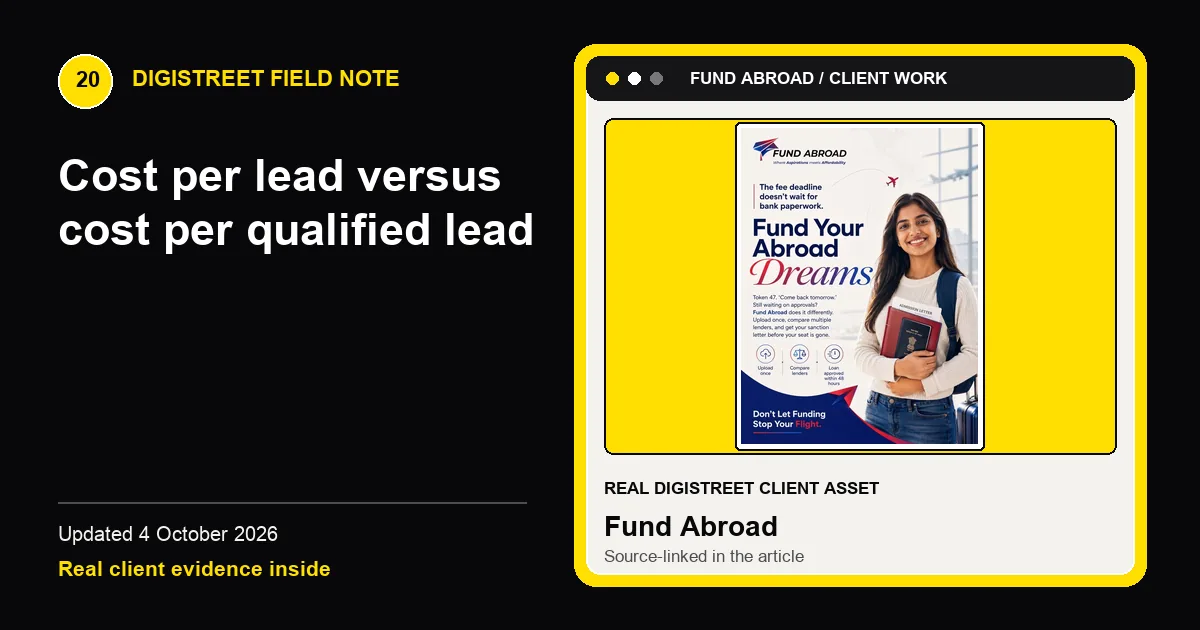
DigiStreet’s published Fund Abroad case reports a verified CPL of ₹97.56. That figure is a cost per lead, not a cost per qualified lead. It should not be relabelled or used as a universal education benchmark. The case can inform a discussion about real campaign creative and enquiry acquisition only within its published context.
To turn such a CPL into CPQL, the account would need spend and a count of leads that met a documented qualification rule for the same period. For example, if every tenth lead qualified, CPQL would be ten times CPL under the same cost boundary. That arithmetic illustrates the relationship; it does not state the Fund Abroad qualification rate.
Budget from the sales constraint backwards
Begin with the number of qualified opportunities the sales team can handle and the observed qualification rate. Required raw leads equal the qualified target divided by that rate. Media need can then be estimated from the observed CPL, with a low, middle and high range rather than one promise. If the rate comes from a tiny or outdated sample, label the uncertainty.
After launch, track contact rate, qualification, meeting or visit, proposal and sale. A rising CPQL may be acceptable if downstream conversion and value improve. A falling CPL may be harmful if the team is flooded with enquiries it cannot serve. The decision should follow the full funnel and the commercial objective, not a single attractive acquisition number.
Build a weekly quality review that sales will use
A weekly review should begin with counts: spend, leads received, leads contacted, leads qualified and the next commercial event. Add median response time and a reason breakdown for rejection. The purpose is to locate the loss. A campaign cannot fix an unanswered phone, while the sales team cannot correct a landing page that promises the wrong service. Each owner needs a visible action from the same evidence.
Sample individual records rather than relying only on percentages. Read the search term or audience, the creative seen, the landing page, the fields supplied, the salesperson note and the final status. This trace can reveal a form field that invites the wrong request, a geo setting that reaches unsupported locations or a qualification rule being applied inconsistently. Remove personal data from discussion materials unless it is necessary and permitted.
Close the meeting by recording one measurement correction, one campaign change and one sales follow-up change where the evidence supports them. Revisit those actions against later cohorts rather than mixing all history together. CPQL then becomes a diagnostic rate attached to a defined process, not a number used to move responsibility between marketing and sales.
Use cohorts before changing the budget
Lead quality often arrives later than lead capture. A campaign launched on Monday may generate forms immediately, but qualification, meetings and sales can take days or weeks. Group leads by capture week or month and allow the agreed response window before comparing cohorts. Otherwise the newest campaign always appears to have the weakest downstream result simply because its records are still open.
Show mature and immature cohorts separately. For the mature group, calculate contact rate, qualification rate, CPQL and the next-stage rate using the same cost boundary. For the current group, present spend and raw lead signals without pretending the later steps are final. This keeps the dashboard useful while the sales cycle catches up.
Budget changes should follow enough evidence for the decision being made. A clear tracking fault can be fixed immediately; an audience conclusion may need more qualified outcomes. Write the threshold before reviewing the result, including the maximum spend, minimum sample or review date. The team can then scale, hold or stop against a stated rule rather than the mood created by one expensive lead.
Where several products share a campaign, calculate quality by product or sales route when the volumes permit. An overall CPQL can hide one offer producing accepted opportunities and another producing repeated rejection. Keep the common total for finance, then expose the segments needed by the people who can change the offer, targeting or follow-up.
Pair cost with value. A qualified lead for a high-value B2B contract and one for a low-ticket service may not deserve the same ceiling. The commercial team can set a CPQL guardrail from close rate and acceptable acquisition cost, then revisit it when realised value changes. This helps planning while campaign delivery remains an observed result.
| Measure | Formula | Example |
|---|---|---|
| Cost per lead | ₹3,00,000 ÷ 1,000 leads | ₹300 |
| Qualification rate | 150 qualified ÷ 1,000 leads | 15% |
| Cost per qualified lead | ₹3,00,000 ÷ 150 qualified leads | ₹2,000 |
| Lead-to-sale rate | 30 sales ÷ 1,000 leads | 3% |
| Media cost per sale | ₹3,00,000 ÷ 30 sales | ₹10,000 |

Fund Abroad
The published Fund Abroad case contains this client asset with a named caption. The source opens the evidence in its original context.
Frequently asked questions
What is the difference between CPL and CPQL?
CPL divides the declared spend by all leads. CPQL divides that same cost boundary by leads that meet the agreed qualification rule.
Why is CPQL higher than CPL?
Qualified leads are a subset of all leads, so the denominator is smaller. The exact difference depends on the measured qualification rate.
What counts as a qualified lead?
The business must define observable criteria such as geography, need, budget, eligibility, role or timing and record them consistently in the CRM.
Should agency fees be included in the calculation?
They may be included in a blended metric, but the numerator must be labelled. Do not compare media-only and all-in costs as though they were the same.
Is Fund Abroad’s ₹97.56 figure a CPQL?
No. The published Fund Abroad figure is CPL. A CPQL would require the qualified-lead count for the same cost and period.
How can Google Ads receive qualified-lead data?
Enhanced conversions for leads and offline outcome imports can send later CRM events back for attribution when consent, identifiers and implementation are handled correctly.