

Published 26 October 2026.
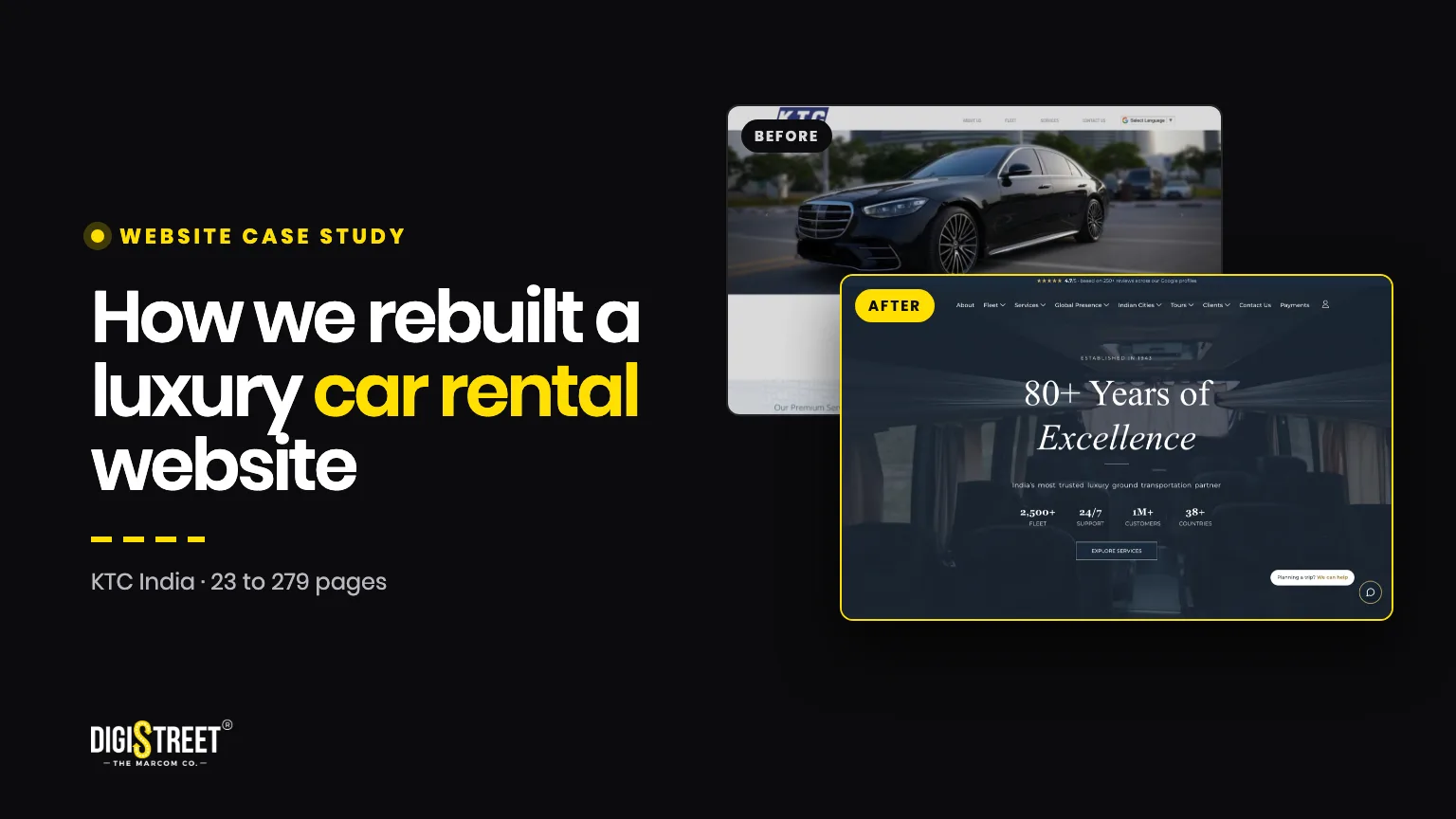
A car rental website gets enquiries when it has a page for every way people search: by car, by city and by occasion. KTC India had one Services page. We rebuilt the site from 23 indexable pages to 279, recorded the source of every enquiry, and in the 40 days after tracking went live it logged 2,873 enquiries, 36.9% of them from organic search.
KTC (India) Ltd has run luxury ground transport since 1943 and has a fleet of more than 2,500 vehicles. Its India site ran on the same template the group’s Saudi Arabian company still uses, a well-made brochure that described the company and very little else. This post goes through how we rebuilt it, decision by decision, so you can apply the same thinking to a rental, travel or fleet business. The full before-and-after screens are in our KTC India car rental website redesign case study, and the site is live at ktcindia.com.
Start from the searches, not the sitemap
Nobody types “luxury travel partner” into Google. They type “luxury car rental Hyderabad”, “Mercedes Sprinter on rent”, “car lease in Delhi” or “wedding car rental Jaipur”. Each of those is a different person with a different budget and a different date in mind, and one Services page cannot be the best answer to all of them.
So the plan began as a list of searches grouped into page types, and only then became a sitemap. KTC ended up with five families of commercial pages, each written for a pattern of search rather than for an internal department:
| Page type | How many | The search it answers |
|---|---|---|
| City pages | 62 | Luxury car rental in a named city |
| Vehicle pages | 41 | A named car or van on rent, with city-level sections |
| Tour and itinerary pages | 14 | A trip or route with a car and driver |
| Wedding car pages | 11 | Wedding car rental in a named city |
| Long-term lease pages | 9 | Car lease for companies and individuals, hub plus cities |
Around them sit 82 editorial posts, including pieces tied to events, and six standalone landing pages for paid campaigns. The sitemap went from 520 URLs, many of them thin or duplicated, down to 280 that each have a job.
If you run a local service business, the same logic applies at a smaller scale: one strong page per city you serve and per service people search for by name. Our local SEO work starts from exactly this list.
Make the menu show the fleet
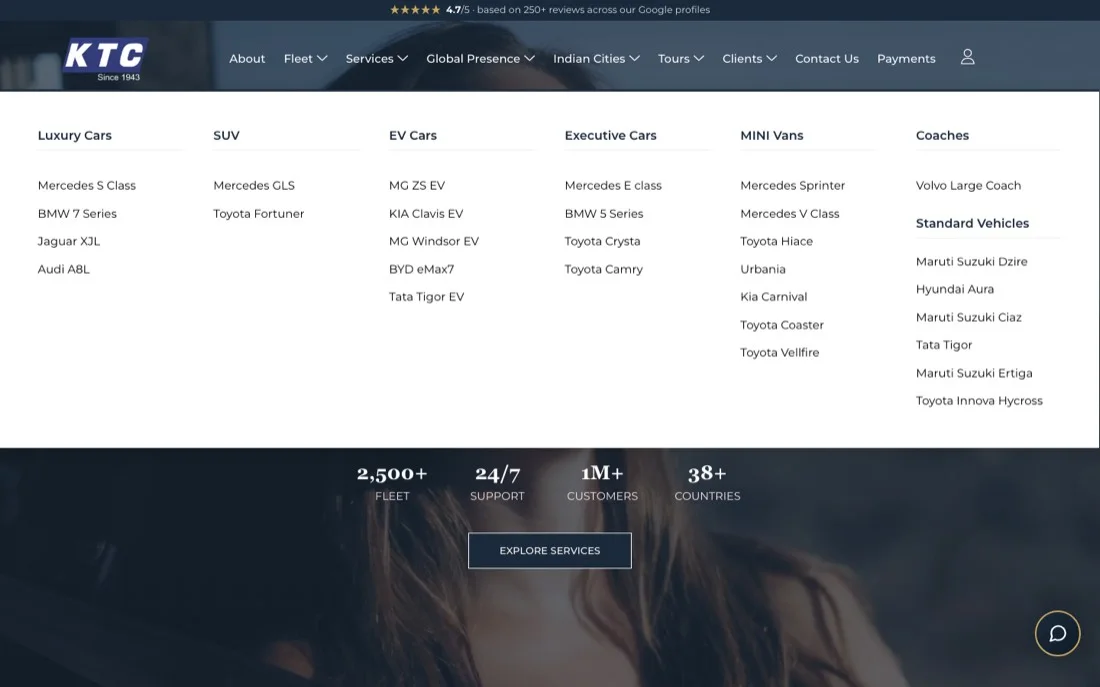
The template had a single Fleet link that opened one gallery page. A buyer who wanted a seven-seater for an airport transfer had to scroll and guess. We replaced it with six mega menus: Luxury Cars, SUVs, Electric, Executive, Mini Vans and Coaches. Each lists the actual vehicles, so more than thirty vehicle pages are one hover away from any page on the site.
The fleet also appears on the commercial pages themselves, not only in a gallery. Someone reading about long-term leasing in Chennai sees the cars they would be leasing, each card linking to that vehicle’s page. That keeps the reader moving towards a specific enquiry instead of back to the menu.
Fix the links that go nowhere
During the audit we found breadcrumbs on 124 pages whose links all pointed at “#”. That is roughly 300 internal links that looked like navigation and led nowhere. Google can only follow a link that is an <a> element with an href that resolves to a real web address [1], so these trails did nothing for visitors or for search.
We mapped 137 breadcrumb trails by hand, from Home to region to country to city, and wired them into the structured data so Google could show the real hierarchy. In KTC’s search results that path now appears in place of a raw URL.
Answer the questions people already ask
Every service page carries an FAQ accordion. The questions came from Google’s own People also ask boxes for each topic, so the page answers what people are demonstrably asking rather than what we guessed they might. Three hub pages went from 30 questions to 48 in one pass.
One thing has changed since we started: Google stopped showing FAQ rich results in Search in May 2026 [2]. The questions still earn their place. Google’s AI Overviews link to pages that are indexed and eligible to show with a snippet, with no extra technical requirement [3], and a plain question with a plain answer is easy for them to quote.
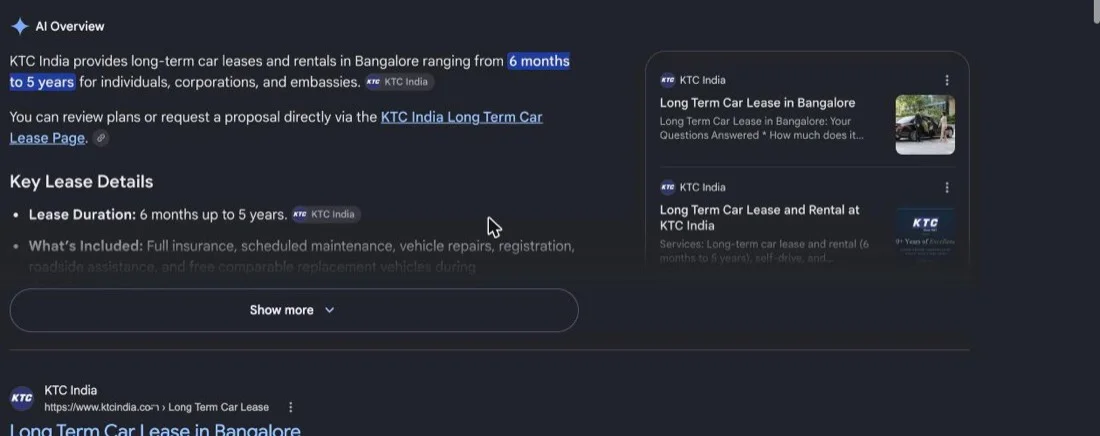
The same pages now bring in enquiries from AI assistants. In six weeks, 78 enquiries came from ChatGPT, Gemini and Perplexity. It is a small number next to search, and it is a channel that did not exist in any of KTC’s earlier reports. Our AEO services are built on this kind of work.
Put the reviews where buyers see them
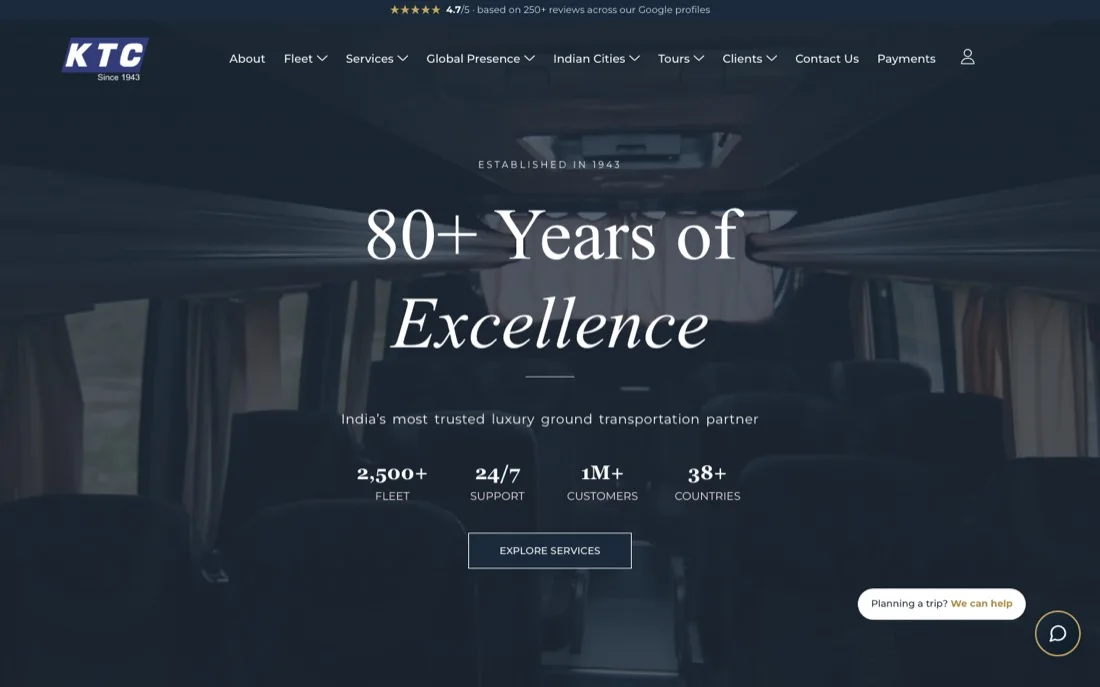
KTC has a 4.7 rating from more than 250 Google reviews. On the old site, nobody saw it. The rebuild shows it in a bar across the top of every page and in the hero counters, alongside the company’s own figures: 80+ years, 2,500+ vehicles, 21 cities and 24 National Tourism Awards.
Every commercial page also carries structured data: Product markup with that aggregate rating, plus Breadcrumb, FAQ and Organization markup. In Google, KTC results now show the stars and a readable path under the title.

Count every enquiry, including the ones that never fill a form
This was the part KTC’s management valued most. Before the rebuild, nobody could say which pages or channels produced business. We wrote a custom module that records the source of every enquiry, whether it is a form, a tap on the phone number or a tap on the WhatsApp button, and separates organic search from Google Ads using last non-direct click. Management gets a monthly view inside the dashboard with a CSV export, and each enquiry email carries its source so the sales team sees it too.
Tracking went live on 17 September. In the 40 days to 26 October it recorded:
| Measure | Result |
|---|---|
| Enquiries recorded | 2,873, about 72 a day |
| Completed forms | 799 |
| Through a WhatsApp tap | 46.5% (forms 27.8%, calls 25.7%) |
| From organic search | 36.9%, 1,059 enquiries |
| From a phone | 89%, 2,557 of 2,873 |
| Pages that produced an enquiry | 137 |
WhatsApp and call figures are taps, the moment someone chose to get in touch. The 799 forms are completed submissions. Google Ads ran alongside the site and accounts for most of the remaining enquiries, which is why the organic share is the figure we credit to the site work.
The biggest finding was WhatsApp. Nearly half of all enquiries arrive through a WhatsApp tap. A form-only setup would have shown the site producing a fraction of what it does, and any decision about the site would have been made on the wrong numbers. If you run paid campaigns, the same tracking tells you which ones bring real enquiries; our performance marketing team sets it up as standard.
Design for the phone, because that is where the enquiries are
89% of KTC’s enquiries come from a phone. Google also uses the mobile version of a page for indexing and ranking, and expects the same content, headings and structured data on mobile as on desktop [4]. So every page was designed for a phone first: the WhatsApp and call buttons within reach, the fleet cards readable at arm’s length, and nothing hidden on mobile that exists on desktop.
Keep campaign pages fast and separate
The six paid-campaign pages are served as plain HTML outside WordPress. A plugin update cannot slow them down, and they load quickly on a phone on a weak connection. They feed the same attribution table as the main site, so an enquiry from a Mercedes Sprinter campaign is counted in the same place as one from a city page.
Underneath everything, we traced a daily CPU spike to a hanging image job and removed it, subsetted the icon fonts, tuned caching to a 0.17-second cached response, and added a web application firewall with rate limits that catch scanners without blocking Googlebot.
What changed in search
In Google Search Console filtered to India, the most recent 28 days against the first 28 days after the rebuild went live:
| Google Search, India | First 28 days | Latest 28 days |
|---|---|---|
| Organic clicks | 4,871 | 6,696 (+37%) |
| Impressions | 124,832 | 202,456 (+62%) |
| Average position | 11.0 | 7.3 |
Between 1 August and 26 October the site earned 17,845 organic clicks, and 442 pages earned impressions. The filter to India matters: on KTC’s account, impressions from the United States made up two-thirds of some pages at a very low click rate, which drags every site-wide average down. The position change from 11.0 to 7.3 is the cleanest single signal, because it only moves when pages rank better.
What to copy for your own rental or travel website
| Do this | Why |
|---|---|
| Build a page for each city, vehicle and occasion people search for | One Services page cannot rank for hundreds of different searches |
| Show the fleet in the menu and on every commercial page | Buyers pick a car before they pick a company |
| Fix every link that points at “#” | Google cannot follow it, and visitors hit a dead end |
| Answer People also ask questions on the page | AI answers and searchers both quote plain answers |
| Show your real rating and add structured data | Stars and breadcrumbs in Google make your result stand out |
| Track WhatsApp and call taps, not only forms | For KTC, WhatsApp is nearly half of all enquiries |
| Design for the phone first | 89% of KTC’s enquiries come from one |
What a rebuild like this costs
Our websites start at ₹1,00,000 plus GST, with B2B sites from ₹1,75,000, corporate sites from ₹2,25,000 and ecommerce sites from ₹2,50,000. A rebuild the size of KTC’s is priced on the number of page types, templates and integrations, and the content written for it. The full breakdown is in our guide to website design cost in India, and the scope options are on our website development page. If you are redesigning a site that already ranks, our redirect map checklist covers how to keep what you have.
For another large site, see how we handled a 333-page redesign for Fund Abroad without losing a page.
Frequently Asked Questions
How do you redesign a car rental website to get more enquiries?
Build a page for each city, vehicle and occasion people search for, show the fleet in the menu and on every commercial page, answer common questions on the page, show your real rating, and track every enquiry including WhatsApp and call taps. That is how KTC India went from 23 to 279 indexable pages and logged 2,873 enquiries in 40 days.
How many pages does a car rental website need?
Enough to answer the searches you want to win. KTC India has 62 city pages, 41 vehicle pages, 14 tour pages, 11 wedding car pages by city and 9 lease pages, plus 82 editorial posts. A smaller operator might need one page per city served and one per vehicle type.
Should a car rental website track WhatsApp enquiries?
Yes. On KTC India, 46.5% of recorded enquiries came through a WhatsApp tap, more than forms at 27.8% or calls at 25.7%. Without tracking those taps, the site would look like it produced about half the enquiries it actually does.
Do FAQ sections still help SEO now that Google has dropped FAQ rich results?
Yes, for a different reason. Google stopped showing FAQ rich results in May 2026, but AI Overviews quote indexed pages that answer a question plainly. Google’s AI Overview answers car lease questions from KTC India’s FAQ pages, and 78 enquiries came from AI assistants in six weeks.
How long did the KTC India rebuild take?
The work ran from August to October 2026. The first version went live in August, enquiry tracking went live on 17 September, and pages kept being added through October.
How much does a car rental website cost?
With DigiStreet Media, websites start at ₹1,00,000 plus GST, B2B sites from ₹1,75,000 and corporate sites from ₹2,25,000. A large rebuild like KTC’s is priced on the number of page types, templates, integrations and the content written for it.
References
- Link best practices for Google, Google Search Central, last updated 10 December 2025.
- FAQ (FAQPage) structured data, documentation updates, Google Search Central, updated 23 October 2026.
- AI features and your website, Google Search Central, last updated 10 December 2025.
- Mobile-first indexing best practices, Google Search Central, last updated 10 December 2025.
- KTC India car rental website redesign case study, DigiStreet Media, October 2026.