



Updated 4 October 2026.
DigiStreet field guide
SEO Pricing Models in India: Fixed, Keyword or Hourly
A fixed monthly tier is the cleanest way to buy ongoing SEO when the site needs technical work, content and reporting together. Per-keyword and hourly quotes can still be useful, but only when the scope is genuinely narrow.
DigiStreet’s published SEO tiers are ₹50,000, ₹75,000, ₹1,25,000 and ₹2,00,000 plus GST per month. The first three carry planning capacity of up to 30, 50 and 80 keywords. The fourth assigns two dedicated specialists because a long list of keywords is the wrong way to size that work. Every tier includes AEO and GEO visibility monitoring.
That table gives a buyer something most SEO proposals hide: the unit used to define scope. A monthly fee alone tells you very little. You need to know how many markets, page types, queries, technical issues and reporting decisions the team can handle without spreading the work thin.
Fixed tier, per keyword and hourly are three different commercial models. They should not be compared as if one number is always cheaper. Compare what the model makes the team responsible for, what happens when priorities move, and what evidence arrives each month.
Use this guide as a working document: keep the URL, date, owner and source beside every decision.
The working view
| Model | Best use | Main buying check | DigiStreet price |
|---|---|---|---|
| Fixed monthly tier | Ongoing search programme | Capacity, deliverables and reporting | ₹50,000 to ₹2,00,000 plus GST |
| Per keyword | Very narrow set of landing pages | How variants and new queries are treated | No separate DigiStreet per-keyword tariff |
| Hourly | One-off diagnosis or specialist help | Named tasks, cap and written handover | No published DigiStreet hourly tariff |
| Resource-based | Large or fast-changing programmes | Named specialists and priorities | ₹2,00,000 plus GST a month |
Read the commercial model before the price
Fixed tiers make ownership clear
A monthly tier works when technical repairs, page improvements, internal links, measurement and editorial work must move together. The agency can trade effort between those jobs without issuing a new quote each time. Ask for the capacity boundary in writing, then check the monthly report against it.
Keyword pricing can hide the real workload
One keyword can represent a product family, while ten long-tail phrases may point to the same page. A quote that counts phrases without mapping them to pages can look precise while saying nothing about the actual work. Ask for the keyword-to-page map before accepting the unit.
Hourly work needs a closed question
Hours are sensible for a log-file review, a migration check or a second opinion on a known fault. They are weaker for an open-ended growth programme because the buyer carries the risk of discovery. A useful hourly brief names the question, evidence, cap and handover format.
The ₹50,000 Starter tier has a defined edge
Starter covers up to 30 keywords and suits a single market or product line. That does not mean thirty pages or thirty guaranteed positions. It means the planning set is small enough for one focused programme, with AEO and GEO visibility monitoring included.
Growth fits a site with competing priorities
At ₹75,000 plus GST a month, Growth covers up to 50 keywords and suits multi-category or multi-city work. The extra capacity matters when different page groups need separate search intent, internal links and reporting. Ecommerce SEO also stays at ₹75,000.
Scale is for harder search spaces
Scale is ₹1,25,000 plus GST a month for up to 80 keywords. Use it when the market is competitive or international, not simply because the site has many URLs. A large catalogue can still be governed by a smaller set of page types and commercial themes.
Resource-based changes the unit
The ₹2,00,000 tier assigns two dedicated specialists. It fits brands where weekly priorities, markets or product lines move too quickly for a fixed keyword ceiling. The buying question becomes whether the named people have a clear backlog, owner and reporting rhythm.
AEO and GEO should not be a mystery surcharge
DigiStreet includes AEO and GEO visibility monitoring at every SEO tier. That is monitoring, not a separate invented line item. Ask what surfaces are checked, what pages were cited or shown, and which page changes followed from the evidence.
Reports should expose capacity decisions
A sound monthly report tells you what moved, what was shipped, what is blocked and what comes next. If twenty new issues appear, the report should show which ones displaced planned work. That is how a fixed fee stays accountable without pretending every task is equal.
Compare twelve months, not one cheap month
Add the fee, content production, development support and internal approval time. Then compare the expected twelve-month workload under each model. A lower headline can cost more if every technical change or new landing page becomes a separate approval and invoice.
A buyer’s comparison sheet
Put every proposal into four columns: recurring fee, included capacity, separately billed work and the evidence delivered each month. Ask the seller to complete the sheet rather than translating the proposal yourself. The exercise exposes whether content, development, digital PR, reporting or answer-visibility monitoring sits outside the headline price. It also makes renewal discussions less emotional because both sides can see what the original fee covered.
For a fixed tier, ask how priorities move when a technical problem appears. A sensible answer explains which planned item moves down the backlog and who approves that change. “Unlimited SEO” is not a capacity answer. A team has finite time, and an honest commercial model makes that time visible without turning every small decision into a change request.
For a per-keyword quote, request the page map and mark phrases that share an intent. If eight phrases land on one page, compare the work with a fixed plan that treats them as one group. Then check whether the quote includes discovery of new queries. Search language changes as products, seasons and competitors change; a frozen list can reward the wrong behaviour.
For hourly work, separate diagnosis from implementation. The diagnosis should end with evidence, priority and a written handover. Implementation should have its own estimate and acceptance check. This protects the buyer from paying for a long investigation that never becomes a change, and it protects the specialist from being blamed for development work outside the agreed hours.
Choose the model that makes trade-offs easiest to discuss. SEO touches templates, editorial pages, analytics and internal approvals. The cheapest rate is rarely the deciding factor once several teams are involved. A clear scope, stable reporting view and named owner usually save more time than a small difference in the monthly invoice.
What to ask a vendor before you sign an SEO quote
Run the arithmetic on a per-keyword quote
For example, a vendor quotes ₹2,500 per keyword for 30 keywords. That is ₹75,000 a month, the same as a Growth tier on paper. Now look at what each buys. Growth covers up to 50 keywords, so the per-keyword quote delivers 20 fewer for the same money, and if each variant is charged separately the bill climbs quickly. Ten close phrases for one product page become ₹25,000 for a single page. Ask the vendor for the phrase count, the page count and the price per page. Divide the monthly fee by the pages touched in a month. That figure compares across models in a way the headline fee never will.
Spot the cheap quote that moves cost elsewhere
A low monthly fee often leaves out the jobs that actually move rankings. Read the proposal for four words: content, development, links and reporting. If any of them is billed separately, add an estimate for it. For example, a ₹30,000 retainer that needs four articles at ₹6,000 each and ten developer hours at ₹1,500 an hour lands at ₹69,000 before GST, and that is before anyone has argued about scope. Put the estimate in your comparison sheet in a different colour, so the finance team can see which numbers are firm and which are guesses. Firm numbers win the comparison.
A decision rule for choosing a model
Use a short rule. If you cannot name the question, buy a fixed tier. If you can name the question and it has an end, buy hours. If you can name the pages and they will not change for six months, a per-keyword quote is workable. If priorities shift every week across markets or product lines, look at the resource-based tier. Most small businesses fall in the first group, because they know the site is underperforming but not exactly why. Write the rule on the first page of your comparison sheet and make each vendor tell you which sentence describes your situation.
Questions that make a vendor show their method
Ask three things on the first call. Which pages will you change in month one, and why those? What happens when I send you a new product launch halfway through the month? Can I see one past report, with the client name removed or approved? Listen for specifics. A vendor with a method names page types and a sequence of work. A vendor without one talks about authority and best practice. Also ask who writes the content, and whether the person who sold the contract will attend the monthly review. Put the answers in writing before you compare prices.
What a small business should see in the first ninety days
A manufacturer or clinic with one site should see month one go on a technical clean-up and a page map, month two on rewriting pages that already earn impressions, and month three on new pages and the links to them. None of that needs a fresh keyword every week. If a proposal front-loads blog posts before the commercial pages are fixed, ask why. Request a one-page plan with three dates: when pages are mapped, when the first rewrites go live, and when the first monthly review happens. Put those dates in the contract schedule, not in an email.
Evidence from DigiStreet work
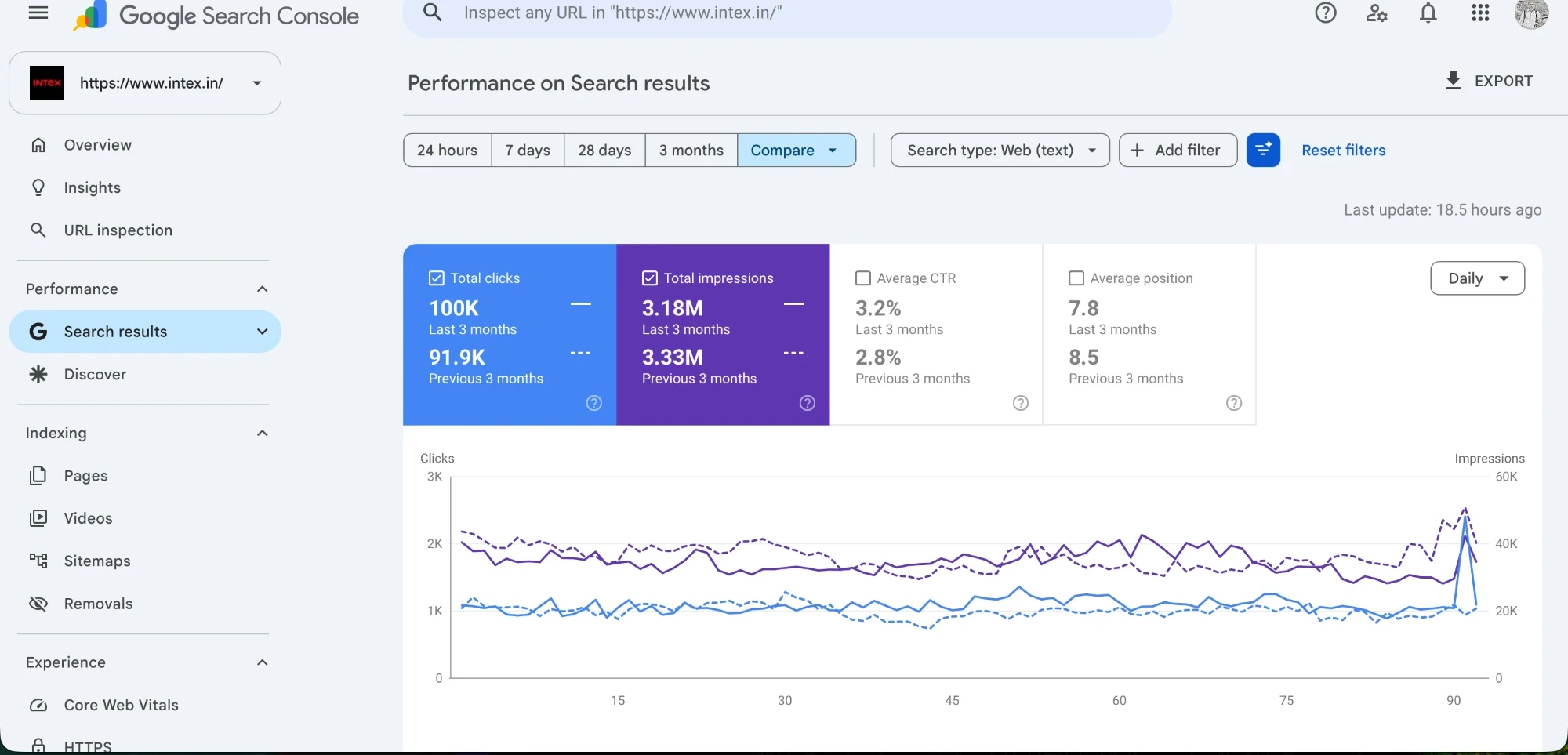
The Intex chart is useful here because it shows the kind of evidence a monthly programme should retain. A buyer should be able to trace the work to pages and then trace the pages to clicks, impressions and query groups. The chart is not a pricing claim. It is an example of what accountable reporting looks like.
Start with the scope you can defend for six months. If the first month is spent arguing about whether a query counts as a new keyword, the commercial model is already getting in the way of the work.
Questions people ask before using this guide
What is the cheapest DigiStreet SEO plan?
Starter is ₹50,000 plus GST a month and covers up to 30 keywords for one market or product line.
Does DigiStreet charge per keyword?
No separate per-keyword tariff is published. Keyword capacity defines the Starter, Growth and Scale tiers.
Is AEO included in the SEO fee?
Yes. AEO and GEO visibility monitoring are included at every published SEO tier.
What does ecommerce SEO cost?
Ecommerce SEO is ₹75,000 plus GST a month.
When does the ₹2,00,000 plan make sense?
Use the resource-based tier when two dedicated specialists and a moving backlog are more useful than a keyword ceiling.
Can I buy a one-off SEO audit?
Yes. Start with the RankStreet audit page or ask for a scoped review through the contact page.
Put the next decision on one page
Bring the URL, the evidence you already have and the business action that matters. We will tell you what should be checked first.