



Updated 3 October 2026.
Cost is the reason you usually hear for American companies hiring digital marketing agencies in India, and we cannot give you a verified number for it, so this post does not use one. The earlier version of this post compared US and Indian rates. We removed those comparisons because we could not source them.
What we can do is tell you what to evaluate if you are a US business thinking about hiring an agency in India, including the parts that count against us. We are an Indian agency, so assume we want the work and read accordingly.
First, what we have and have not shown
Our performance marketing page says we run active campaigns for brands in India, the USA, the UK, Europe and the Middle East, and that international engagements get a custom proposal.
So treat our US claim the way you would treat anyone else’s. It is a statement on a page, not proof. If you are a US business, ask us for references and a sample report, and ask any other agency the same. Our published case studies are mostly Indian brands, plus a Dubai consultancy on the SEO page, and you can check every figure in them in our case study library.
What to evaluate before you hire an agency in India
Six things decide whether the arrangement works. Price is not on the list because it is the easiest to compare and the least informative.
| Factor | What to check | What a good arrangement looks like |
|---|---|---|
| Time-zone overlap | Which hours both teams are online, and who covers the gap | A fixed daily window, written down, with one named person on each side |
| Reporting cadence | How often you see results and in what form | Weekly reviews, a monthly business review and a dashboard you can open any time |
| Currency and invoicing | Which currency, who pays bank charges, how taxes are shown | Terms stated in the proposal, checked by your own accountant |
| Data and account ownership | Whose name is on the ad accounts, analytics and domain | Everything registered to you, with the agency added as a user |
| Understanding of the US market | Whether anyone on the team has worked on US audiences in your category | Named people, named categories and work you can look at |
| Scope and exit | What is billed extra, and how you leave | A written scope and a notice period you can live with |
Time-zone overlap, in actual hours
India Standard Time is UTC+5:30 and India does not observe daylight saving[1]. The US does. Daylight saving time starts on the second Sunday in March and ends on the first Sunday in November, and Eastern time is UTC-5 in winter and UTC-4 in summer, with Pacific at UTC-8 and UTC-7[2]. The gap therefore changes twice a year, and a meeting that fits in October may not fit in December.
Here is the arithmetic, using those offsets, for a 9 am call on the US side.
| US zone | Gap to India | 9 am US time is this in India |
|---|---|---|
| Eastern, daylight saving (UTC-4) | 9.5 hours | 6:30 pm |
| Eastern, standard (UTC-5) | 10.5 hours | 7:30 pm |
| Pacific, daylight saving (UTC-7) | 12.5 hours | 9:30 pm |
| Pacific, standard (UTC-8) | 13.5 hours | 10:30 pm |
For an East Coast business the overlap is workable. A US morning call is an Indian early evening, and a brief sent at the end of the US day can be worked on while you sleep. For a West Coast business it is poor. A 9 am Pacific call lands at 9:30 pm in India. If your agency cannot say who will take that call, assume it will be missed.
Ask the agency to name the overlap window in the proposal, and agree one fixed slot a week for the people who decide. Without a standing slot, work waits for answers.
Reporting that survives the time difference
A gap of half a day makes reporting more important, not less, because you cannot walk over and ask. Our page describes weekly performance reviews, monthly business reviews and an always-on dashboard for performance marketing engagements. The dashboard matters most for you. It lets you check results at your own hour without waiting for an email.
Whatever the agency, ask for a sample monthly report with a client’s name removed. It should be built from your own accounts, show the outcome you agreed, such as cost per qualified lead or cost per order, and say plainly what was tested and what changed. If the sample only shows impressions and followers, you will have to wait weeks to learn that nothing is working.
Currency, invoicing and tax
We have no sourced figures to give you here, so we give you questions instead. Our published prices are in rupees, plus GST. They are not dollar prices, and the earlier version of this post listed dollar rates that we cannot support from our current pages, so we removed them.
Ask which currency the invoice comes in, and who bears the bank and transfer charges. Ask how tax is shown on the invoice, and ask your own accountant to read it before you sign. Ask whether media spend runs on your card in your own ad account or passes through the agency. Our practice on ads is that media spend runs through the client’s own ad accounts and our fee is separate. It keeps spend visible to you.
Who owns the accounts and the data
Your ad accounts, analytics property, Search Console, domain and creative files should be in your name. The agency should be a user with the access it needs. If an agency opens the accounts under its own name, you lose your history when you leave, and that is true whichever country the agency is in.
Check what happens at the end. Dashboards, raw data and documentation should transfer to you. Agree this before the first invoice, when it costs nothing to ask. In our website proposals, ownership, source files and accounts are written into the document, and we recommend client-controlled accounts.
Creative and understanding of the US market
This is the part where an agency in India is most likely to fall short, and we would not tell you otherwise. Writing for an American consumer means knowing how people talk, what they find funny, what offends them and what they expect from a brand. We are based in Noida, and our published work is Indian and Middle Eastern. We do not claim a depth of American consumer insight that our published work does not show.
Technical work travels more easily than tone. Fixing site health, setting up tracking, building and testing campaigns, structuring pages for search and reporting are jobs where quality can be checked in the numbers. Consumer copy aimed at a US audience is a job where you need an editor who lives there. One sensible split is a US-side writer or brand lead who owns the voice, with the agency running the technical and media work.
Ask any agency which US categories it has worked in, who worked on them and whether you can see the work. If the answer is a general statement, ask again. You can also see how we handle SEO, AEO and GEO as a technical service that depends less on cultural nuance.
What not to hand to an agency in India
Anything that needs someone in the room belongs elsewhere: event activation, location shoots and in-person sales support. We say so about our own work too. And if your budget is small, a retainer may cost more than the ads. For performance work we suggest ₹50,000 to ₹1,00,000 a month of media as a floor, and below that you are better off with a freelancer.
For how to compare agencies on proof and contracts wherever they are, our guide on how to choose a digital marketing agency covers it. If you want a view of our national work first, the digital marketing agency in India page explains how we operate.
Frequently Asked Questions
Why do US companies outsource digital marketing to India?
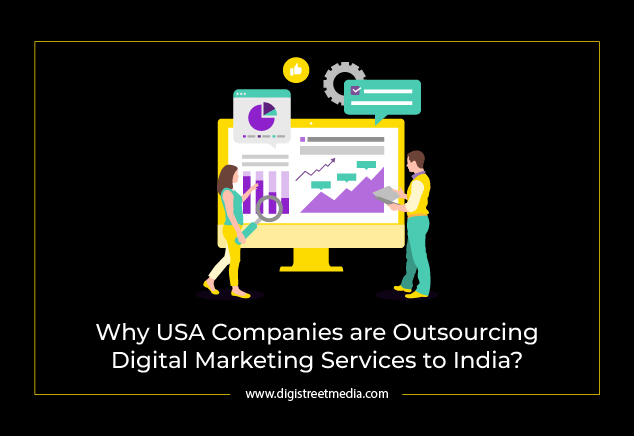
We cannot give you a sourced figure, so we will not claim one. Cost is the reason usually given. The reasons worth testing yourself are specialist depth at a given budget, the ability to scale work up and down and an overnight work cycle. Check each against a real proposal.
Does DigiStreet have US clients?
Our performance marketing page says we run active campaigns for brands in the USA, among other regions. We have not published a US case study or named a US client here, so ask us for references and a sample report before you rely on that.
How big is the time difference between India and the US?
India is 9.5 hours ahead of US Eastern while daylight saving applies, and 10.5 hours ahead in winter. Against Pacific it is 12.5 and 13.5 hours. India does not change its clocks, so the gap moves when the US does.
What should a US business ask an Indian agency about invoicing?
Ask which currency the invoice uses, who pays bank charges, how tax appears and whether media spend goes through your own ad accounts. Have your accountant read the terms before you sign. Our published prices are in rupees plus GST.
Will an agency in India understand my US customers?
For search, paid media and technical work, often yes, because results are measurable. For consumer tone of voice, be careful, and ask which US categories the team has worked on. We have no published US consumer case study to show you.
Who should own the ad accounts and analytics?
You should. Keep the ad accounts, analytics, domain and creative files in your name and add the agency as a user. That way you keep your data if you change agencies.
What is the minimum budget to hire an Indian performance marketing agency?
Our performance marketing management starts at the higher of 15% of monthly media spend or ₹50,000 plus GST a month, with media spend separate. We suggest ₹50,000 to ₹1,00,000 a month in media as a floor.
References
- Wikipedia, Time in India.
- Wikipedia, Daylight saving time in the United States.
- DigiStreet Media, published case studies, each with its source and date range.