



Updated 3 October 2026.
A lead that costs ₹200 sounds like a win until you find out how many of them bought. On our Omaxe Chowk campaign in Chandni Chowk, 2% of the qualified leads went on to buy or lease, and that was the number the client’s sales team cared about.
Performance marketing is paid advertising where you agree a measurable business outcome before spending, such as a qualified lead or an order, and judge every rupee against it. The platforms still charge for delivery under their own buying models, not for your result, and nobody can guarantee the outcome. What changes is that tracking, creative and landing pages are built around one number you can check.
The rest of this post covers how it differs from brand advertising, the channels, the numbers that matter, when it is the wrong tool, and what it costs in India.
How it differs from brand advertising
Brand advertising buys attention, and you judge it on reach, awareness and recall over a few quarters. Performance marketing buys an action, and you judge it on what each action cost. Both are legitimate. They answer different questions.
A television campaign does not produce a spike in enquiries on Tuesday. A performance campaign does, and tells you within days whether the offer works. The catch is what happens when you switch it off. Brand awareness lingers. Performance traffic stops the same afternoon.
So treat performance marketing as a way of collecting demand efficiently and learning fast, not as a replacement for being known.
The channels it runs on
| Channel | What it does well | What to watch |
|---|---|---|
| Search ads (Google, Bing) | Reaches people already looking for what you sell, so intent is high | The most competitive channel, so clicks get expensive first |
| Paid social (Meta, LinkedIn and others) | Reaches people who were not looking, so creative does the work. LinkedIn suits named job titles and industries | The same ad wears out, and cost per lead climbs when it does |
| Retargeting | Brings back people who already visited your site | It harvests demand that something else created, so do not credit it with the whole sale |
| Display and programmatic | Wide reach across networks, useful for retargeting | Weak at finding new buyers for most mid-sized brands, in our experience |
| Affiliate and partnerships | Partners promote you and take a cut of what they produce, the closest thing to paying purely for results | Needs oversight, or partners may damage your brand |
Which ones you need depends on the model. A B2B firm selling to named companies leans on Search and LinkedIn. An online store leans on Shopping, catalogue ads and retargeting. Our B2B digital marketing and ecommerce marketing pages cover each mix.
The numbers that matter
Most accounts that disappoint are being steered by the wrong number. Four are worth knowing.
Cost per qualified lead is what one lead that sales accepted cost you. Cost per lead is easy to halve by widening the targeting or shortening the form, and the report improves while sales gets worse leads. Fund Abroad, an education loan platform, shows it. The average cost per lead across the engagement was ₹170.75, but the change that mattered was the qualified-lead ratio rising from 5% to 15%, which cut cost per qualified lead by 67%. The full figures are in the Fund Abroad case study.
Customer acquisition cost, or CAC, is what you spend to win one new customer. Divide your total acquisition spend by the number of new customers. Repeat buyers do not count, so a figure that looks like ₹600 per order can be a higher CAC once you remove them.
Break-even ROAS is the return on ad spend at which you stop losing money. It equals 1 divided by your contribution margin, which is what is left of an order after product cost, shipping, payment fees and returns. At a 40% margin, break-even is 2.5x. At 25%, it is 4x. A platform report showing 3x on a 25% margin is a loss, however good the dashboard looks.
Lifetime value sets the ceiling on what you can afford to pay for a customer. It is the answer to “is a 3x ROAS on the first order fine”, because a buyer who returns can pay a thin first order back.
A worked example, clearly marked
Our performance marketing page carries a sample report. It is an illustration, not a client’s account. It shows ₹3,00,000 of media producing 1,200 leads, a blended ₹250 per lead, of which 216 qualified.
| Channel | Spend | Leads | Qualified | Cost per lead | Cost per qualified lead |
|---|---|---|---|---|---|
| Search | ₹1,80,000 | 600 | 144 | ₹300 | ₹1,250 |
| Paid social | ₹1,20,000 | 600 | 72 | ₹200 | ₹1,667 |
| Total | ₹3,00,000 | 1,200 | 216 | ₹250 | ₹1,389 |
Paid social looks cheaper per lead. Search is cheaper per qualified lead. A report that stops at cost per lead moves budget to the wrong channel.
Tracking comes before the first rupee
If conversions are counted wrongly, the ad platform learns to find the wrong people. Google Ads has enhanced conversions, which send hashed first-party data such as an email address, hashed with SHA256, to improve conversion measurement[1]. Meta has the Conversions API, which connects data from your servers, website, apps and CRM to Meta, runs alongside the Meta Pixel, and has built-in deduplication so an event is not counted twice[2].
Set both up, then send your CRM’s lead status back, so the event you optimise for is a qualified lead and not a form fill. Matching is never complete, so expect your CRM and the ad platform to disagree a little. Ask whoever runs your ads to explain the gap, not hide it.
Creative decides more than most people expect
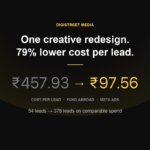
On paid social, the ad itself is usually the biggest lever, bigger than targeting. One ad on a live account, redesigned around a single 48-hour promise, cut cost per lead from ₹457.93 to ₹97.56. We wrote up what changed in how one ad redesign cut cost per lead by 79%. It is a before-and-after on a real account, not a controlled test.
That is also why creative volume matters. A steady campaign needs a supply of new ads as old ones tire. UGC-style video and AI video production are two ways to get that supply without a film shoot each time.
One more thing before you spend. Check that someone who clicks can see in a few seconds what you sell, who it is for, what it costs or how to find out, and what happens after they submit the form. Send ad traffic to a page built for the ad, with a form that asks only what sales needs to qualify the lead. No campaign rescues a weak offer.
When performance marketing is the wrong tool
It is the wrong tool when nobody knows you. Performance marketing collects existing demand efficiently and is expensive at creating demand from nothing.
It is the wrong tool when the page cannot convert. Paid traffic to a weak landing page burns money at scale, so fix the destination first.
It is the wrong tool when the sales cycle runs for months. Last-click attribution misleads in long B2B cycles, and a lead may take weeks to become a sale.
And it is the wrong tool when the budget is too small to learn from. If the account produces only a handful of conversions, the platform has little to learn from, and you are paying for guesswork.
Organic search is the counterweight. SEO builds slowly and keeps working when the budget stops, while paid stops the day you stop. Most brands run both and judge them against one shared measure of qualified pipeline.
What it costs in India
You pay two separate things: media spend to the platform, and a management fee to whoever runs the account. Our fee is the higher of 15% of monthly media spend or ₹50,000 plus GST a month, with the rate falling to 10% from ₹20,00,000, 8% from ₹50,00,000 and 4% from ₹1,00,00,000 of monthly media. The 15% rate overtakes ₹50,000 once your media passes ₹3,33,333 a month.
Creative and production, such as statics, motion, UGC-style videos and landing pages, are billed separately on actuals. Media runs through your own ad accounts. We suggest ₹50,000 to ₹1,00,000 a month of media as a floor. Our full breakdown, with the sums, is in our performance marketing cost guide, and the service itself is on our performance marketing agency page.
Frequently Asked Questions
What is performance marketing in simple terms?
Paid advertising judged on a measurable result, such as a qualified lead or an order, agreed before you spend. Platforms still charge for delivery, and results are not guaranteed. The difference is that every campaign is tracked against one outcome.
What is the difference between performance marketing and digital marketing?
Digital marketing is the whole field, including SEO, content, social, email and paid media. Performance marketing is the part bought and measured on outcomes. All performance marketing is digital, and most digital marketing is not performance marketing.
Which metric should I optimise for?
Cost per qualified lead for lead generation, and ROAS against break-even ROAS for ecommerce. Cost per lead alone rewards cheap, poor leads. Break-even ROAS is 1 divided by contribution margin, so a 40% margin needs 2.5x.
How much does performance marketing cost in India?
Our management fee is the higher of 15% of monthly media spend or ₹50,000 plus GST, with the rate falling to 10% from ₹20,00,000, 8% from ₹50,00,000 and 4% from ₹1,00,00,000 of monthly media. Media spend is separate, and creative is billed on actuals. See our cost guide for the worked numbers.
How long before performance marketing shows results?
Early data helps you decide what to test, but timing depends on budget, conversion volume, the offer and the sales cycle. We agree milestones and a review schedule, not a fixed number of leads or returns.
Is performance marketing better than SEO?
They do different jobs. Performance marketing produces data and traffic quickly and stops when the budget stops. SEO takes longer and keeps working afterwards. Brands with a serious target usually run both.
References
- Google Ads Help, About enhanced conversions for web.
- Meta for Developers, Conversions API.
- DigiStreet Media case studies: Fund Abroad performance marketing, figures from Meta Ads Manager.