




Websites for US healthcare revenue cycle and billing companies
Updated 4 November 2026.
HealthCare.gov insurers denied about 20% of in-network claims in 2023, 86 million of them, and fewer than 1% were appealed. That is the problem your prospects live with. Your website has about ten seconds to look like the firm that can be trusted with it, and we build those from $3,300.
Trust is the whole sale
A practice manager handing you claims is handing you the money the practice runs on, plus patient data she is personally accountable for. Nothing on your website matters more than looking like a firm that will not lose either. Price is not the objection. Risk is.
The scale of the problem is why they are looking. KFF’s analysis of HealthCare.gov plan data, published on 27 January 2025 and updated on 24 March 2026, found insurers denied about 20% of in-network claims in 2023, which was 86 million denials out of 436 million in-network claims. Fewer than 1% of those denials were appealed, 376,508 of them.
So the page that converts is not the one that says you are passionate about healthcare. It is the one that says what you do with a denial, who does it, how long you have been doing it, and who will take the call. We build these on the healthcare side of the business, and the pattern barely changes between billing, collections and full revenue cycle outsourcing.
The first ten seconds
A provider arriving from a search or a referral checks four things before scrolling: what exactly you do, who you do it for, whether you are a real company with a US address and phone number, and how long you have existed. If any of those four is missing above the fold, they go back to the search results.
Put the year in the headline area. “Recovering accounts for healthcare providers since 1999” does more work than any adjective, because it is checkable. Put the US address and a phone number in the header, not only in the footer. A billing company that hides its location reads as a company you cannot serve notice on.
Then name the specialties. “Behavioral health, orthopedics and ambulatory surgery” tells a practice manager in two seconds whether to keep reading. “All specialties” tells her nothing and is almost never true.
| What the provider checks | Where it goes | The number or standard we hold |
|---|---|---|
| Page load on a phone | Every template | Largest contentful paint 2.5 seconds or less, 75th percentile |
| Response when they tap | Navigation and forms | Interaction to next paint 200 milliseconds |
| Whether the page jumps as it loads | Whole page | Cumulative layout shift 0.1 or less |
| Accessibility | Every template | WCAG 2.1 Level AA, the standard named in the DOJ Title II rule |
| How long you have existed | Header and about page | The year, stated as a year. masrecovery.com says 1999 |
| Fields asked for on the form | Consultation page | Six, and a line telling visitors not to send patient data |
| The problem you solve, in their numbers | Service pages | 20% of in-network marketplace claims denied in 2023 (KFF) |
Compliance conscious design
Build the site so it never touches patient data. No claim details, no dates of birth, no member numbers and no account numbers in any web form. The marketing site collects a name, a role, a practice, an email, a phone number and a short note, and the real intake happens inside your secured portal or over the phone afterwards.
Say that on the form. One line under the fields, telling the visitor not to send patient information through the form and where the secure channel is, does two jobs at once: it protects you and it signals that you know what you are doing. Most billing company websites have no such line and ask for “details of your claim” in a free text box.
The same logic applies to your analytics. Keep tracking off pages and parameters that could carry patient or account identifiers, and never pass a form value into a URL. We set this up at build time rather than retrofitting it, because once a pixel has fired on the wrong page the problem is historical, not technical.
Proof and credentials, in a form a committee accepts
Years trading, named client types, volumes handled, and certifications with numbers. A revenue cycle firm that says it recovers accounts for 40 practices across three states is more convincing than one claiming a 98% success rate with no definition of success attached.
If you can publish a named client, publish one. If you cannot, publish the shape of the work: specialty, state, size of the backlog, what you did, what came back, over what period. Anonymised but specific beats named but vague, and a practice manager can recognise her own situation in it.
Put the credentials a committee will ask for on their own page and keep it current. Your certifications and their numbers, your insurance cover, your business associate agreement process, your audit history, your staff screening. When procurement asks, you send a link instead of writing an email.
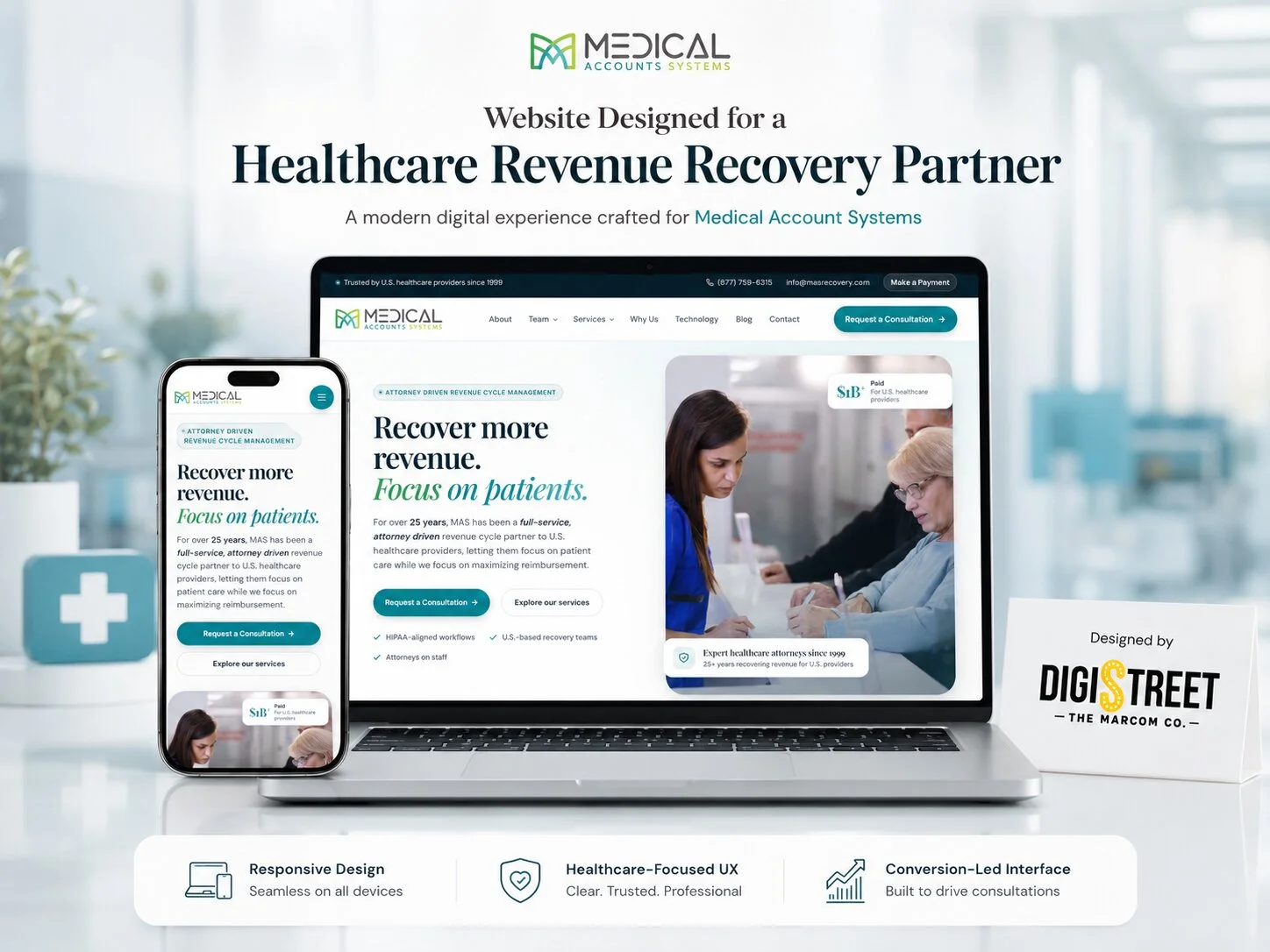
Medical Account Systems
We designed and built masrecovery.com for Medical Account Systems, a Florida healthcare revenue recovery firm that has traded since 1999. The brief was the one in this post: make a careful buyer believe, in the first screen, that her accounts and her patients’ data are safe here. The year, the US contact details and the consultation request all sit where a provider looks for them.
The consultation request
One primary action across the whole site, and it is a consultation or an accounts review, not a quote. Pricing in this market depends on specialty mix, payer mix, backlog age and volume, so a quote form promises something you cannot deliver and the visitor knows it.
Six fields. Name, role, practice or facility name, email, phone, and one dropdown for the service they want. Then a sentence about what happens next: who calls, within how long, and whether the first call costs anything. The sentence matters more than the sixth field.
Offer a second, lower action for the people not ready to talk. A denial reason checklist or a one page explanation of your appeals process, downloaded without a form, will be read by the person who becomes a client in four months. Gating it buys you an email address and loses you the reader.
Speed and accessibility, which are not optional here
Google’s thresholds are the floor: largest contentful paint of 2.5 seconds or less, interaction to next paint of 200 milliseconds, cumulative layout shift of 0.1 or less, measured at the 75th percentile of page loads. A practice manager checking you between patients is on a phone on clinic wifi, which is the worst case your site will ever meet.
Accessibility has a named standard and a date. The Department of Justice rule for state and local governments names the Web Content Accessibility Guidelines 2.1, Level AA, with compliance dates of 26 April 2027 for governments serving 50,000 or more people and 26 April 2028 for smaller ones. If any of your clients is a public hospital district or a county health department, that standard reaches your work through them.
WCAG 2.2 became a W3C Recommendation on 12 December 2024, and building to it now costs nothing extra because it is mostly discipline: real heading order, labels tied to inputs, contrast that passes, keyboard access through every form, and no information carried by colour alone. Retrofitting it later costs a rebuild.
What a provider’s committee asks for
Expect five questions in the first call, and answer all five somewhere on the site. How quickly do you start. What systems do you work in. Who owns the data if we leave. What is the fee structure. Who is my day to day contact and in which time zone.
The systems question decides more deals than price. List the practice management and electronic health record systems you actually work in, by name. A clinic on a specific platform will shortlist on that line alone, and the firm that lists it wins a call it never had to compete for.
The exit question is the one firms dodge, and dodging it costs the deal. Write down what leaving looks like: notice period, what data comes back, in what format, inside how many days. A clear exit clause on a web page is read as confidence.
What we charge to build it
A corporate build for a revenue cycle or billing firm is $3,300, with hosting and maintenance from $300 a month. A simpler B2B site is $2,600 and a basic marketing site is $1,450. There is no GST on a US invoice. The scope and the templates are set out on our corporate website design page.
Search work alongside it is $750 a month for Starter with 30 keywords, $1,100 for Growth with 50, $1,850 for Scale with 80, and $2,950 for a resource-based team of two specialists. Every plan includes answer engine and generative engine monitoring, which matters when a practice manager asks an assistant for a billing company in her state. Paid media management is the higher of 15% of monthly media or $750 a month.
We work US hours for review, 8:00 am to 12:00 noon Miami time, and we have built this exact type of site before. Our USA page covers how the engagement runs and our Florida page covers the state we have done most of this work in. Send us the three pages you think are losing you calls.
References
- KFF, Claims Denials and Appeals in ACA Marketplace Plans in 2023, published 27 January 2025, updated 24 March 2026
- US Department of Justice, Fact Sheet on the ADA Title II web and mobile app accessibility rule, accessed 11 October 2026
- W3C, Web Content Accessibility Guidelines (WCAG) 2.2, W3C Recommendation, 12 December 2024
- Google, Web Vitals, web.dev, last updated 31 October 2024
Frequently asked questions
What does a revenue cycle company website cost?
$3,300 for a corporate build, $2,600 for a simpler B2B site and $1,450 for a basic marketing site, with hosting and maintenance from $300 a month. No GST applies on a US invoice.
Should our web form collect claim details?
No. Keep patient and account data off the marketing site entirely. Collect name, role, practice, email, phone and the service wanted, add a line telling visitors not to send patient information, and move the real intake to your secured portal or a call.
Which accessibility standard applies to us?
WCAG 2.1 Level AA is the named standard in the Department of Justice Title II rule, with compliance dates of 26 April 2027 and 26 April 2028 depending on population served. WCAG 2.2 became a W3C Recommendation on 12 December 2024 and is what we build to.
How fast does the site need to be?
Largest contentful paint of 2.5 seconds or less, interaction to next paint of 200 milliseconds and cumulative layout shift of 0.1 or less, at the 75th percentile. Your buyer is on a phone on clinic wifi between patients.
What proof do providers actually want to see?
Years trading, the specialties you serve, the systems you work in by name, certifications with numbers, and what leaving looks like. A defined exit clause converts better than a percentage with no definition behind it.
How many denials are we really talking about?
About 20% of in-network claims in 2023 on HealthCare.gov plans, which KFF put at 86 million denials out of 436 million claims, with fewer than 1% appealed. That gap is the market your service sells into.