


Updated 4 October 2026.
A B2B website should help a buying group reach a decision
A B2B website is working when technical visitors, commercial reviewers and senior approvers can each find their next answer without calling sales for basic information. Before setting the build scope, compare it with the website design cost in India. DigiStreet websites start at ₹1,00,000, with the final scope shaped by content, templates, integrations and the number of decision paths.
The 2026 priority is not a cosmetic redesign. It is a clearer structure for search discovery, AI answers, product understanding and qualified enquiry. That means the content model, page speed, forms, proof and analytics need to be planned together. This guide uses Videonetics website work as a real B2B reference and turns the optimisation job into a set of decisions a marketing, product and sales team can share.
Write for several readers on the same page
A technical evaluator wants specifications, compatibility, deployment detail and support information. A commercial reviewer wants scope, risk, cost logic and evidence. A senior approver needs the business case in language that can travel through an internal note. A strong page gives each person an entry point without repeating the same sales claim.
Lead with the use and outcome, then move into product detail, proof, implementation and the next step. Use descriptive subheads that make sense when scanned alone. Tables should compare meaningful choices. Diagrams should explain relationships that prose makes harder to follow. Downloadable documents can support procurement, but the main page still needs enough substance for search and for a visitor who will not download a file.
Specifications, architecture, integrations, security and operating detail.
Scope, commercial logic, support model and purchase conditions.
The problem, expected change, evidence and internal case for action.
Documentation, service routes, releases and the path to related products.
Organise the site around tasks instead of departments
Internal team names rarely match the words a buyer uses. Navigation should group products, industries, problems, resources and support in a way an unfamiliar visitor can predict. Product families need consistent templates. Industry pages should explain the sector use rather than copy product pages. Resource hubs should connect learning material to relevant commercial pages.
Start with a page inventory and assign one primary intent to each important URL. Mark duplicate, thin and orphaned pages. Decide which URL owns each search cluster before rewriting copy. Add contextual links where a reader naturally needs another answer. Breadcrumbs, clear URL paths and an accurate XML sitemap help crawlers understand the same structure. The result is a site that can expand without adding another isolated page for every campaign.
Set measurable speed and interaction targets
Google describes Core Web Vitals as measures of loading, responsiveness and visual stability. Its current guidance uses LCP within 2.5 seconds, INP below 200 milliseconds and CLS below 0.1 as good experience thresholds. Treat these as engineering acceptance checks, not as a single marketing score. Test real templates, devices and connections.
Large hero media, third-party scripts, consent tools and embedded forms often create the largest delays. Give the main image explicit dimensions, serve an appropriate file size and load it early. Delay media that begins below the fold. Remove scripts that add little commercial value. Check interaction after menus, filters and forms are live. A quick empty template is not proof that the finished website will remain quick.
| Metric | Good threshold in Google guidance | Typical B2B repair |
|---|---|---|
| Largest Contentful Paint | Within 2.5 seconds | Resize and prioritise the main image; reduce render delay |
| Interaction to Next Paint | Below 200 milliseconds | Reduce long script tasks and heavy third-party code |
| Cumulative Layout Shift | Below 0.1 | Reserve space for media, banners and embedded forms |
| Form completion | Site-specific business measure | Shorten fields and explain the response that follows |
Make expertise easy to retrieve and cite
Search visibility starts with crawlable pages that answer a defined query. Answer-engine visibility also benefits from clear definitions, tables, named evidence, descriptive headings and consistent entity details. The page should state who the product suits, what it does, how it connects and where the evidence comes from. Hiding this information inside a brochure weakens both usability and retrieval.
Create a source record for technical claims and update dates. Link authors to relevant experience when expert review matters. Keep product naming consistent across navigation, headings, images and structured data managed by the site. Case studies should state the client, situation, work and recorded result only where the published case supports it. The aim is a source a researcher can understand and a sales team is comfortable sending.
Offer the next action that matches the page
A visitor reading a specification page may need a datasheet or technical consultation. Someone reading an industry page may need a relevant case and a short enquiry form. A pricing or comparison page may be ready for a quotation. Give each page one main action and a quieter supporting link. Avoid sending every visitor to a general contact page without context.
Forms should say what happens after submission and collect only useful fields. Preserve the page, campaign and product context when the lead enters the CRM. Route enquiries by product and territory. Confirmation pages can provide a relevant document or meeting path while analytics records the completion. Sales feedback should mark accepted, duplicate, unsuitable and active leads so marketing can see which pages start worthwhile discussions.
Replace broad claims with evidence a buyer can inspect
B2B buyers need material they can use internally. A customer story should describe the starting situation, the work and the recorded change. Product pages need supported specifications, drawings, standards and service information. Team pages should show the people responsible for delivery. Contact and policy pages should be current.
Do not scatter logo walls where a relevant example would be stronger. Match proof to the page topic. A manufacturing page should link to manufacturing work; an integration page should show the integration environment; a regional page should explain delivery coverage. Add captions and alt text that identify the client and work. This helps every reader understand why the example is present rather than treating it as decoration.
Improve the site in a controlled twelve-week cycle
| Weeks | Work | Output |
|---|---|---|
| 1–2 | Inventory pages, search intent, analytics, leads and technical blockers | Prioritised page and measurement list |
| 3–5 | Rewrite the highest-value paths and build reusable page patterns | Approved content and component set |
| 6–8 | Implement speed, accessibility, forms and CRM context | Tested templates with recorded acceptance checks |
| 9–12 | Release in groups, review search coverage and compare lead quality | Next-quarter backlog based on observed use |
Do not wait for a full relaunch to repair the pages that carry current demand. Ship changes in logical groups, keep redirects mapped and record each release date. Compare before and after on the same page set. Search, usability and sales evidence together give a better priority than design preference alone.
Keep the website accurate after launch
Assign owners for product facts, sector pages, case studies, policies and contact routes. Give each high-value page a review date and source record. A content management system makes editing possible, but it does not decide who is responsible. Teams need a small publishing rule that covers request, factual review, release and later review.
Use a component library for headings, tables, proof, downloads, forms and calls to action. A controlled set reduces design drift and makes accessibility checks repeatable. Document image ratios, file-size expectations and alt-text rules. Keep analytics and consent scripts in a reviewed register so new tools are not added without understanding their speed and privacy effect.
After launch, review search queries, on-page behaviour, form completion and sales feedback by page group. Give product teams a simple route to submit changed specifications. Give sales teams a route to flag missing objections. The website then develops from observed buyer needs instead of becoming another large redesign project every few years.
Test the complete path before publishing
Open every priority template as a visitor and as a search crawler would receive it. Check the status code, title, heading, canonical, index setting, structured data managed by the site, image dimensions and internal links. Submit each form and confirm that the product, page and source reach the correct record. Review the confirmation state and email. Test menu, filters, downloads and video controls with a keyboard.
Repeat the path on a 390-pixel screen and a representative slower connection. Look for horizontal scroll, shifting layouts, hidden buttons and unreadable tables. Confirm that dark sections keep white text and yellow focus treatment. Record the test date and template version. A short release checklist protects the work after a page leaves design review.
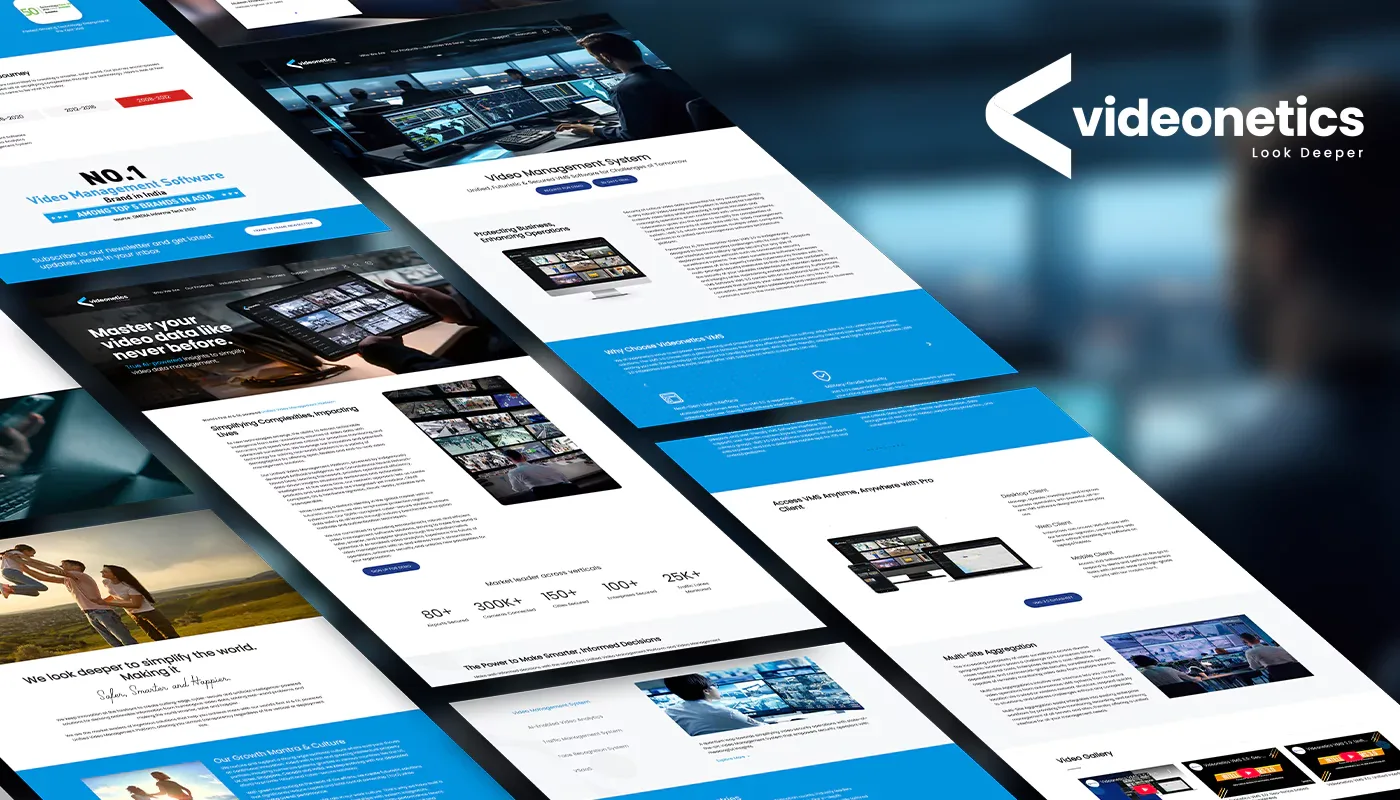
Videonetics work shows a technical B2B offer inside a clear website frame
B2B website questions for the 2026 plan
What should a B2B website optimisation project start with?
Start with important buyer tasks, current search demand, lead quality and technical blockers. That evidence sets the order of work.
How much does a B2B website cost?
DigiStreet websites start at ₹1,00,000. Content volume, templates, integrations and functional needs shape the final scope.
Should product and industry pages be separate?
Usually yes. Product pages explain the offer, while industry pages show how it applies to a sector and connect relevant proof.
Which Core Web Vitals should the team track?
Track LCP, INP and CLS on representative live templates, using both field and lab evidence where available.
How many fields should a B2B lead form contain?
Use only the fields needed for routing and a useful first response. Ask later questions after the contact is established.
How often should B2B pages be reviewed?
Review priority pages after product, market or evidence changes and in a scheduled quarterly content and performance check.
Sources used for this guide
Turn the site into a useful sales asset
Share the products, audiences and current website problems. DigiStreet can scope the content, design, development and search work.