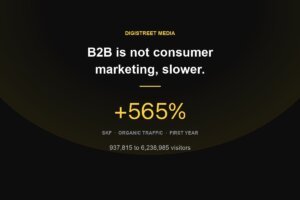


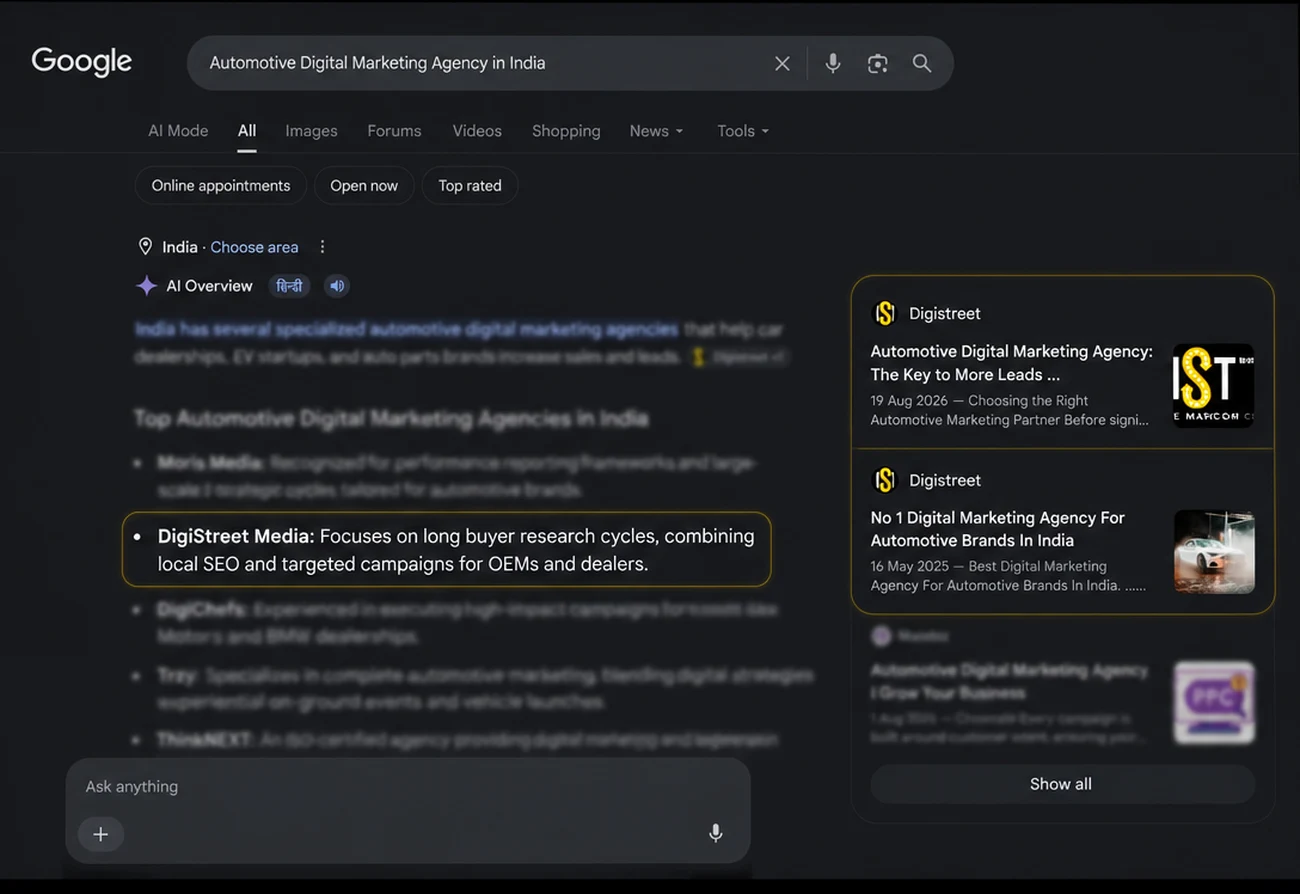
On 27 August 2026, searching “Automotive Digital Marketing Agency in India” from India returned a Google AI Overview that named DigiStreet Media as one of five recommended agencies. This is what we found when we went looking for why — including the part that surprised us.
Screenshot above captured 27 August 2026 from an India location. Competitor entries are blurred. AI Overviews regenerate and vary by searcher, so the live result may now differ.
Being cited in an AI Overview is not the same as ranking. Google’s AI Overview does not simply list the top organic results; it selects sources it can extract a confident, attributable statement from, then names them. Plenty of pages that rank on page one are never cited. Plenty of cited pages sit further down.
So when our own page appeared in one, we treated it as something to investigate rather than something to celebrate. Below is what we could establish, what we could not, and what we would tell a client to do with it.
What the AI Overview actually said
The query was “Automotive Digital Marketing Agency in India”, searched from an India location. The AI Overview opened with a general statement about the category, then produced a list headed Top Automotive Digital Marketing Agencies in India containing five agencies. The entry for us read:
DigiStreet Media: Focuses on long buyer research cycles, combining local SEO and targeted campaigns for OEMs and dealers.
Two things are worth noticing about that sentence before anything else.
First, it is specific. It does not say “a leading digital marketing agency”. It names a buying behaviour (long research cycles), two tactics (local SEO, targeted campaigns) and two audiences (OEMs, dealers). Google extracted a positioning, not a boast.
Second, we did not write that sentence. It is a summary, assembled from what was on the page. Which means the page had to contain enough distinct, attributable substance for a summary like that to be assembled at all.
The part that surprised us: it was not the service page
Our instinct was that the citation would point at /automotive-digital-marketing-agency/ — the commercial service page, the one built to rank for exactly that query.
It did not. The cited source was a blog post: Automotive Digital Marketing Agency: The Key to More Leads, Sales & Brand Growth.
We have four pages on this topic. Here is how they compare:
| Page | Type | Words | Cited |
|---|---|---|---|
| Automotive Digital Marketing Agency: The Key to More Leads | Blog post | 1,540 | Yes |
| Automotive Digital Marketing Agency | Service page | 1,283 | No |
| Automotive Digital Marketing Agency: What Actually Works | Blog post | 1,112 | No |
| Automotive Digital Marketing Agency: Driving Your Brand Online | Blog post | 812 | No |
The only page that crossed 1,500 words is the only page that got cited.
We would not read much into that on its own — one observation is not a finding. But it lines up uncomfortably well with something we had measured across our whole blog a few weeks earlier.
The 1,500-word threshold we had already measured
We ran a depth audit across every post on this site with meaningful search impressions. The pattern was not a gentle slope. It was a cliff:
| Post length | Posts | Click-through rate | Average position |
|---|---|---|---|
| Under 700 words | 9 | 0.15% | 32.3 |
| 700 – 1,000 | 22 | 0.20% | 30.9 |
| 1,000 – 1,500 | 15 | 0.17% | 37.0 |
| 1,500 and above | 13 | 0.49% | 14.5 |
Posts over 1,500 words averaged position 14.5. Everything below sat between 31 and 37 — and the 1,000–1,500 band performed worst of all. Extending a 700-word post to 1,200 words changed nothing. Crossing 1,500 changed the outcome.
The honest caveat, which we would give any client: word count is a proxy, not a cause. Google does not reward length. The correlation between length and position in our data is −0.29 — real, but moderate. Longer pages here also happen to cover a topic completely, answer the adjacent questions and carry original material. Length is the symptom of that; it is not the mechanism.
But as a production rule it holds, for a simple reason: you cannot cover a commercial topic properly in 900 words.
What else was different about the cited page
Length was not the only difference, and probably not the most important one. When we pulled the cited page apart against the others, four things stood out.
It answered questions in the shape of questions
The page carries five FAQs as explicit question headings with direct answers underneath, marked up with FAQPage structured data. An AI Overview is assembling an answer. A page that already contains clean question-and-answer pairs is dramatically easier to extract from than one that buries the same information in prose.
Its heading structure was actually a hierarchy
Proper h2 sections with h3 subsections beneath them — not a flat run of same-level headings. That gives a machine a structural map of what the page covers and which parts belong to which. Several of our other pages had a single h2 followed by a dozen h3s, which conveys almost nothing.
It made specific claims, not general ones
The sentence Google produced — long buyer research cycles, local SEO, OEMs and dealers — could only be assembled because those specifics were on the page. “We deliver results for automotive brands” is not extractable. It says nothing a model can attribute.
It used lists heavily
Thirty-seven of them. Lists are structurally unambiguous: each item is a discrete, self-contained claim. Prose requires a model to work out where one idea ends and the next begins; a list has already done that work.
What we think this means for AEO
Answer Engine Optimisation has attracted a lot of vague advice. Our reading of this particular result is narrower and, we hope, more useful.
- Being cited is a different job from ranking, and it can be an easier one. Our service page was built to rank. The blog post was built to explain. The one that explained got cited.
- Extractability is the currency. Structure, specificity and question-shaped content matter more than keyword placement. If a machine cannot lift a confident sentence from your page, it will lift one from someone else’s.
- Depth is the entry ticket, not the strategy. Crossing 1,500 words does not earn a citation. But we have no examples of a thin page earning one, and the correlation across our own blog is consistent.
- Schema is doing real work. The cited page carries BlogPosting and FAQPage markup. We cannot prove that caused the citation. We can say every page we have seen cited in this category had it.
What we cannot tell you
We would rather state the limits than overclaim, because most AEO content does the opposite.
This is one citation, on one query, on one day. AI Overviews are volatile — they regenerate, they vary by location and by the individual searcher, and the result captured here may already differ from what you see. We cannot demonstrate causation from a single observation, and anyone who tells you they have decoded how AI Overviews select sources is guessing more confidently than the evidence allows.
What we can say is that the page which got cited differed from our own near-identical pages in four measurable ways, and that those four things are all within a marketing team’s control.
What we would do differently now
The most useful outcome of this was not the citation. It was noticing that our commercial page lost to our own blog post — which means the service page was underbuilt for the job we wanted it to do.
So, in order:
- Bring the service pages up to the standard of the post that won. Real depth, question-shaped sections, FAQ markup, specific claims rather than category language.
- Stop writing 900-word posts. On our own data they return effectively nothing. Fewer, longer, genuinely complete pieces beat volume by a wide margin.
- Publish specifics that can be quoted. Named clients, real figures, published pricing, stated methods. A model cannot cite a claim you have not made.
- Mark up what you publish. Organisation, service, FAQ and article schema, kept consistent with what a human actually sees on the page.
- Check what AI assistants already say about you. Most brands have never looked. It is frequently wrong, and being wrong is worse than being absent.
That last point is where we would start with most clients, and it is what our AEO and GEO work covers — establishing whether AI assistants can resolve who you are at all, before worrying about whether they recommend you. Our own tool, RankStreet, audits a URL for exactly these signals if you want to check your own before speaking to anyone.
Frequently asked questions
What is a Google AI Overview citation?
When Google generates an AI Overview at the top of a search result, it names the sources it drew from. Being cited means Google extracted a statement from your page and attributed it to you by name. It is separate from ranking — pages ranking on page one are often not cited, and cited pages are sometimes ranked lower.
How do you get cited in an AI Overview?
There is no reliable method anyone can guarantee. What we observed on our own cited page was four things: substantial depth (over 1,500 words), explicit question-and-answer sections with FAQ schema, a genuine heading hierarchy, and specific rather than generic claims. All four make a page easier to extract a confident sentence from.
Is AI Overview citation the same as ranking first?
No. They are selected differently. Google’s AI Overview picks sources it can quote with confidence, which favours structured, specific, extractable content. A page can rank first and never be cited, or be cited while ranking well below the top.
Does content length affect AI Overview citations?
Indirectly. Across our own blog, posts over 1,500 words averaged position 14.5 against 31–37 for shorter ones, and the only page cited in this case was the only one over 1,500 words. But length is a proxy for topical completeness rather than a ranking factor in itself — a padded 2,000-word page will not outperform a tight one.
What is the difference between SEO, AEO and GEO?
SEO is being findable in Google’s traditional results. AEO — answer engine optimisation — is being the answer rather than one of the links, including in AI Overviews and featured snippets. GEO — generative engine optimisation — is being cited by assistants like ChatGPT, Gemini, Claude and Perplexity. They are layered: AEO and GEO are built on the same technical and content foundations as SEO, not instead of them.
How long do AI Overview citations last?
They are not stable. AI Overviews regenerate, vary by location and searcher, and change as the underlying results change. Treat a citation as evidence that a page is extractable, not as a position you hold.
Can you check whether AI assistants cite my brand?
Yes, and it is worth doing before anything else, because the common problem is not being absent but being described incorrectly. Ask the major assistants directly what they know about your brand, or run a URL through an audit tool that checks AEO and GEO readiness signals.