





A gym owner in Gurugram puts up a banner, hands out flyers and waits. A few people walk in, and most never return. Meanwhile, a competitor two streets away appears first on Google Maps, replies to every enquiry within minutes and fills batches before the owner opens the doors. Digital marketing for gyms rewards the owner who treats local search, trials and follow-up as one system.
This guide gives a practical plan for gyms, yoga studios, CrossFit boxes and fitness studios. It covers where to find members, what to offer, how to follow up and how to keep members, so that your marketing fills memberships, not just inboxes.
How People Choose: Digital Marketing for Gyms Starts Here
People rarely pick a gym from an ad alone. They usually:
- Search for “gym near me” or a similar phrase on Google
- Look at the map results, photos and reviews
- Check the website or Instagram page
- Message or call to ask about price and timings
- Visit for a trial before they pay
Your marketing has to support each step. A weak step, such as poor photos or a slow reply, can lose the member.
Step 1: Win Local Search
Local search brings the most ready buyers.
- Claim and complete your Google Business Profile. Add the right category, address, phone number, hours, services and photos.
- Add real photos and short videos of equipment, classes, trainers and the space. Update them often.
- Collect reviews from members in an honest way. Our guide on how to get more Google reviews shows the process.
- Use posts and offers on your profile for trial passes and events.
- Keep your name, address and phone number consistent across directories.
- Add questions and answers about fees, timings, parking and facilities.
Our local SEO service covers profile setup for single and multi-branch businesses.

Know Your Local Market
Most members come from a short distance, so study your area before you spend. Map the gyms and studios within a few kilometres, and note their prices, timings and review scores. Check which facilities residents need, such as women-only batches, early-morning slots, parking or parent-friendly timings. Talk to current members about why they joined. These answers shape your offer, your photos and your ad copy.
Step 2: Build a Website That Converts
A simple site often works better than a flashy one. Include:
- A clear headline, such as “Strength training in Sector 56, Gurugram”
- Your trial offer and a booking button above the fold
- Class timetable and pricing guidance
- Trainer profiles with qualifications
- Transformation stories, with member permission
- Photos of the real space
- A map, parking and contact details
- A fast mobile experience
Create separate pages for each service you want to rank for, such as personal training, yoga or weight loss programmes, with unique content on each. Avoid copying text across them.
Step 3: Make a Strong Trial Offer
The trial is the bridge from interest to membership. Options include:
| Offer | Good for |
|---|---|
| Free one-day pass | Busy, low-commitment buyers |
| Three-day trial | Buyers who want to test timings and crowd |
| Free assessment and trial session | Studios with personal training |
| Paid short trial | Premium studios that want serious buyers |
| Bring-a-friend pass | Referral growth |
Pick one main offer, and make it easy to claim. Explain what happens at the visit: who they meet, how long it takes and what to bring. Avoid fake scarcity.
Step 4: Run Ads That Bring Trials
Paid ads work well for gyms because you serve a local area.
- Google Search ads for people searching for a gym or class near them
- Meta ads with short videos of workouts, trainers and members, targeting a radius around the gym
- Local awareness and lead ads for trial sign-ups
- Retargeting for visitors who viewed pricing but did not book. See our guide on the retargeting funnel for lead generation.
Set a radius around each location, since most members live or work within a short travel time. Test two or three creatives, and measure cost per trial booked and cost per paying member, not just cost per click. Our Meta ads agency and PPC agency teams run these campaigns.
Step 5: Follow Up Fast
Speed decides who wins. A person who fills a form today may fill three more.
- Reply within minutes, by call or WhatsApp
- Use a short script: greet, ask the goal, offer a trial slot and confirm
- Send a reminder the day before and the morning of the visit
- Call no-shows the same day, and offer a new slot
- Follow up after the trial within 24 hours with a clear offer
- Track every lead in a simple CRM. See our guide on how to choose a CRM.
Step 6: Use Content That Builds Trust
Content shows your space and your people.
- Short videos of a class, a trainer tip or a member milestone
- Before-and-after style stories only with permission and honest claims
- Day-in-the-life posts from staff
- Simple guides, such as how to start strength training safely
- Events, challenges and open days
Keep health claims careful. Do not promise specific weight loss or medical results, and follow Indian advertising rules. Trainers should state qualifications accurately.
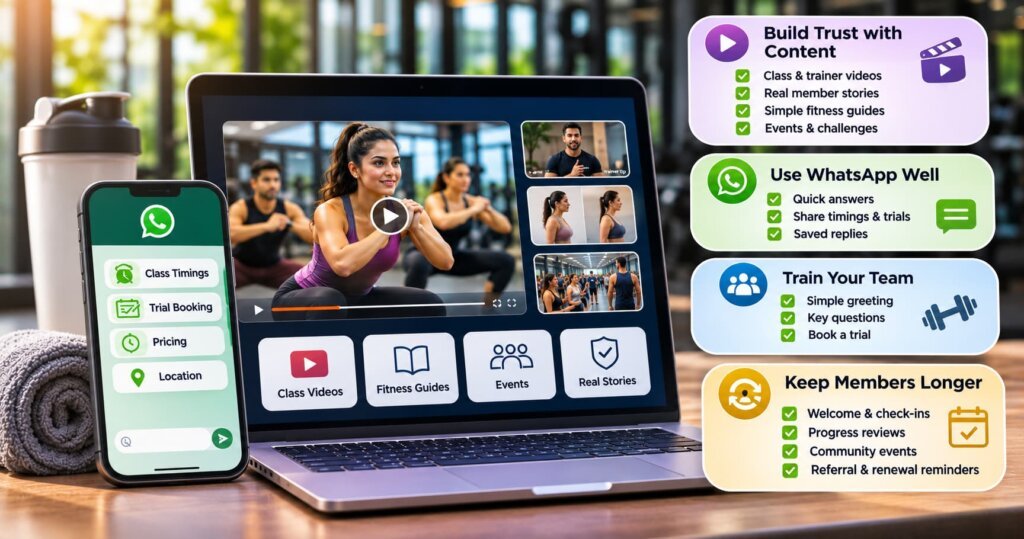
Use WhatsApp Well
WhatsApp suits gyms, because people like quick answers. Use the WhatsApp Business app or platform to share timings, send trial confirmations and answer common questions. Keep a few saved replies for price, location and trial details. Get permission before you send promotions, and avoid spamming members. Our guide on WhatsApp marketing for D2C brands shares message ideas that also work for local businesses.
Staff and Trainer Training
Your front desk and trainers handle most enquiries, so train them. Teach a simple greeting, three questions to ask a new lead and how to book a trial. Share the offer details and pricing rules. Remind them not to promise results they cannot guarantee. A confident, kind team turns online interest into memberships.
Step 7: Keep Members
Acquiring a member costs more than keeping one. Retention marketing includes:
- A welcome sequence in the first 30 days with check-ins
- A monthly progress review or small goal reset
- Group challenges and community events
- Reminders for members who miss classes, sent with a caring tone
- A referral offer for members who bring friends
- Renewal reminders before expiry, with options
A quiet member is a warning sign. Reach out early.
Measure What Matters
| Metric | Why it matters |
|---|---|
| Leads by source | Shows which channel brings interest |
| Trial bookings | Shows how many leads take the next step |
| Trial show-up rate | Shows follow-up quality |
| Conversion from trial to member | Shows sales and experience quality |
| Cost per paying member | Shows true marketing efficiency |
| Retention rate | Shows long-term value |
A Hypothetical Example
We made up this example for illustration. A Pune yoga studio has one location and 90 members. The owner completes the Google Business Profile, posts fresh photos weekly and asks every member for an honest review. She runs a small Meta campaign for a “first class free” offer within 4 km, and she replies to every enquiry on WhatsApp within ten minutes. She tracks leads, show-ups and sign-ups in a sheet. After a few months, she compares cost per new member with the earlier period, and she keeps the channel that gives the best result.
Seasonal Opportunities
Fitness demand rises at certain times, such as the start of a year, before summer and after festivals. Plan offers and content for these windows in advance. Do not rely on seasons alone, since steady local marketing keeps the base strong.
Common Mistakes
- Neglecting the Google Business Profile
- Slow replies to enquiries
- Heavy discounts with no follow-up
- No tracking of trials and sign-ups
- Overpromising results
- Ignoring retention
- Targeting too wide an area
Fill Your Next Batch
If you want a local marketing system for your gym or studio, our digital marketing team can set up your profile, ads, tracking and follow-up process. Contact DigiStreet Media to plan it.
Reference Links
| Relevant Topic or Resource | Why It Is Relevant | Verified Link |
|---|---|---|
| Google Business Profile Help: Improve your local ranking | Explains relevance, distance and prominence in local results | https://support.google.com/business/answer/7091 |
| Advertising Standards Council of India | Guidelines for health and fitness advertising claims | https://www.ascionline.in/ |
| Meta Business Help: Create a lead ad | Official guide to lead forms for local businesses | https://www.facebook.com/business/help/1010099645793558 |
Frequently Asked Questions
How can a gym get more members online?
Win local search with a complete Google Business Profile, run a clear trial offer through Google and Meta ads, reply fast to enquiries and ask members for honest reviews.
What is the best marketing for a small gym?
Local SEO, a strong trial offer, short videos of your space and trainers and quick follow-up on WhatsApp usually give the best start. Test and track results.
Do Facebook and Instagram ads work for gyms?
They can, especially with a local radius and a clear trial offer. Measure cost per trial booked and cost per paying member.
How do I get more people to take a free trial?
Make the offer clear, explain what happens at the visit and send reminders. Call no-shows and offer another slot.
How can I keep gym members longer?
Use a welcome sequence, progress check-ins, community events, reminders for missed sessions and referral rewards.
Can I show before-and-after photos in gym ads?
Only with the member’s permission and honest claims, and follow advertising rules. Avoid promising specific results.
How much should a gym spend on marketing?
There is no fixed figure. Set a budget based on the value of a member and the cost per paying member you can afford, then review monthly.