




Updated 4 October 2026.
SEO Audit Cost in India and What It Includes
DigiStreet Media does not publish a separate fixed price for an SEO audit, so the audit should be quoted after reviewing site size, technology, markets, data access and the depth of the required output. Ongoing SEO starts at ₹50,000 plus GST a month. The SEO audit scope should state the evidence reviewed, pages sampled, checks run and decisions delivered.
Site size is more than a URL count
A site with fifty distinct pages can take more thought than a catalogue with thousands of similar product URLs. Templates, languages, filters, JavaScript rendering, user accounts and regional versions change the audit. The quote should name the main page types and the sample size for each one, as well as any areas that require login or special access.
Ask how the auditor will find URLs. A crawl is one source, but XML sitemaps, analytics, Search Console, internal links, server records and platform exports can reveal other pages. The scope should explain which sources are used. This prevents the audit from treating an incomplete crawl as the whole website.
Crawl and index checks need evidence
The audit should review status codes, redirect chains, canonical signals, index directives, sitemap entries, duplicate routes and internal link depth. It should distinguish a page that cannot be crawled from one that can be crawled but is not selected for search. Each issue needs example URLs and a count or pattern that a developer can verify.
Screenshots can help, but exportable URL lists are more useful for repair. Ask for the rule behind every group. A list of warnings without template context sends teams into one-page fixes when the same cause is repeated across thousands of URLs.
Page review should follow search tasks
Titles and headings are only part of a page review. The auditor should examine whether the page answers the query, shows the product or service clearly, uses evidence, supports the next decision and receives useful internal links. The sample should include strong pages, weak pages and pages that compete with each other.
For ecommerce or large service sites, page types need separate notes. A category page has a different job from a product page, guide or location page. One checklist across every URL creates noise. The audit should point to the template decision that will improve the group.
What a usable SEO audit contains
| Audit area | Evidence to expect | Output to request |
|---|---|---|
| Discovery | Crawl, sitemap, Search Console and other URL sources | Coverage notes and page-type map |
| Indexing | Status, canonical, index rules and sitemap examples | Grouped URL lists with causes |
| Pages | Intent, content, headings, proof and internal links | Template and priority recommendations |
| Performance | Repeatable tests and affected resources | Page examples with repair owners |
| Handoff | Priority, effort, owner and acceptance check | Working sheet plus review session |
Search data gives priority to the findings
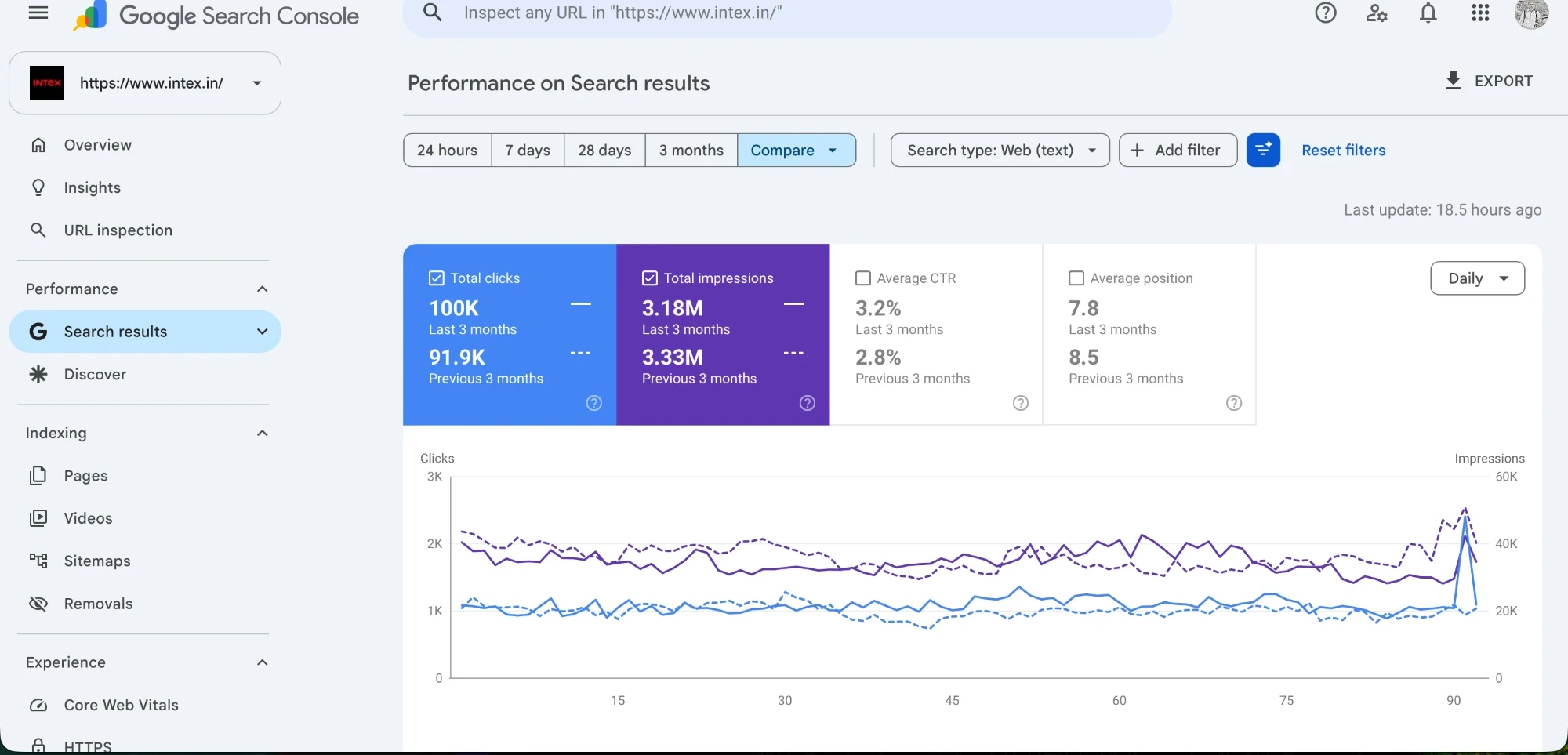
Search Console can show which queries, pages and devices already receive impressions and clicks. Analytics can show what visitors do after arrival. These sources help separate a widespread technical pattern from a page with current demand. The audit should state the date range used and keep screenshots tied to the exported evidence.
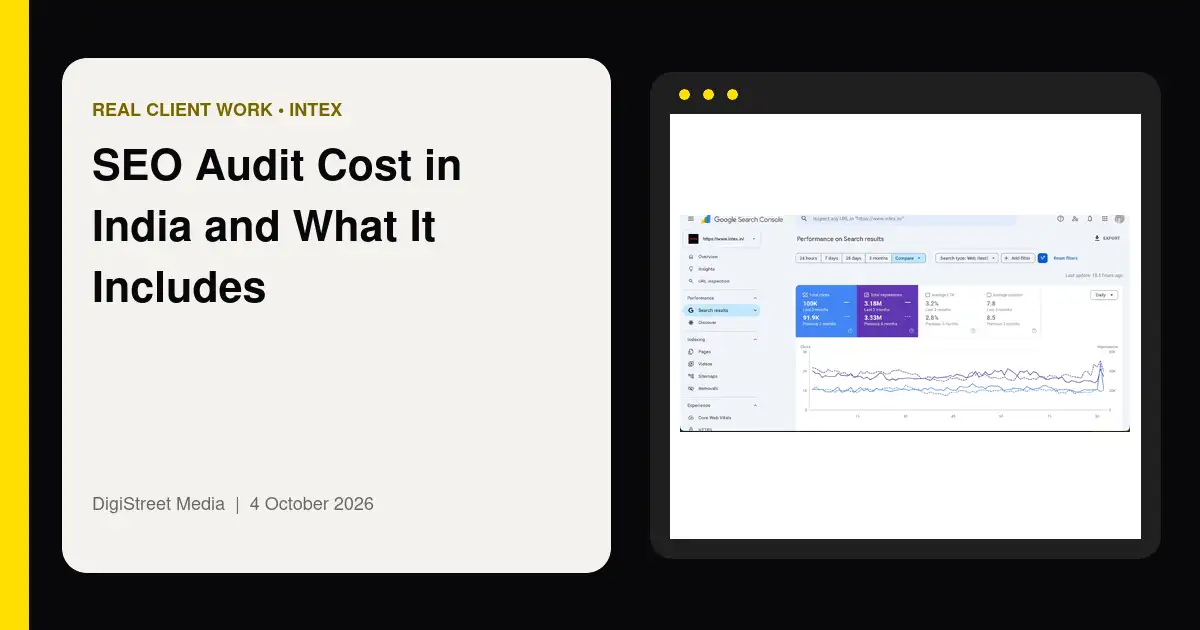
The Intex chart below is a real case-study asset with its Search Console context. An audit should use that kind of named source rather than an unexplained score. The case-study hub hub provides more published work, and the SEO services page explains the ongoing service that may follow an audit.
Performance checks must point to page causes
A performance report should identify which templates, files or third-party scripts contribute to slow or unstable pages. A single score is not an implementation plan. The audit needs repeatable test conditions, example pages and a distinction between lab observations and real-user data when both are available.
Priorities should consider user effect, search effect, scale and repair effort. A small issue repeated on every product page may outrank a severe issue on an unused archive. Ask the auditor to explain that judgement in the final review rather than sorting a spreadsheet only by tool severity.
The deliverable should be ready for owners
Every finding needs an owner such as development, content, design, analytics or operations. It also needs examples, expected repair, acceptance check and priority. Group related findings by template or system. That format helps teams schedule work and avoids passing a long PDF between departments without action.
A review call should resolve questions against the evidence. Ask whether the price includes developer discussion after the first handoff and a check of completed repairs. If implementation is separate, the boundary should be clear. The audit remains useful when another team can act on it without translating vague labels.
Compare audit quotes by depth and output
Put each quote beside the same site facts: approximate URL volume, main templates, technology, markets, languages, data access and known changes. Then compare source access, crawl limits, manual page review, performance testing, output format, review call and repair check. A cheaper audit may simply inspect fewer systems or produce less usable evidence.
Ongoing SEO prices are separate: Starter ₹50,000, Growth ₹75,000, Scale ₹1,25,000 and Resource-based ₹2,00,000, plus GST each month. AEO and GEO monitoring are included. The audit quote should say whether any implementation time is included before it is compared with a retainer.
Prepare the site so the audit can be useful
Create an access sheet before the audit begins. Include the production site, staging site, Search Console properties, analytics views, tag setup, sitemap locations, platform details and recent release notes. Give each access item an owner and expiry rule. Time spent discovering missing permissions is time not spent reading the site.
List known business changes beside technical changes. A discontinued product line, new region, rebrand or sales priority may explain page movement and affect recommendations. The auditor needs this context to avoid treating an intentional decision as an error. Use dates and named pages wherever possible.
Share previous migrations, domain changes and large template releases. Redirect layers and old sitemap records can remain for years. A short release history helps the auditor choose samples and compare date ranges. It also points to developers or vendors who may hold information about systems that are no longer visible in the current interface.
Ask for a draft priority review before the report is polished. Technical teams can confirm whether a proposed repair fits the platform, while content owners can identify active campaigns and legal constraints. That review improves the final work list and reduces recommendations that cannot be scheduled in the current stack.
Keep the audit sheet alive after handoff. Add assigned owner, planned release, test result and completion date. Re-crawl the affected pattern and check search evidence after enough data exists. The point is not to keep the audit open forever; it is to make the repair history visible so the same issue is not diagnosed again next quarter.
Turn the brief into decisions you can verify
Map page types
Count templates and systems, not only total URLs.
Demand evidence
Require example URLs and source date ranges.
Ask for grouped causes
Fix repeated rules instead of isolated warnings.
Name repair owners
Every priority needs a team and acceptance check.
The Intex chart is evidence, not an audit score
This Intex Search Console chart is a published case-study asset. It gives a real dated source for discussing queries, pages, clicks and impressions. An audit uses evidence like this alongside crawl and page review; it does not replace those checks.
Ask how charts, exports and URL examples are connected in the deliverable. A good answer should let a content owner and a developer see the same problem, understand its scale and agree on the next repair.
Check the service, cost and evidence pages
References
- DigiStreet Media pricing sheet, updated 4 October 2026.
- Intex SEO case study, published and accessed 4 October 2026.
- DigiStreet Media RankStreet audit page, accessed 4 October 2026.
Frequently Asked Questions
How much does an SEO audit cost in India?
DigiStreet does not publish one fixed audit price; the quote follows site size, technology, markets, access and required depth.
Is an SEO audit included in monthly SEO?
The proposal should state which discovery and audit work sits inside the selected monthly scope.
How long should an SEO audit report be?
Length is a poor test. The report needs grouped evidence, example URLs, priorities, owners and acceptance checks.
Does an audit include implementation?
Only when implementation hours or tasks are listed. Audit, repair and repair checking can be separate work.
What access does an auditor need?
Common inputs include the website, sitemap, Search Console, analytics, platform details and any restricted areas in scope.
What should happen after the audit?
Owners should schedule the highest-value grouped fixes, record acceptance checks and review the changed evidence.
Bring the site map and the data access list
Share the domain, main page types, platform, markets, recent changes and available search data. We can scope an audit that ends in assigned work.