
⚡ Quick Answer: The best digital marketing strategy for B2B brands in 2026 combines five pillars: technical SEO with AEO/GEO optimisation for AI search visibility, LinkedIn-led account-based marketing, intent-driven performance marketing, conversion-focused website architecture, and data-backed content that earns citations in Google AI Overviews and chatbot answers. Brands that integrate all five — rather than running them in isolation — generate the highest quality leads at the lowest cost per acquisition.
Introduction: B2B Marketing Looks Completely Different in 2026
B2B buyers no longer follow a straight line from search to sale. They research on Google, ask ChatGPT for vendor shortlists, scroll LinkedIn for proof points, and only then fill out a contact form. A brand that ignores any one of these touchpoints loses the deal before the sales team even gets a call.
Anthropic, OpenAI, and Google all reshaped search behaviour through AI Overviews and conversational assistants. Buyers now ask direct questions like ‘best ERP software for manufacturing’ or ‘top industrial equipment supplier in India’ and expect a synthesized answer, not ten blue links. This shift forces B2B marketers to rethink every layer of their strategy — from how they write content to how they structure their website.
This guide breaks down the strategy that wins in 2026: not a single tactic, but five integrated pillars that work together to capture demand wherever B2B buyers search.
Why Old B2B Playbooks Stop Working in 2026
- Buyers research 70% of their journey before contacting sales
- AI Overviews now answer many high-intent B2B queries directly — reducing organic clicks
- LinkedIn algorithms now favour authentic founder and employee content over branded posts
- Procurement teams cross-check vendors through ChatGPT and Gemini before shortlisting
- Long sales cycles demand multi-touch nurturing, not single-channel campaigns
These shifts mean B2B brands need a strategy that earns visibility across traditional search, AI search, and social proof channels simultaneously.
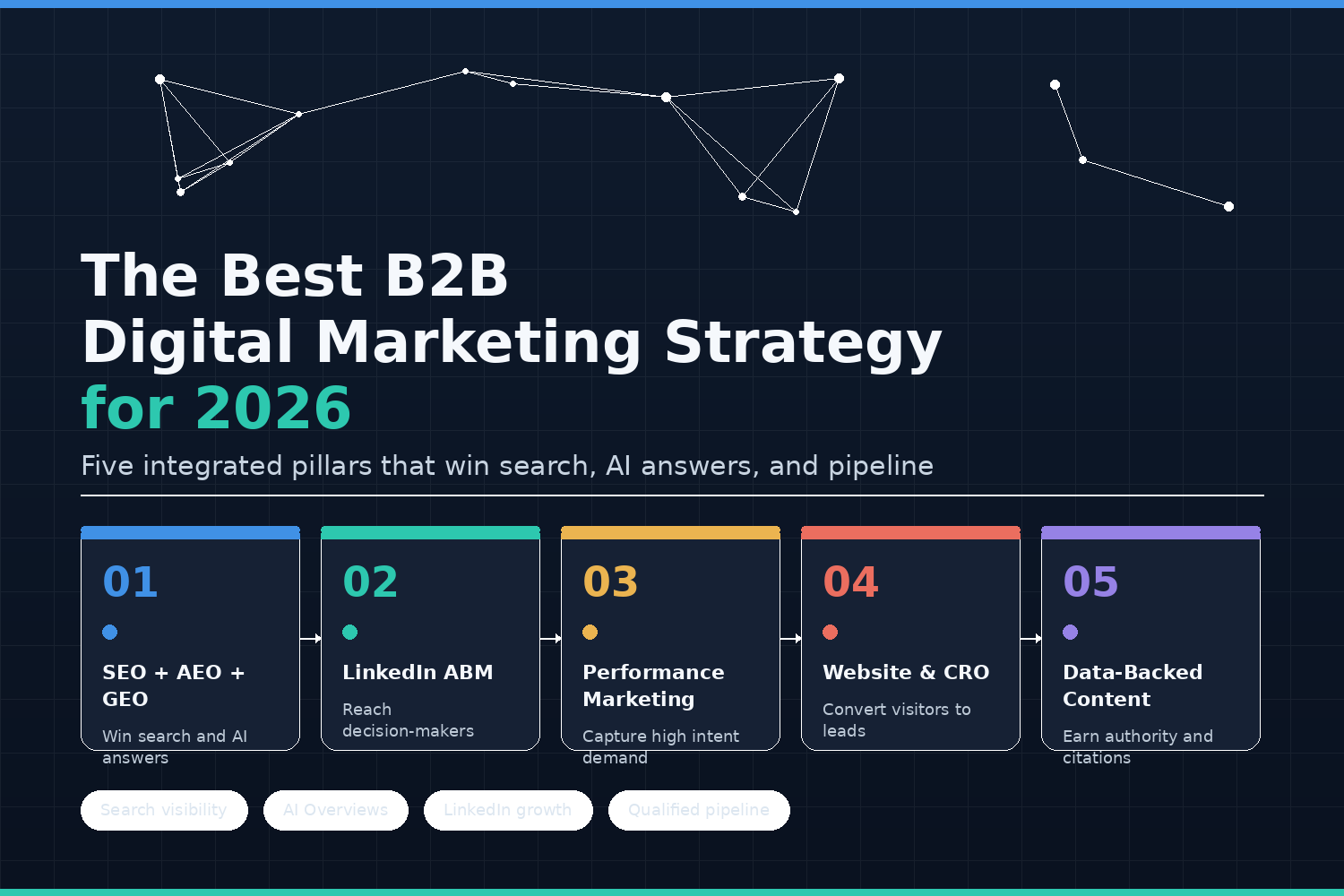
The 5-Pillar B2B Digital Marketing Strategy for 2026
Pillar 1: SEO + AEO + GEO — Win Both Search and AI Answers
Traditional SEO still drives the foundation: technical health, fast load times, clean site architecture, and authoritative backlinks. But B2B brands now need to layer Answer Engine Optimisation and Generative Engine Optimisation on top.
AEO focuses on structuring content so search engines and voice assistants can extract direct answers — using clear question-based headers, concise definitions, and FAQ schema. GEO goes further: it ensures that large language models like ChatGPT, Gemini, and Perplexity actually cite a brand when generating answers about its category.
- Publish content that directly answers buyer questions in the first two sentences
- Use schema markup (FAQPage, Organization, Product) so AI engines parse content accurately
- Build topic clusters around core product categories to establish entity authority
- Earn mentions on third-party industry sites, since LLMs weigh external citations heavily
💡 Brands that appear in Google AI Overviews see meaningfully higher trust signals from buyers — even when the buyer does not click through immediately.
Pillar 2: LinkedIn-Led Account-Based Marketing (ABM)
LinkedIn remains the single most important platform for B2B demand generation in 2026. But the platform now rewards personal, founder-led, and employee-generated content far more than polished corporate posts.
- Identify target accounts and decision-makers, then build content that speaks directly to their pain points
- Combine organic thought-leadership posts from founders and sales leaders with targeted LinkedIn ads
- Use LinkedIn’s Matched Audiences feature to retarget website visitors with relevant case studies
- Run Sponsored Content campaigns aimed at specific job titles and company sizes, not broad demographics
ABM works because B2B deals involve multiple stakeholders. A single ad rarely converts a buying committee — but a sustained presence across LinkedIn, email, and search does.
Pillar 3: Intent-Driven Performance Marketing
Performance marketing for B2B brands looks very different from D2C. Instead of optimising for volume, B2B campaigns optimise for intent quality and pipeline value.
- Run Google Search campaigns on high-intent commercial keywords (e.g. ‘industrial packaging supplier near me’)
- Layer LinkedIn lead-gen ads for top-of-funnel awareness among decision-makers
- Use retargeting to bring back website visitors who viewed pricing or case study pages
- Track cost per qualified lead (CPQL), not just cost per click, as the core performance metric
DigiStreet Media’s work with industrial and manufacturing clients consistently shows that intent-matched search campaigns outperform broad-reach social campaigns for B2B lead quality.
Pillar 4: Conversion-Focused Website and Content Architecture
A B2B website must do more than describe products. It must build trust quickly and route different buyer types to the right next step.
- Create dedicated landing pages for each major service or industry vertical, not one generic page
- Add case studies, client logos, and measurable results above the fold
- Build clear conversion paths: free audit, demo request, or downloadable resource
- Optimise page speed and mobile experience, since procurement teams often browse on mobile during meetings
💡 A B2B website that loads in under three seconds and shows proof points immediately converts significantly more qualified leads than a slow, generic corporate site.
Pillar 5: Data-Backed Content That Earns Citations
Content remains the engine that powers every other pillar. But in 2026, content must do double duty: rank in traditional search and earn citations from AI engines.
- Publish original research, benchmarks, or industry data that other sites and AI engines want to cite
- Write in direct, declarative language that AI summarisers can extract cleanly
- Update high-performing content regularly, since AI engines favour fresh, accurate sources
- Repurpose long-form content into LinkedIn posts, email sequences, and sales enablement decks
How the 5 Pillars Work Together
| Pillar | Primary Goal | Key Channel |
| SEO + AEO + GEO | Visibility in search and AI answers | Website, Google, ChatGPT/Gemini |
| LinkedIn ABM | Reach decision-makers directly | LinkedIn organic + ads |
| Performance Marketing | Capture high-intent demand | Google Ads, LinkedIn Ads |
| Website & CRO | Convert visitors into leads | Landing pages, forms |
| Data-Backed Content | Build authority and earn citations | Blog, research reports, case studies |
Each pillar reinforces the others. SEO content feeds LinkedIn posts. LinkedIn ads drive traffic to conversion-optimised landing pages. Performance marketing data reveals which content topics convert best, informing the next content cycle. Brands that run these pillars in isolation waste budget; brands that integrate them compound results over time.
Industry-Specific Considerations for B2B Strategy in 2026
Manufacturing and Industrial Brands
Buyers in this space research extensively before contacting sales. Technical SEO, detailed product pages, and case studies with measurable outcomes (uptime improvements, cost savings) carry more weight than broad brand awareness campaigns.
Fintech and BFSI Brands
Trust and compliance dominate buyer decisions. Content must balance SEO performance with regulatory accuracy, and LinkedIn thought leadership from senior leaders builds credibility faster than paid ads alone.
EdTech and Education Brands
Admission cycles create seasonal demand spikes. A strategy combining always-on SEO with timed performance marketing bursts around key enrollment windows captures both steady and seasonal demand.
Common Mistakes B2B Brands Make in Their 2026 Strategy
- They optimise only for traditional SEO and ignore AEO/GEO, missing AI search visibility entirely
- They run LinkedIn ads without first building organic credibility through employee and founder content
- They send all paid traffic to a generic homepage instead of intent-matched landing pages
- They measure success by traffic volume instead of qualified pipeline generated
- They publish content once and never update it, losing relevance in both search and AI citations
How to Build Your B2B Strategy for 2026: A Practical Starting Point
- Audit current SEO performance and identify gaps in AEO/GEO readiness
- Map your buying committee — who researches, who recommends, who approves budget
- Build or refresh dedicated landing pages for each core service and industry vertical
- Launch a LinkedIn content cadence combining founder posts, case studies, and targeted ads
- Set up tracking that connects marketing activity to actual pipeline and revenue, not just leads
Frequently Asked Questions (FAQ)
Q1: What is the best digital marketing strategy for B2B brands in 2026?
The best strategy combines SEO with AEO/GEO optimisation, LinkedIn-led account-based marketing, intent-driven performance marketing, conversion-focused website design, and data-backed content. Brands that integrate all five pillars generate higher-quality leads than those running isolated tactics.
Q2: How does AEO differ from traditional SEO for B2B brands?
Traditional SEO targets search engine rankings through keywords and backlinks. AEO structures content so search engines and AI assistants extract direct, accurate answers — using clear definitions, FAQ formats, and schema markup. B2B brands need both to stay visible as buyers shift toward AI-powered research.
Q3: Does LinkedIn still work for B2B lead generation in 2026?
Yes. LinkedIn remains the strongest platform for reaching B2B decision-makers, but the platform now rewards authentic, founder-led content over polished corporate posts. Combining organic thought leadership with targeted LinkedIn ads produces the strongest results.
Q4: How long does a B2B digital marketing strategy take to show results?
SEO and AEO/GEO improvements typically show measurable traction within three to six months. LinkedIn ABM and performance marketing can generate leads within weeks, though qualified pipeline growth usually compounds over two to three quarters of consistent execution.
Q5: How do B2B brands measure the success of their digital marketing strategy?
Cost per qualified lead, pipeline value generated, and conversion rate from lead to customer matter more than raw traffic or impressions. B2B brands should track marketing activity through to actual revenue, not stop at lead volume.
Q6: Can small and mid-sized B2B companies compete with large enterprises using this strategy?
Yes. Mid-sized B2B companies often move faster on AEO/GEO adoption and LinkedIn content than large enterprises with slower approval processes. A focused, well-executed strategy across these five pillars frequently outperforms a larger budget spent on outdated tactics.
Q7: How does DigiStreet Media help B2B brands execute this strategy?
DigiStreet Media brings together SEO, AEO/GEO, performance marketing, content, and website development under one accountable team — working with B2B brands across manufacturing, industrial, fintech, healthcare, and education sectors to build integrated strategies that generate measurable pipeline growth.