


By Kavish Arora, Co-Founder, DigiStreet Media
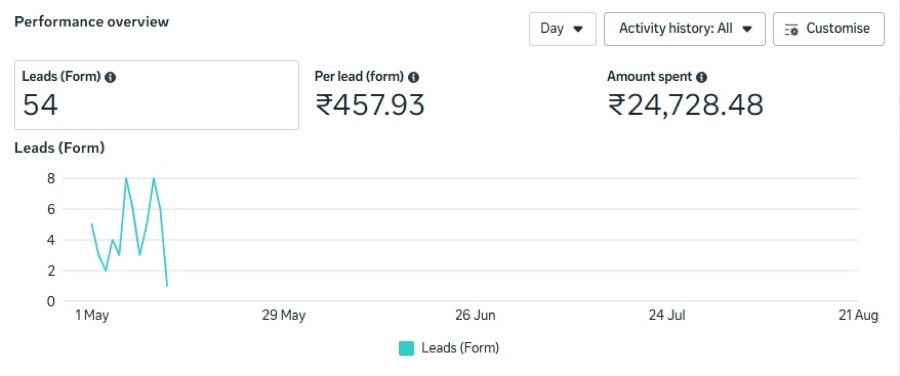
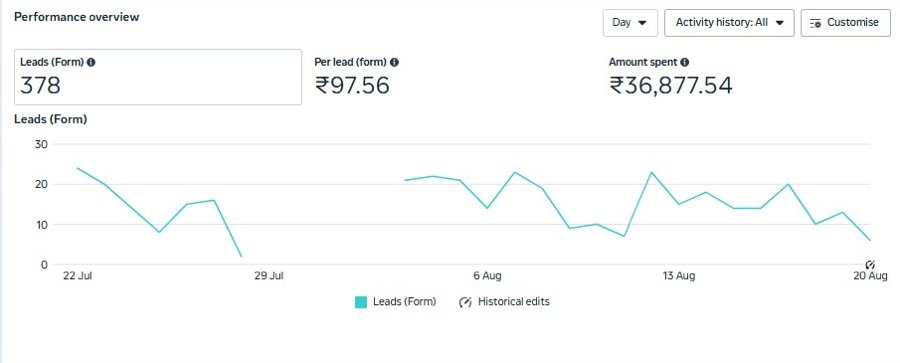
Two ads for the same product, the same audience and the same offer. One cost Rs 457.93 per lead. The other cost Rs 97.56.
Nothing about the loan changed between them. No new lender joined the panel, no rate moved, no landing page was rewritten in between. The only meaningful difference was what the ad chose to say first — and that difference was worth a 79% reduction in cost per lead.
This is the breakdown of what changed and why, using the real numbers from our work with education loan brand Fund Abroad.
The Ad That Was Not Working

Read it the way a student would — in about one second, thumb already moving. You are asked to process: 20+ lender partners, one form, a list of bank names, “don’t settle for one loan”, an 89% approval rate, a Rs 2 crore maximum, a 48-hour sanction, and zero charges.
Eight things. In a feed. From a brand the reader has never heard of.
There is a detail in that creative that gives the whole game away: the “48hrs sanct” chip is cut off at the edge of the frame. The single most compelling thing the product does — sanction a loan in two days — did not fit, because four other claims were in front of it.
What Was Actually Wrong
It is tempting to call this a design problem. It was a decision problem, and the design was just where the decision became visible.
Somebody had decided not to decide. Every stakeholder’s favourite benefit made it into the frame, so nothing led. That is the most common failure in performance creative and it almost never gets diagnosed, because every individual claim in that ad is true and defensible. The ad did not fail on accuracy. It failed on hierarchy.
Five claims do not give a reader five reasons to click. They give the reader a paragraph to skip.
The Redesign: One Promise

The replacement keeps exactly one claim: 48 hours. It is the largest element on the page, rendered so it cannot be missed. Everything else is support — “Any Amount. Any College.” exists purely to remove the two objections a student raises next, and it does that in five words rather than four chips.
The other four claims did not disappear. They moved to the landing page, where a reader who has already chosen to pay attention will genuinely read them. That is the correct division of labour: the ad buys a second of attention, the page rewards it.
The Numbers Side By Side
| Original creative | Redesigned creative | Change | |
|---|---|---|---|
| Cost per lead | Rs 457.93 | Rs 97.56 | −78.7% |
| Leads | 54 | 378 | 7x |
| Spend | Rs 24,728.48 | Rs 36,877.54 | 1.5x |
The clearest way to see the gain is to hold spend constant. At the original Rs 457.93, the Rs 36,877 spent on the redesign would have bought roughly 80 leads. It bought 378. Same money, same product, same audience — 298 additional leads, produced entirely by deciding what the ad was about.
An Honest Note On This Comparison
This is a before-and-after from a live account, not a controlled split test. The two creatives ran in different windows — the original in early May, the redesign between 22 July and 20 August — and in between, the account accumulated learning that will have contributed something to the improvement.
We are not claiming the redesign is responsible for every rupee of the difference. We are claiming it is the largest single variable, and a 4.7x swing is far too big to attribute to optimisation drift. Anyone showing you a before-and-after without that caveat is selling something.
Cheaper Is Not Automatically Better
Here is the discipline that has to sit alongside a number like this, and the reason we report it second rather than first.
Halving cost per lead is easy. Widen the targeting, simplify the form, promise something vague, and your CPL will fall while your sales team quietly stops trusting the pipeline. A CPL reduction is only a genuine win if lead quality held or improved at the same time.
In this account it did. Over the preceding period the qualified lead ratio moved from 5% to 15%, which is the metric we actually manage to — we wrote about why that number matters more than CPL in why lead quality beats lead cost in education and finance marketing. A cheaper lead that nobody can convert is not a saving, it is a faster way to waste money.
How To Apply This To Your Own Advertising
Open your best-performing ad and count the claims. If there are more than two, you have found your next test.
Then ask which single claim your customer would repeat to a friend. Not the one your product team is proudest of — the one that solves the problem your customer actually has this week. For a student with a fee deadline, that was never the approval percentage. It was the two days.
Put that claim in the largest type in the frame, move everything else to the landing page, and run it. The result will tell you quickly whether you had a design problem or a decision problem.
If you want the fuller picture of this engagement — the website rebuild, the video strategy and the geo-targeted activation that sat around this creative work — it is all in the Fund Abroad case study. You can also see how we approach performance marketing and marketing for the education sector.
Frequently Asked Questions
How much can a creative redesign realistically reduce cost per lead?
In this case cost per lead fell from Rs 457.93 to Rs 97.56, a reduction of about 79%. That is a large move and it happened because the starting creative was genuinely weak, not because redesigns always produce that result. Where an existing ad is already clear and single-minded, a redesign might buy you 10-20%. The biggest gains are always available to the brands whose current advertising is trying to say five things at once.
Why does putting more benefits in an ad make it perform worse?
Because attention in a social feed is allocated in roughly a second, and every additional claim competes for that same second. Five benefits do not give a reader five reasons to click; they give the reader a paragraph to skip. The original ad here carried 20+ lenders, an 89% approval rate, a Rs 2 crore maximum, 48-hour sanction and zero charges. The redesign kept one of those and let the rest live on the landing page, where someone who has already decided to pay attention will actually read them.
Is a lower cost per lead always a good thing?
No, and this is the trap most reporting falls into. It is trivially easy to halve cost per lead by widening targeting and simplifying the form – you will get more leads and fewer of them will be worth calling. A CPL reduction only counts as a win if lead quality held or improved alongside it. That is why cost per qualified lead is the number worth taking to a board, and why we track the qualified ratio separately.
What makes a good education loan ad creative?
One promise the student can verify, expressed in their language rather than the lender’s. Education borrowing is deadline-driven, so timelines outperform features: a specific 48-hour commitment beats a vague claim about fast processing. Aspiration imagery works in this category because the purchase is emotional before it is financial, but it has to sit alongside something concrete or the ad becomes a poster with nothing to act on.
Should I test creative or targeting first?
Creative, almost always. Targeting changes who sees the ad; creative changes whether the right person responds. In a category as broad as study-abroad finance the audience is not the constraint – almost every student considering overseas education is potentially in market – so the leverage sits in the message. We have repeatedly seen creative produce multiples where targeting produces percentages.
How long should you run a creative before judging it?
Long enough to clear the learning phase and gather a meaningful number of conversions, which for most lead campaigns means at least a week and several dozen leads. The failing creative here was identifiable early because its cost per lead was several times the account average, but ordinary differences between two decent creatives need patience. Killing a variant after two days of data is how good ideas get discarded for noise.
Does this apply outside education and finance?
The underlying principle does. Any considered purchase with multiple selling points suffers the same problem: internal stakeholders each want their benefit in the ad, and the result performs worse than any single one of them would alone. The discipline of choosing one claim, and defending that choice against everyone who wants theirs added, is what separates advertising that works from advertising that is a committee document.
What should the landing page do differently from the ad?
Carry everything the ad deliberately left out. If the ad promises 48 hours, the page should immediately confirm that promise and then answer the questions the promise creates: which lenders, what documents, what eligibility, what happens on day three. The ad’s job is to win a second of attention; the page’s job is to reward it. Splitting the work this way is what lets an ad stay single-minded without the proposition feeling thin.